Ep 148 | Richard Gephardt
Richard Gephardt: “Preserving Democracy: A Call for Civility”
Show Summary
As the trust in the U.S. presidential election process continues to be in question, alongside growing polarization and dwindling good-faith conversations, the precarity of our democratic systems is becoming increasingly worrisome. Amongst the rising tensions, calls for civility are sorely needed – regardless of who wins.
In this conversation, Nate is joined by former Congressman Richard Gephardt to discuss the importance of democracy as a system of self-governance, as well as the need for respecting differing views in order to keep that system intact. Richard highlights the unique historical context of U.S. democracy, emphasizing the ongoing commitment of citizen participation required for its survival.
How can we encourage bipartisan collaboration and compromise toward effective policy action beyond the current election cycle? In what ways do our rapidly evolving information systems, including social media and artificial intelligence, deepen our political divides? Despite the domestic and global challenges facing us, is there hope for the future of the American “democratic experiment”?
About Richard Gephardt
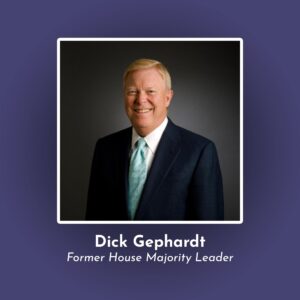
Richard Gephardt is an attorney, author, lobbyist, and politician who served 28 years in the United States House of Representatives. He is the President and CEO of the Gephardt Group, where he works to inspire a new understanding of citizenship based on activism to bring about economic, social, and political change.
Gephardt previously served as the United States House Majority Leader (1989-1995) and House Minority Leader (1995-2003). He is the author of three books, including An Even Better Place and The American Immigrant: The Outsiders.
Show Notes & Links to Learn More
Download transcript00:00 – Richard Gephardt info, prior TGS Episode
01:10 – Advance Policy
02:39 – Tristan Harris, TGS Episode
04:06 – 1979 US Constitution
04:19 – Athenian Democracy + Roman Republic
06:10 – A republic if you can keep it
08:42 – Churchill quote on democracy
11:00 – Growing partisan hostility
11:30 – Trust in election results
15:50 – 2004 voting conspiracies Ohio
16:50 – Proportion of Republicans who believe Biden’s win was illegitimate
17:15 – Lawsuits regarding the 2020 election
17:49 – Republicans who voted to overturn the 2020 election
18:45 – Swing states
19:15 – Gerrymandering + Redistricting in different states
20:43 – Ranked Choice Voting
25:20 – The printing press and witch hunts
26:47 – Radio and the rise of the Nazis
27:50 – Social media algorithms
28:33 – Aza Raskin, TGS Episode
28:53 – Center for Humane Technology
29:00 – Project Liberty + bid for TikTok
38:58 – John McCain
39:59 – Campaign finance reform
41:05 – Institute for Civic and Community Engagement
42:00 – 535 Not 1
46:36 – US voter turnout
48:13 – Clausewitz
49:14 – The Sunni-Shia divide
52:36 – US debt
53:20 – US Federal spending