Great simplification pulsing lines

Ep 19  |  Simon Michaux

Simon Michaux: “Minerals Blindness”
Check out this podcast

TGS19 Simon Michaux The Great Simplification

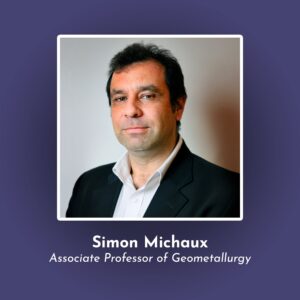
On this episode, we meet with Associate Professor of Geometallurgy at the Geological Survey of Finland, Simon Michaux.

Why do humans ignore important mineral and material limits that will effect human futures?  Michaux reveals how we are “minerals blind” — and the consequences of this myopia.

To shed light on the effects of our minerals blindness, Michaux explores the disconnect between experts in renewable energy and economic and government leaders.

Michaux offers individual strategies for us to overcome our energy and minerals blindness. How can we learn to adapt in order to overcome the coming challenges?

About Simon Michaux

Simon Michaux is an Associate Professor of Geometallurgy at the Geological Survey of Finland. He has a PhD in mining engineering. Dr. Michaux’s long-term work is on the development and transformation toward a circular economy.

In French, we have a motto that says that a simple drawing is often better than a long explanation. Jean-Marc Jancovici Carbone 4 President

That’s very understandable because with left atmosphere thinking, one of the problems is that you see everything as a series of problems that must have solutions. Iain McGilchrist Neuroscientist and Philosopher

We can’t have hundreds and hundreds of real relationships that are healthy because that requires time and effort and full attention and awareness of being in real relationship and conversation with the other human. Nate Hagens Director of ISEOF

This is the crux of the whole problem. Individual parts of nature are more valuable than the biocomplexity of nature. Thomas Crowther Founder Restor

Show Notes & Links to Learn More

Download transcript

00:45 – Simon Michaux info + works

01:10 – Energy Blind

02:58 – Mintech

03:11 – Geometallurgy

08:10 – Fossil energies are finite

08:15 – Mineral resources are finite

09:30 – Volcanic reproduction of minerals

10:25 – The fourth industrial revolution

14:20 – Coking coal

15:08 – Low carbon steel

15:59 – Scalability

17:11 – It takes decades to build a grid of new plants

19:40 – 19 terawatt powered society

20:44 – In general we’re adding 1-2 nuclear power plants per year

22:19 – Nuclear cannot scale up fast enough to replace fossil fuels

22:51 – Base metals are recycled at 30-60% and technology metals don’t get recycled at all

24:09 – Circular economy

25:20 – Resource balanced economy

26:42 – Quantitative easing

29:26 – Availability of uranium and thorium

30:50 – Energy properties

32:22 – Cobb Douglas Function

32:50 – Generation IV nuclear power

35:15 – 2018 Peak Oil

38:10 – Extracting copper will become more difficult

40:28 – Renewables: Right answer to the wrong question

32:35 – Minerals in a wind turbine (2-ton neodymium magnet)

43:28 – ⅓ of current system will be electrified according to the European commission

43:43 – There’s not enough time or materials to mine and replace lithium to meet goals by 2030

46:07 – Brandenburg, Germany 100% renewable by 2030

52:03 – Manufacturing and raw material production in Russia and China

52:38 – Natural gas in Europe comes from Russia

53:50 – Liquifying and unliquifying gas loses 30% of energy properties

58:04 – Peak coal 2013 and peak gas 2019

1:03:10 – Paul Ehrlich info + TGS Episode

1:03:20 – Industrial fertilizer

1:03:40 – We’ve lost 40% of arable land since 1960

1:05:45 – Cuban response to oil embargo
More: Navajo Nation: Cleaning Up Abandoned Uranium Mines

Back to episodes
Why Science Communication FailsWith Mark Medish & Chuck WatsonThe Great SimplificationEp 22 | Mark Medish & Chuck Watson

In this Reality Roundtable, Nate is joined by geopolitical risk experts Mark Medish and Chuck Watson to discuss the increasing strain being placed on human governance as a result of escalating conflicts between nations and state leaders.

Watch nowJan 21, 2026
Why the West Can't Defend ItselfWith Craig TindaleThe Great SimplificationEp 207 | Craig Tindale

For decades, the West has outsourced its own material production to other countries, in favor of lower costs and short-term returns over more expensive, long-duration investments like mining and manufacturing. But while this has seemed like a success on the surface, it has left us with a society based on consumption, unable to produce what we need on our own. What are the deeper costs of this long-term offshoring – including for our geopolitical, climate, and technological ambitions? 

Watch nowJan 14, 2026
How We've 'Drugified' Our Entire ExistenceWith Anna LembkeThe Great SimplificationEp 206 | Anna Lembke

Dopamine: the most famous neurotransmitter that regulates pleasure, motivation, and (perhaps most importantly) addiction. When examining  why our society is hooked on consuming more and more of everything – food, clothes, videos, news, vacations – it’s imperative to look at how our modern environments hijack our brain’s dopamine, sending it into overdrive at nearly every turn. Could taking a closer look at how our societal norms make us more vulnerable to addiction help us transition to more balanced and mindful lifestyles?

Watch nowJan 7, 2026

Subscribe to our Substack

The Institute for the Study of Energy and Our Future (ISEOF) is a 501(c)(3) non-profit corporation, founded in 2008, that conducts research and educates the public about energy issues and their impact on society.

Support our work
Get in touch
x