Ep 158 | John Vervaeke
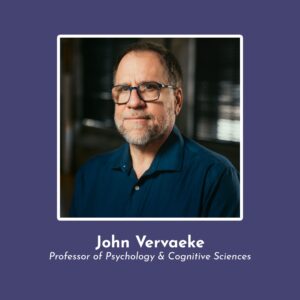
John Vervaeke: “The Meaning Crisis: Wisdom, Purpose, and the Search for Coherence”
Show Summary
The crises that our world is facing seem to be constantly growing, leading to enormous and devastating systemic effects across the globe. Yet, the ripples of the human predicament are also reaching our personal lives in unexpected ways – through chronic loneliness, loss of coherence to reality, and a widespread feeling of insignificance.
How do we begin to navigate the crisis of meaning that seems to accompany modernity, exacerbated by feeling out of control in the broader world we live in?
In today’s conversation, Nate is joined by professor of psychology and cognitive scientist John Vervaeke to discuss the state of ‘the meaning crisis’, including the social and cultural contexts that have fostered such pervasive loss of connection and purpose. Vervaeke also unpacks the key practices that he and others have found most effective in regaining wisdom and direction while living in the modern era.
What can cognitive science tell us about the role of spirituality and religion in living a life that is rich in relationships and clarity? How do flow states, rituals, and lifelong learning contribute to strengthening mental health and fostering adaptability? And perhaps most importantly, how might reconnecting with a sense of humility, wisdom, and shared humanity help guide us toward a more meaningful, collective existence?
About John Vervaeke
John Vervaeke, Ph.D. is an award-winning professor at the University of Toronto in the departments of psychology, cognitive science, and Buddhist psychology. He currently teaches courses in the Psychology department on thinking and reasoning, cognitive development, and higher cognitive processes.
John is also the director of the Cognitive Science program where he teaches additional courses on Cognitive Science and consciousness, wherein he emphasizes 4E (embodied, embedded, enacted, and extended) models of cognition and consciousness.
Additionally, John is the director of the Consciousness and Wisdom Studies Laboratory. He is also the co-author of the book Zombies in Western Culture: A 21st Century Crisis, which integrates Psychology and Cognitive Science to address the meaning crisis in Western society.
He is the author and presenter of the YouTube series Awakening from the Meaning Crisis.
Show Notes & Links to Learn More
Download transcript00:00 – John Vervaeke info + works, Youtube series: Awakening from the Meaning Crisis, Awaken to Meaning
03:12 – *89% of 16-29 year olds in the UK say their life has no meaning
03:28 – Academic studies suggest life is meaningful, Samantha Heintzelman
03:41 – Christopher Mastropietro
03:49 – A symptomology of the meaning crisis
04:10 – Predictive processing and relevance realisation
06:20 – ‘Spiritual but not religious’ Americans
07:25 – Spiritual bypassing + conspirituality
08:12 – Increasing loneliness over time + loneliness declared a global public health concern
08:16 – Increase in anxiety and depression over time
08:34 – Increase in suicide rates over time
10:16 – Mindfulness revolution + rise in stoicism
14:17 – Pleistocene
15:47 – Winkelman on hunter-gatherer shamanism
16:01 – Flow state
17:44 – Perennialism and constructivism + The Perennial Philosophy, Aldous Huxley
17:59 – Steven Katz’s philosophy of mysticism
18:14 – The Unity of Mystical Traditions book
20:49 – Mystical experience
22:24 – Andrew Newberg
23:47 – Fluency heuristic
24:30 – Maurice Merleau-Ponty
26:36 – Dopamine and set-shifting
29:57 – Flow as spontaneous thought
31:09 – Dialogical problem solving and Wason’s task
32:39 – Transfer-appropriate processing + encoding specificity
36:52 – Chimpanzee accumulative stone throwing
37:30 – Gregg Henriques
40:30 – Zombies in Western Culture
42:21 – Zombie walks
45:46 – Coherence, purpose and significance
47:43 – Peter Turchin + immiseration
49:38 – Hartmut Rosa + dynamic stabilization
50:38 – The Burnout Society
51:00 – Erich Fromm + To Have or To Be?
58:37 – Awaken to Meaning
59:51 – Scott Barry Kaufman + Transcend
1:00:07 – Maslow’s pyramid of needs
1:05:02 – Leisure time for hunter-gatherers + more info
1:05:47 – Jordan Hall
1:05:59 – Dunbar’s number
1:08:49 – After Socrates series
1:10:15 – Einstein and Spinoza’s God course
1:10:33 – The Philosophical Silk Road
1:14:14 – Ecology of practices
1:18:49 – Chess moves and atoms in the universe
1:21:14 – Salience network
1:24:05 – Relevance realization and wisdom
1:28:52 – The Psychology of Belonging
1:31:47 – The Axial Age
1:34:23 – Pierre Hadot + What Is Ancient Philosophy?
1:34:37 – Marcus Aurelius