Show Summary
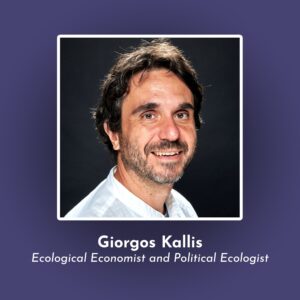
On this episode, Nate is joined by ecological economist and degrowth scholar Giorgos Kallis. He and Nate discuss the science and philosophy behind the degrowth movement and some of the challenges behind implementing such an enormous task. As a system precariously based on growth becomes more unstable, it is important to turn to those who specialize in ‘out-of-the-box’ thinking. This doesn’t necessarily mean we, as a society, are going to advocate or plan for degrowth – but postgrowth societies are on the horizon, and in many places are already here. Perhaps, the larger purpose of degrowth scholarship (and conversations like these) is to act as Overton Windows – to help people imagine and actualize behaviors and networks that will help us adjust in a post-growth world.
About Giorgos Kallis
Giorgos Kallis is an ecological economist and political ecologist working on environmental justice and limits to growth. He has a Bachelor’s degree in chemistry and a Masters in environmental engineering from Imperial College, a PhD in environmental policy from the University of the Aegean, and a second Masters in economics from the Barcelona Graduate School of Economics. He has been an ICREA professor since 2010. Before coming to Barcelona, Giorgos was a Marie Curie International Fellow at the Energy and Resources group at the University of California-Berkeley. He has also written numerous books, including his latest, Limits: Why Malthus was Wrong and Why Environmentalists Should Care.
Show Notes & Links to Learn More
Download transcript00:35 – Giorgos Kallis Works + Info
02:38 – The US geologically rich land, petro-dollar, largest economy, and lingua-franca
05:52 – Decoupling
07:47 – Degrowth Movement
09:20 – Green Growth
09:45 – Post-growth
14:15 – Increasing inequality and no increase in quality of life with continued growth
18:48 – Record debt
19:00 – Debt is a claim on future energy
21:23 – Energy requirements and carbon emissions for a low-carbon energy transition | Nature Communications – Aljoša Slameršak, co-authored by Giorgos Kallis
22:50 – Energy Return on Energy Investment (EROI)
25:44 – We are growing renewable rapidly, but still growing fossil fuels faster
30:30 – Nate’s reflection on TGS Demographics – Frankly #19: Islands
33:50 – Availability Cascade
34:01 – AC limits in Spain in summer ‘22
36:11 – How extreme cold blasts are affected by climate change
40:18 – We use 100 billion barrels of coal, oil, natural gas, which equates to 500 billion human laborers
42:20 – EROI of fossil fuels vs renewables
42:40 – Challenges of energy types in fossil fuels vs renewables
43:04 – Julia Steinberger
44:57 – Nate’s multi-criteria analysis on Energy thesis
46:20 – Materials scarcity for renewables
47:23 – Olivia Lazard, analysis of location of renewable materials and geopolitical implications
48:01 – New geopolitical realignment
48:41 – Limits: Why Malthus was Wrong and Why Environmentalists Should Care
49:18 – Thomas Malthus
52:08 – ‘The Good Life’
52:43 – Coevolution –
52:44 – Richard Norgaard
56:50 – Spain’s energy per capita, US energy per capita
57:02 – Spain’s health care system
57:48 – US water per capita, Europe’s energy per capita
57:50 – Why do US toilets use more water
1:00:53 – Rethinking degrowth through dépense | Towards a Society of Degrowth
1:00:55 – Giacomo D’Alisa, Onofrio Romano
1:01:13 – Georges Bataille
1:06:50 – Paul Erhlich + TGS Episode
1:07:02 – Banks creating money
1:07:36 – Nate’s animated movie
1:10:17 – Taxing Resources Instead of labor, Untax project
1:13:44 – Antonio Turiel, Pedro Prieto
1:15:43 – Climate anxiety
1:17:48 – Nate’s Reality 101 Course
1:21:41 – Solon