Great simplification pulsing lines

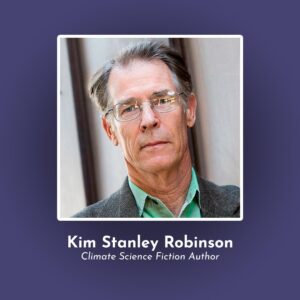
Ep 66  |  Kim Stanley Robinson

Kim Stanley Robinson: “Climate, Fiction, and The Future”

Check out this podcast

TGS66 Kim Stanley Robinson The Great Simplification

Show Summary

On this episode, Nate is joined by climate science fiction author Kim Stanley Robinson to discuss how he contributes to the discussion of climate and pro-social changemaking through writing. There have been many calls to improve the communication of scientists to the general public in hopes it will help people understand the severity of the various global threats we face. A key component to such communication comes from art and literature. Even further, the humanities help us think about the type of future and culture we want to have given the information that science brings us. How can we incorporate fiction into our set of tools to bring more people into awareness of the pressing systemic dynamics underpinning global events?

About Kim Stanley Robinson:

Kim Stanley Robinson is an American science fiction writer. He is the author of over twenty books, including the internationally bestselling Mars trilogy, and more recently Red Moon, New York 2140, and The Ministry for the Future. He was part of the U.S. National Science Foundation’s Antarctic Artists and Writers’ Program in 1995 and 2016, and a featured speaker at COP-26 in Glasgow, as a guest of the UK government and the UN. His work has been translated into 28 languages, and won awards including the Hugo, Nebula, and World Fantasy awards. In 2016 asteroid 72432 was named “Kimrobinson.”

In French, we have a motto that says that a simple drawing is often better than a long explanation. Jean-Marc Jancovici Carbone 4 President

That’s very understandable because with left atmosphere thinking, one of the problems is that you see everything as a series of problems that must have solutions. Iain McGilchrist Neuroscientist and Philosopher

We can’t have hundreds and hundreds of real relationships that are healthy because that requires time and effort and full attention and awareness of being in real relationship and conversation with the other human. Nate Hagens Director of ISEOF

This is the crux of the whole problem. Individual parts of nature are more valuable than the biocomplexity of nature. Thomas Crowther Founder Restor

Show Notes & Links to Learn More

Download transcript

00:05 – Kim Stanley Robinson Info + Works

00:46 – Ministry For The Future

06:09 – New York 2140

06:59 – 40 Signs of Rain

07:15 – National Science Foundation

07:50 – An Inconvenient Truth – Al Gore

13:30 – Rich getting richer since the 1980s and exponentially during the pandemic

13:35 – Quantitative Easing value was captured by top 2% of wealthiest people

13:52 – Carbon Footprint of Quantitative Easing

14:09 – Externalities

14:17 – Discount Rate

14:55 – Carbon Coin

16:14 – Keynesian

19:35 – Swiss Federal Institute of Technology DNA test in a river to determine the living species

26:04 – Actor Network Theory

26:35 – Anglo-Saxon Literature

26:58 – Eyewitness Account in Fiction

28:04 – Erica Thompson + TGS Episode

30:15 – Dystopia reinforces resignation to catastrophe

31:02 – Nineteen Eighty-Four 

34:26 – Wet Bulb Temperature

36:01 – False conception that humans are infinitely adaptable

37:41 – Increase in heat waves and mortality

41:25 – Aurora

44:34 – Half-Earth EO Wilson

45:04 – Ben Franklin, William James

45:31 – 30 by 30

48:11 – Regenerative agriculture

48:28 – Bill McKibben

48:52 – Mordor Economy

51:20 – Carbon in the soil is 1% in North America

51:39 – Maximum carbon content in the soil is around 3-4%

52:02 – If we maxed out carbon content in the soil it would be equivalent to what we’ve released since the beginning of the industrial revolution

53:51 – Pinatubo volcanic eruption

54:35 – Slowing down glacial melt in antarctica

54:51 – When we killed off 95% of whales we ruined the oceans bio-pump

55:05 – Replacing whale excrement 

56:45 – Twilight Zone

57:02 – The Dispossessed

57:55 – John Muir

59:22 – The Ragged-Trousered Philanthropist

59:45 – Freddy and the Baseball Team From Mars

1:03:26 – Raymond Williams – Structure of Feeling

1:10:30 – Aldo Leopold

1:14:15 – Biophilia by EO Wilson

1:14:40 – The Superorganism EO Wilson

1:14:41 – Nate’s Superorganism Paper

1:15:20 – COP 15 Biosphere treaty

1:15:32 – Ocean Treaty

1:15:55 – Network for Greening the Financial System

1:18:30 – Human Development Index, Gross National Happiness

Back to episodes
End of Year ReflectionsWith Nate HagensThe Great SimplificationEp 205 | Nate Hagens

In this week’s episode, Nate reflects on four years(!) of the podcast by answering listener-submitted questions, which cover a broad range of topics related to The Great Simplification. He invites subscribers to investigate how they navigate a complex and ever-changing world, while avoiding overly prescriptive solutions that brush aside personal agency and the inherent uncertainty that exists in our world.

Watch nowDec 17, 2025
Fighting for a Livable FutureWith Kelly ErhartThe Great SimplificationEp 204 | Kelly Erhart

While current conversations about global heating tend to center around a few well-established pieces of science, we don’t often hear about the scientists and leaders working at the frontier of what is still unknown about Earth’s systems. This includes unpredictable tipping points and cascading effects of our rapidly changing climate, as well as the unconventional adaptation strategies that might help us maintain a stable planet. What is the newest climate science being researched right now, and what areas are we still needing to explore as we fight for a livable future? 

Watch nowDec 10, 2025
If Anyone Builds It, Everyone DiesWith Nate SoaresThe Great SimplificationEp 203 | Nate Soares

Technological development has always been a double-edged sword for humanity: the printing press increased the spread of misinformation, cars disrupted the fabric of our cities, and social media has made us increasingly polarized and lonely. But it has not been since the invention of the nuclear bomb that technology has presented such a severe existential risk to humanity – until now, with the possibility of Artificial Super Intelligence (ASI) on the horizon. Were ASI to come to fruition, it would be so powerful that it would outcompete human beings in everything – from scientific discovery to strategic warfare. What might happen to our species if we reach this point of singularity, and how can we steer away from the worst outcomes?

Watch nowDec 3, 2025

Subscribe to our Substack

The Institute for the Study of Energy and Our Future (ISEOF) is a 501(c)(3) non-profit corporation, founded in 2008, that conducts research and educates the public about energy issues and their impact on society.

Support our work
Get in touch
x