#107 | Frankly
This Week’s Learnings: Gold Holdings, Political Divides, and the DOE Climate Report

Description
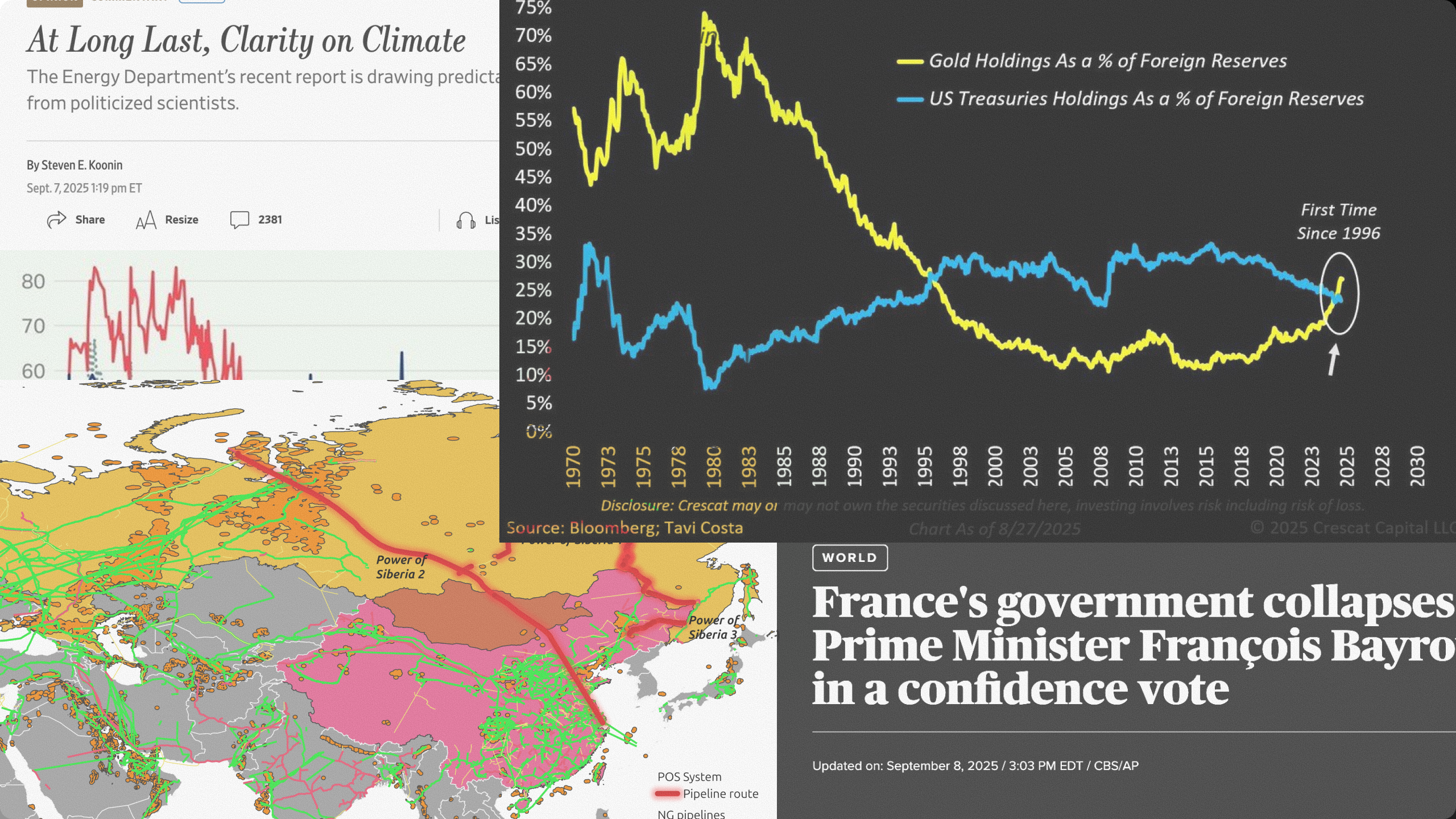
In this week’s Frankly, in a continuation of his ‘This Week’s Learnings’ series, Nate updates viewers on things he learned in the past week, and the implications for our sociocultural trajectory. This edition focuses on recent financial and political headlines – global gold holdings, shifting geopolitical energy deals, and new U.S. Department of Energy reports – and explains their relevance to our biophysical reality and broader geopolitical landscape. Through this exercise, Nate invites podcast viewers to use a systems lens to integrate the wide array of news we are bombarded with into the large evolving story of The Human Predicament.
Why does it matter that central banks now hold more gold than the U.S. treasuries? How might expanding energy collaborations between Russia and China shift the global political power of the United States and Europe? How do current economic and political incentives affect the nature of energy science, and what we consider to be ‘truth’ itself?
Show Notes & Links to Learn More
Download transcript01:13 – Foreign Central Banks Hold More Gold Than Treasuries
01:38 – Value of gold
02:22 – TGS Bend Not Break series
02:50 – Fertilizer production by country
03:32 – France bond yields, Germany bond yields, Japan bond yields
04:23 – France’s government collapses with Prime Minister François Bayrou ousted in a confidence vote
04:52 – Gallup poll: Americans’ Satisfaction With U.S., by Party ID
06:00 – Shanghai Cooperation Organization
06:15 – New “Power of Siberia 2” energy collaboration between China and Russia
07:55 – 2025 Dept of Energy report on climate change
08:06 – Secretary of Energy Chris Wright,
09:25 – Steven Koonin: At Long Last, Clarity on Climate
09:42 – ‘CO2 is plant food’ argument
10:17 – What do plants need to thrive?
10:32 – Liebig’s Law of the Minimum
10:52 – Kristie Ebi, et al.: “Nutritional quality of crops in a high CO2 world”
11:15 – Plants responding to drought and heat stress, Increased flooding, Shifting seasons
11:30 – Osler Ortez, et al.: “Corn Response to Long-Term Weather Stressors”
12:22 – Land/soil degradation, Water scarcity, Pollinator decline