#123 | Frankly
The Consumption Pyramid

Description
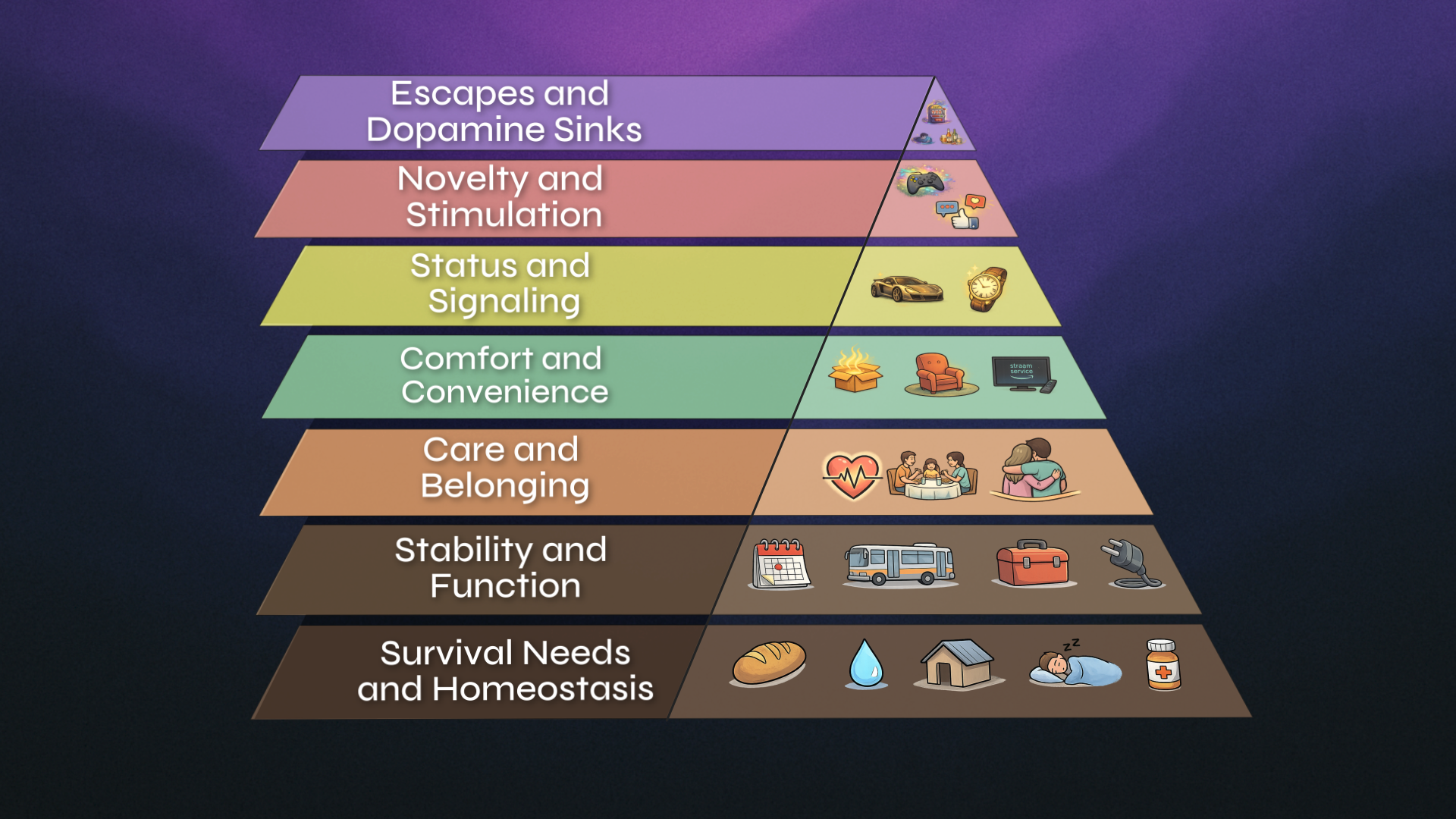
This week’s Frankly unpacks humans’ current identification with the label “consumer.” Consumption is something much deeper and more nuanced than shopping or spending. Nate highlights the ways that it shows up across our whole lives – from basic needs and stability to status and mental escape. He outlines a “consumption pyramid” framework that acts as a map for the different layers of consumption present in daily life, emphasizing that they vary in dependency, reliability, and necessity.
This episode also explores why this understanding is especially relevant in a world that will be increasingly volatile, expensive, and uncertain. In the energetically-intensive reality we have lived in for the past few decades, it has been easy to drift to the top of the consumption pyramid without even really choosing to. This has made us increasingly dependent on systems that reliably provide us comfort and convenience. Rather than taking some sort of moral high ground on consumption, Nate aims to invite listeners to pay closer attention to their own patterns of consumption. He analyzes habits that could support stability, and how listeners might intentionally simplify before external circumstances force the issue – mirroring the taking stock he’s doing in his own life.
Where in your life do you feel most dependent on things always being fast, easy, and available? What kinds of consumption actually make you feel better afterward, not just distracted in the moment? Finally, if you stopped thinking of yourself primarily as a consumer, which other roles – maker, neighbor, caretaker, citizen – do you think would come most clearly into focus?
Show Notes & Links to Learn More
Download transcriptThe TGS team puts together these brief references and show notes for the learning and convenience of our listeners. However, most of the points made in episodes hold more nuance than one link can address, and we encourage you to dig deeper into any of these topics and come to your own informed conclusions.
00:00 – Essay version of this Frankly
00:25 – Game of Monopoly
00:40 – Autotrophs, Heterotrophs
01:30 – The Great Simplification
04:20 – Homeostasis
04:30 – Self-actualization
06:30 – Human need for social connection
07:35 – William Butler Yeats, The Second Coming (“slouches towards Bethlehem”)
08:27 – Signaling
09:00 – Historical use of objects as symbols
10:25 – Frankly #44 The Many Shapes of the Carbon Pulse
10:31 – Boredom and social media
10:39 – TGS Franklys
10:50 – The Wanting is stronger than the Having
11:11 – Disassociation
11:50 – Anna Lembke, TGS episode Anna Lembke
12:10 – Billions of barrels of ancient sunlight into microliters of dopamine (TGS Movie @03:11)
14:20 – I.C.E. (U.S. Immigration and Customs Enforcement) activity in Minneapolis
18:15 – Hedonic treadmill
20:40 – Global superorganism
22:08 – John Merrick, The Elephant Man 1980 film