

Ep 242 | Luke Gromen
Print or Default (or Both?): The US Debt Trap Accelerates

Description
The Great Recession, the dot-com bubble, the Mexican debt crisis: for every major financial crisis in the last 50 years, the U.S. has answered with more borrowing and more money printing. These rescues were temporary fixes for an accelerating debt crisis, pushing the U.S. dollar – and the entire economic system – toward a breaking point. Now, with interest and entitlement payments slightly larger than total federal tax receipts, there are no painless options left to correct the situation.
In this episode, Nate welcomes back macroeconomic analyst Luke Gromen to unpack the financial bind facing the United States and the broader Global economy, a bind that leaves governments with two options: print or default (or some combination of the two). Moving line by line through one of Luke’s recent analyses, they explore why austerity, long the textbook remedy for excessive debt, would likely backfire now, which in Luke’s view makes a deep depression or a currency reset nearly unavoidable. Luke also explains how the Iran war and the closure of the Strait of Hormuz have exposed the deep links between oil, the dollar, and bond markets. He makes the case that gold has re-emerged as a major reserve asset, and why a gold revaluation is a possible way to “rip the Band-Aid off,” setting us up for longer-term success. Nate presses him on what such a reset would mean in a world of declining net energy, and how that might put further pressure on an already strained system.
Whether an economic collapse happens in nominal or real terms, what does it look like for the average citizen who has to bear the cost? What are the international implications of a sudden break in the U.S. Treasury Market? And if governments aren’t preparing for what’s coming, how might individuals and communities invest in the physical resilience and relationships that help society bend rather than break?
About Luke Gromen
Luke Gromen has become one of the most respected names in the global research sector. Having been in the industry for 20+ years and earning a reputation as a client-focused analyst with an unparalleled ability to make broad connections between increasingly siloed industry news and drawing conclusions that help investors understand the bigger picture. Luke offers unique and insightful research derived from a wide variety of sources that provide a clearer picture of global macroeconomic, thematic, and sector trends.
Luke founded FFTT, LLC in early 2014 to address and leverage the opportunity he saw created by applying what clients and former colleagues consistently described as a “unique ability to connect the dots” during a time when he saw an increasing “silo-ing” of perspectives occurring on Wall Street and in corporate America. FFTT caters to institutions and sophisticated individuals by aggregating a wide variety of macroeconomic, thematic and sector trends in an unconventional manner to identify investable developing economic bottlenecks for clients.
Show Notes & Links to Learn More
Download transcriptThe TGS team puts together these brief references and show notes for the learning and convenience of our listeners. However, most of the points made in episodes hold more nuance than one link can address, and we encourage you to dig deeper into any of these topics and come to your own informed conclusions.
Guest:
Luke Gromen: Founder and President, FFTT, LLC, Works
Previous The Great Simplification appearances: RR #12, #91
Grab-and-Go Resources:
New? Start here:
From the Archive:
- Ep 91: Luke Gromen, Peak Cheap Oil and the Global Reserve Currency
- Ep 237: Art Berman, A World-Changing Event: We’re Not Going Back to January 2026
- Inflation, Deflation, & Simplification: The 8 Things That Influence Prices (Frankly #115)
Episode Foundations:
- Luke Gromen on “true interest expense” (MacroVoices #499)
- Luke Gromen’s proposal to revalue U.S. gold reserves
- U.S. Net International Investment Position
Next Steps:
Resources by Timestamp:
05:46 – Gold’s rise from under $2,000 to a record near $5,600 (January 2026), back below $4,000 in October 2026
05:56 – Key takeaways from the 2026 midterms
06:05 – 2026 Iran war, Strait of Hormuz closures, over 1 billion barrels of oil demand lost to the war (IEA, September 2026)
06:12 – Fed raises rates for the first time since 2023 (September 2026), 10-year Treasury yield
06:36 – Gold exceeded U.S. Treasuries in official reserves by market value at end-2025 (ECB), valuation and coverage caveats from the Federal Reserve
06:53 – Central bank gold purchases of 321 tonnes in Q3 2026 (World Gold Council)
07:18 – Foreign official holdings and total foreign holdings of U.S. Treasuries
08:44 – China cut crude imports and drew on stockpiles during the war
08:54 – IEA estimate of oil demand displaced by EVs in China
09:28 – Record 400 million barrel IEA emergency stock release (March 2026)
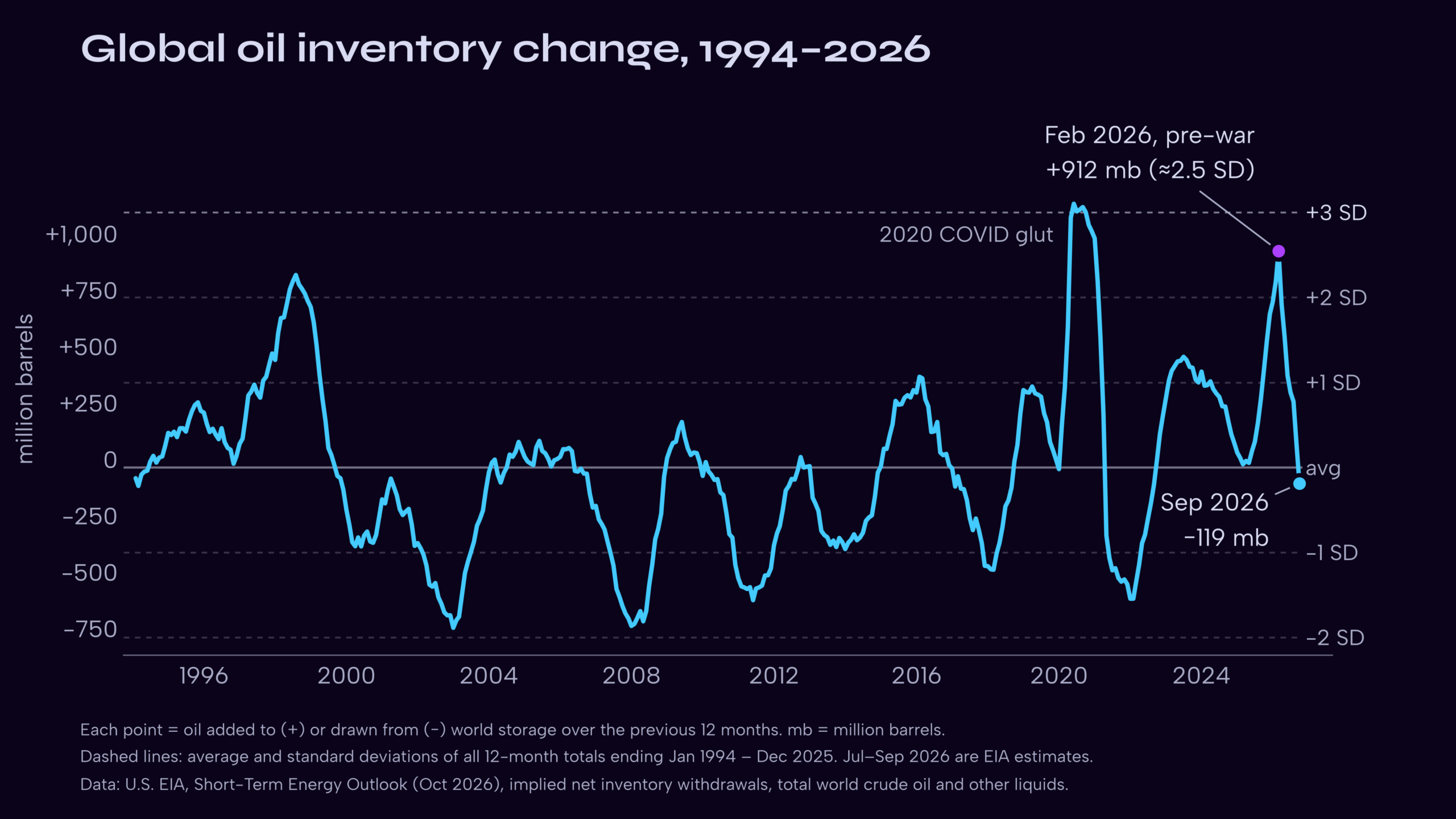
09:35 – Global oil inventories falling at a record pace
10:23 – In-video insert by Art Berman (Art on The Great Simplification): Oil inventories about three standard deviations above normal going into February 2026 (Exceptionally large global oil-stock builds in 2025 (IEA))
11:00 – Refining crude oil: inputs and outputs, gasoline vs. diesel yields
11:38 – Luke Gromen’s post on austerity and the U.S. debt predicament
12:05 – Zero interest-rate policy, quantitative easing
12:25 – 2026 global bond selloff: French and UK long-term yields at multi-decade highs
12:30 – Modern Monetary Theory, Austrian economics, austerity
13:20 – Ludwig von Mises (referenced quote), fiat money
13:59 – Crises met with more credit: Black Monday (1987), Mexican peso crisis (1994), Asian financial crisis (1997), Long-Term Capital Management (1998)
14:29 – Dot-com bubble, Paul Krugman (referenced quote)
14:41 – 2008 financial crisis, Bank recapitalization through TARP’s Capital Purchase Program
15:31 – The Great Simplification: financial claims reconnecting with physical reality
16:10 – China’s rare-earth squeeze on Pentagon supply chains
16:27 – Political polarization in the U.S., Bon Jovi, It’s My Life (2000), killing of UnitedHealthcare CEO Brian Thompson
17:49 – Ratchet effect
19:11 – 2021-2023 inflation surge, Federal Debt: Total Public Debt as Percent of GDP, Federal deficit: $3.1 trillion in fiscal 2020 to $1.4 trillion in fiscal 2022
20:08 – CBO: federal receipts of $5.4 trillion in fiscal 2026
20:40 – Hyperinflation in the Weimar Republic
21:04 – U.S. energy production and consumption
21:30 – Nixon shock: end of dollar-gold convertibility (1971), Triffin dilemma
22:08 – Foreign investment positions: U.S. liabilities excluding financial derivatives, U.S. net international investment position, Major foreign holders of Treasury securities (latest Treasury data)
22:33 – Surging U.S. diesel prices, Trump backs a diesel export ban (September 2026)
23:32 – Draining America First, a chapter by Nate and DJ White (The Great Simplification appearances)
23:56 – Occam’s razor
24:12 – Drill, baby, drill
24:22 – China’s central bank in 2013: adding to FX reserves no longer in its favor
24:28 – IMF crisis medicine: structural adjustment and austerity conditions, Asian financial crisis (1997), Russian financial crisis (1998), Mexican peso crisis (1994), Latin American debt crisis (1980s)
25:15 – U.S. shale oil production: tight oil, horizontal drilling, and hydraulic fracturing
26:07 – Federal Surplus or Deficit as Percent of GDP, automatic stabilizers
27:43 – Scott Bessent’s 3-3-3 plan, U.S. deficit of nearly $2 trillion in fiscal 2026
28:33 – Fiscal multiplier
29:18 – *BIS: $14.7 trillion in dollar credit to non-bank borrowers outside the U.S. (March 2026), Ben Bernanke
31:25 – Hedge funds’ record share of the Treasury market ($2 trillion, 7% at end-2025)
31:47 – 2014 liquidity rules requiring high-quality liquid assets, Treasury and Agency Securities: All Commercial Banks
32:08 – 2023 United States banking crisis
32:45 – Keyser Söze
32:53 – When stocks and bonds fall together: positive stock-bond correlation
34:12 – Chatham House Rule
34:53 – Bessent: focus on the 10-year Treasury yield (February 2025)
35:18 – Energy blindness: money-and-technology vs. energy-and-materials worldviews
36:11 – Treasury bills
37:13 – Social Security, Medicare, Medicaid and veterans’ outlays (CBO, fiscal 2026)
38:29 – *CBO: Defense Department military outlays of $916 billion in fiscal 2026
38:37 – Related research on security alliances and reserve-currency holdings
40:51 – Javier Milei’s chainsaw spending cuts
41:19 – Sudden stop, Lula re-elected in Brazil (October 2026)
43:03 – Double-entry bookkeeping
43:38 – Maslow’s hierarchy of needs
43:44 – Japan and other foreign governments sold Treasuries during the Iran war
44:04 – Sovereign gold sales during the Iran war, to defend currencies and pay for energy
44:35 – *World War II deficits peaked above 25% of GDP in 1943, Fed capped Treasury yields until the 1951 Treasury-Fed Accord
45:18 – Dallas Fed survey: oil prices producers require to profitably drill new wells (Q1 2026), Capital controls and captive government-debt markets under Bretton Woods
45:52 – 2014 money-market fund reforms, subsequently revised in 2023
46:34 – Volcker shock
47:05 – The Deficit Myth on why a currency issuer isn’t like a household
48:00 – Post-COVID fiscal stimulus: CARES Act, American Rescue Plan
48:28 – Brad Setser on fewer automatic backers for the U.S. deficit, China’s record $1.19 trillion trade surplus (2025)
48:58 – GENIUS Act reserve requirements, permitting eligible short-term Treasury securities, insurers’ private credit exposure
50:37 – *Hong Kong’s stablecoin rules cover fiat-backed coins only; gold-backed tokens are private issues (private gold-backed token launch in Hong Kong)
51:36 – Bank Term Funding Program: loans against securities valued at par, bank runs of the Great Depression
51:58 – What bank capital is and how it absorbs losses
52:25 – Silicon Valley Bank, Signature Bank
52:54 – Fed’s temporary 2020–2021 exclusion of Treasuries from the supplementary leverage ratio
53:15 – FDIC deposit insurance, Deposits, All Commercial Banks
54:19 – Yield curve control (Luke’s 2023 call on The Great Simplification)
55:47 – S&P CoreLogic Case-Shiller U.S. National Home Price Index, 30-Year Fixed Rate Mortgage Average in the United States, home prices measured in gold
56:10 – Dow to Gold Ratio
56:23 – Financialization
57:15 – The dollar’s approximately 90% decline in oil-purchasing power as crude prices rose roughly tenfold between 2001 and their 2008 peak: Crude Oil Prices: Brent – Europe
57:32 – U.S. became the world’s largest crude oil producer
57:59 – Hyperinflation: a common definition is inflation above 50% per month
59:01 – *CBO: net interest of $1.1 trillion against receipts of $5.4 trillion in fiscal 2026
1:00:33 – China shock
1:00:52 – Social Security cost-of-living adjustments
1:01:09 – Social Security and Medicare’s projected long-term funding gaps (Treasury’s 75-year projections)
1:02:07 – Fall of Kabul (2021)
1:05:25 – Wheelbarrows, soil, skills and friends (Frankly on such)
1:05:50 – Financial repression
1:06:02 – Felix Somary, The Raven of Zurich: The Memoirs of Felix Somary
1:08:17 – Gold’s 2026 selloff during war, an oil shock and a Fed hike, What drives gold prices? (Chicago Fed)
1:09:12 – Luke Gromen on sovereign debt spiral risk under higher-for-longer rates, Japan’s national debt
1:10:09 – Luke Gromen’s proposal to revalue U.S. gold reserves: Treasury’s ~261 million ounces of gold at the $42.22 statutory price
1:10:56 – Gold certificate accounting (FAM §2.10) and statutory restrictions on gold certificates
1:13:32 – How unexpected inflation transfers wealth from lenders to borrowers
1:14:03 – Gold to Oil Ratio
1:14:54 – Gold as a primary reserve asset in Luke’s proposed monetary reset
1:16:10 – Wood-burning stoves, home solar panels
1:17:57 – How AI borrowing can affect bond markets and long-term interest rates (Dallas Fed), individual income and payroll taxes as the bulk of federal revenue
1:18:56 – AI’s energy demands
1:20:12 – China joins the WTO (2001), *U.S. manufacturing employment fell about a third from 2000 to 2010 (BLS), The China shock: labor-market adjustment to Chinese import competition
1:20:29 – *Anne Case and Angus Deaton on roughly 500,000 excess deaths among white, non-Hispanic Americans aged 45-54, 1999-2013, relative to continued earlier mortality declines
1:21:58 – Unemployment and underemployment among recent college graduates
1:22:59 – Data center backlash in the 2026 midterms
1:24:44 – Distribution of household wealth by generation
1:25:29 – K-shaped economy
1:26:54 – Gold as an oil currency: Luke’s proposal
1:27:43 – Nuclear power in China, Peak cheap oil (Luke’s first The Great Simplification appearance)
1:28:03 – China’s electricity generation growth (Ember Global Electricity Review 2026)
1:28:51 – Energy return on investment (EROI) and its relationship to net energy
1:30:11 – Maya Angelou (referenced quote)
1:30:37 – Reflexivity in financial markets: how expectations can influence outcomes
1:32:18 – 2026 U.S. midterm election results
1:32:43 – Voters favored limits on data centers in 40 of 41 local ballot measures on November 3 (Ballotpedia) and subsequent results
1:34:28 – Economic collapse in 1990s post-Soviet Russia
1:34:37 – The end of growth (Frankly #164: 7 Ways Growth Ends)






: The US Debt Trap Accelerates&p[url]=https://www.thegreatsimplification.com/episode/242-luke-gromen&p[images[0]=https://www.thegreatsimplification.com/wp-content/uploads/2026/11/Luke-Gromen-Podcast-Thumbnail-2-2-BG.png)