#164 | Frankly
7 Ways Growth Ends

In this week’s Frankly, Nate examines the possibility that global economic growth is approaching its limits, reframing it as a historically unusual period in human history enabled by an extraordinary inheritance of fossil fuels. By tracing the relationship between economic output and the energy, materials, and ecological systems that sustain it, Nate uncovers how financial markets, debt, and technological innovation can obscure the physical constraints beneath economic activity, allowing financial claims to expand even as the underlying stocks and flows become harder to access. He outlines seven potential pathways to the end of growth, including how things like geopolitical conflict, social unrest, ecological degradation, catastrophic external events, and cascading systemic failures could expose the fragility of an increasingly interconnected global economy.
Rather than attempting to predict a single moment of collapse, Nate investigates the shared vulnerabilities connecting these growth-ending scenarios. He challenges the belief that human ingenuity and technological substitution can overcome every constraint, emphasizing that innovation itself requires a functioning biosphere and a surplus of energy. Ultimately, this episode widens the focus from forecasting collapse to understanding how societies might build resilience today in preparation for a future of reduced material abundance.
What happens when the financial promises that underpin economic growth exceed the physical resources available to fulfill them? How can societies adapt to ecological and material limits without deepening inequality or accelerating systemic instability? And what might our societal trajectory look like if progress were measured by the strength of communities and living systems rather than the endless expansion of the economy?
Show Notes & Links to Learn More
Download transcriptThe TGS team puts together these brief references and show notes for the learning and convenience of our listeners. However, most of the points made in episodes hold more nuance than one link can address, and we encourage you to dig deeper into any of these topics and come to your own informed conclusions.
Grab-and-Go Resources:
New? Start here:
– The Great Simplification (32-minute film)
– The Superorganism Explained in 7 Minutes (Frankly #97)
– Reality Blind: Energy and Money
From the Archive:
– 7 Rungs of a Runaway System: How Civilization Descended Into Crisis (Frankly #162)
– Inflation, Deflation, and Simplification (Frankly #115)
– Growth Until Not (Frankly #7)
Episode Foundations:
– Maddison Project Database 2023
– Economics for the future: Beyond the superorganism by Nate
– Global Resources Outlook 2024 (UNEP International Resource Panel)
Next Steps:
– What to Do as the World Falls Apart: A Framework for Action (Frankly #132), Substack write-up
– Community Tool Box: building and sustaining relationships
– Ecosystem Restoration Playbook, Homegrown National Park
Resources by Timestamp:
00:00 – The coming end of global economic growth
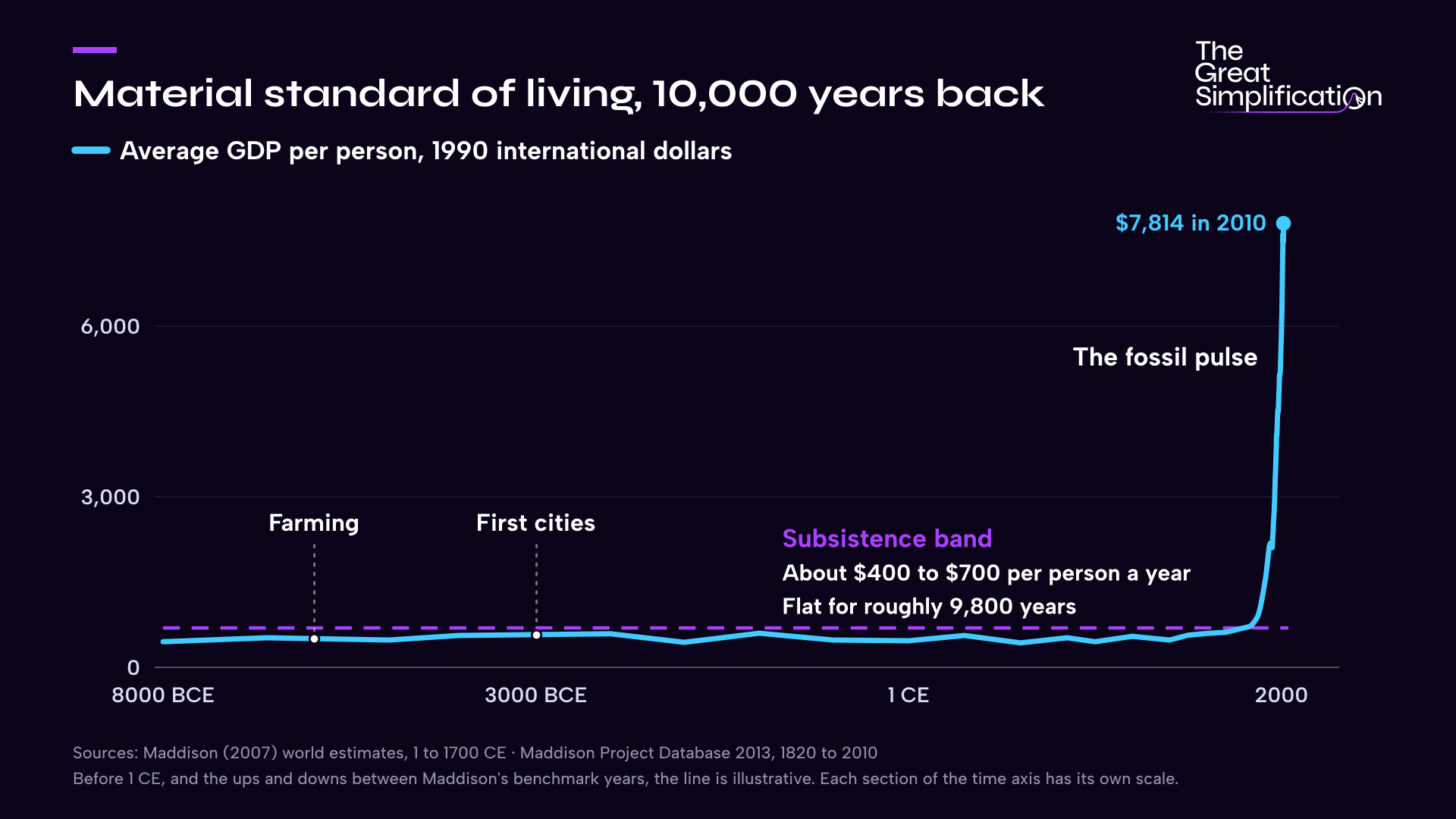
00:22 – Opening chart: global average GDP per capita over the long run, built on the Maddison Project Database, a world average near subsistence, $467 per person in 1 CE and $667 in 1820, in 1990 dollars, In-video graph
00:53 – Black Death killing an estimated third to half of Europe’s population
01:25 – Continual material growth as the anomaly in human history
01:48 – Late Bronze Age collapse, fall of the Western Roman Empire
01:57 – Civilizational rise and collapse as surplus is found and used up (related The Great Simplification episode with Joseph Tainter)
02:14 – Anatomically modern humans for roughly 300,000 years
02:22 – A single, tightly connected global economic superorganism riding the carbon pulse of ancient stored planetary productivity
02:54 – Wile E. Coyote running off the cliff (Paul Krugman’s “Wile E. Coyote moment” for the dollar)
04:07 – GDP as a tally of energy and materials pulled through the economy (social metabolism) to satisfy the wants of 8.3 billion people
04:39 – No sustained absolute decoupling of GDP from resource use
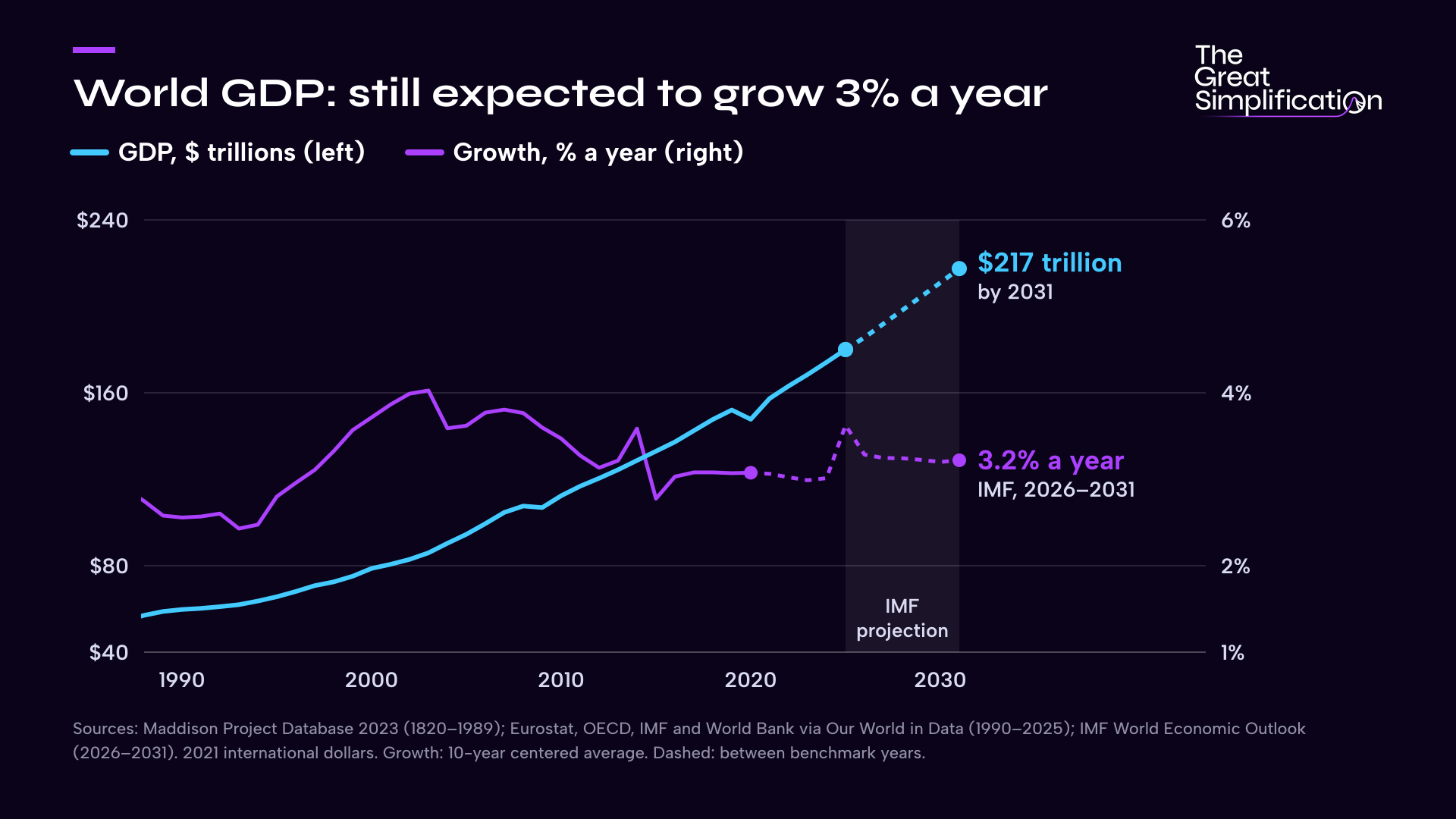
04:56 – Planning on ~3% growth in perpetuity: the IMF projecting 3.1% global growth for 2026 and 3.4% for 2027, In-video graph
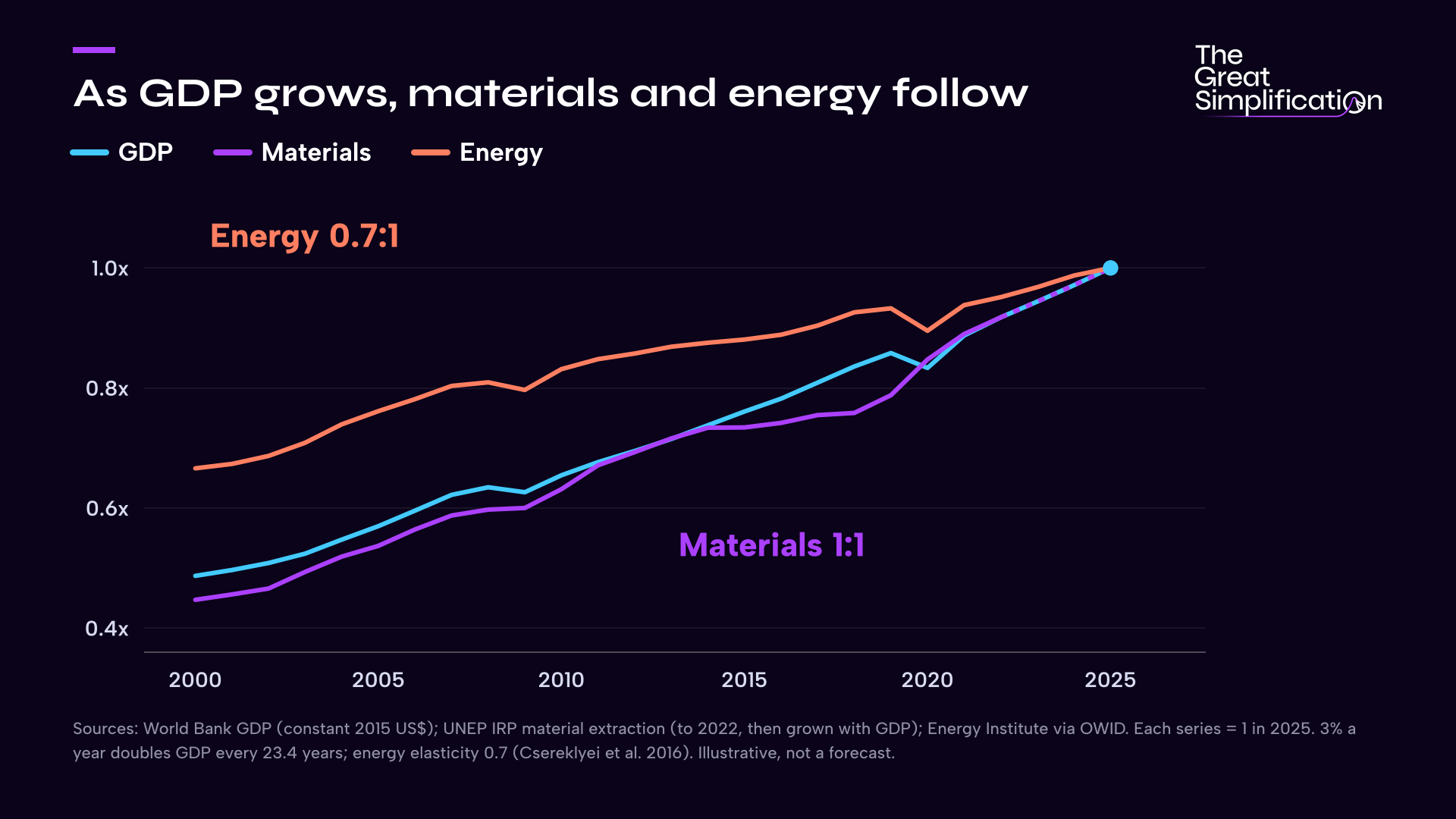
05:10 – GDP historically coupled to material use, roughly one-for-one, and to energy use, at an elasticity of about 0.7 (Nate and DJ’s book covering such), In-video graph
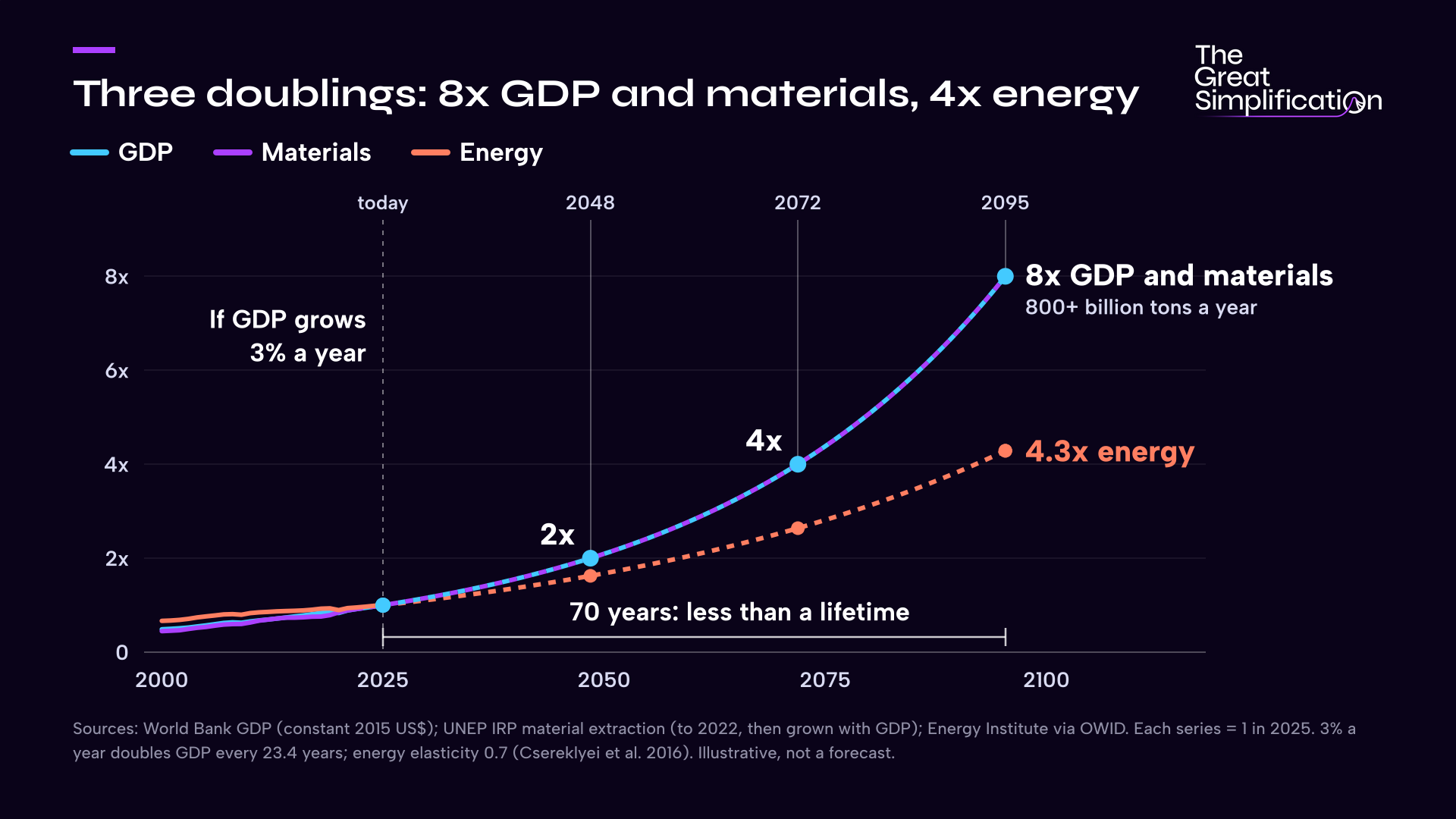
05:28 – Rule of 70: 3% annual growth doubles GDP about every 23 years, In-video insert
05:47 – Global material extraction of about 106 billion tonnes a year
06:58 – Energy applied to materials within functioning ecosystems as the ultimate driver, money as the proximate signal (proximate vs. ultimate causation)
07:26 – Money creation by commercial banks and central banks (Nate and DJ’s book covering such)
07:47 – Declining ore grades and rising energy costs as the easiest resources are used first
08:06 – Printing more financial claims against a thinning biophysical base (In-video animation from this Frankly)
09:24 – All financial debt as a claim on future energy and materials
09:45 – Post-2008 growth leaning on borrowing: global public debt heading for 100% of GDP, credit to the non-financial sector as a share of GDP, U.S. Debt Clock
10:19 – Deficits that have become permanent rather than counter-cyclical
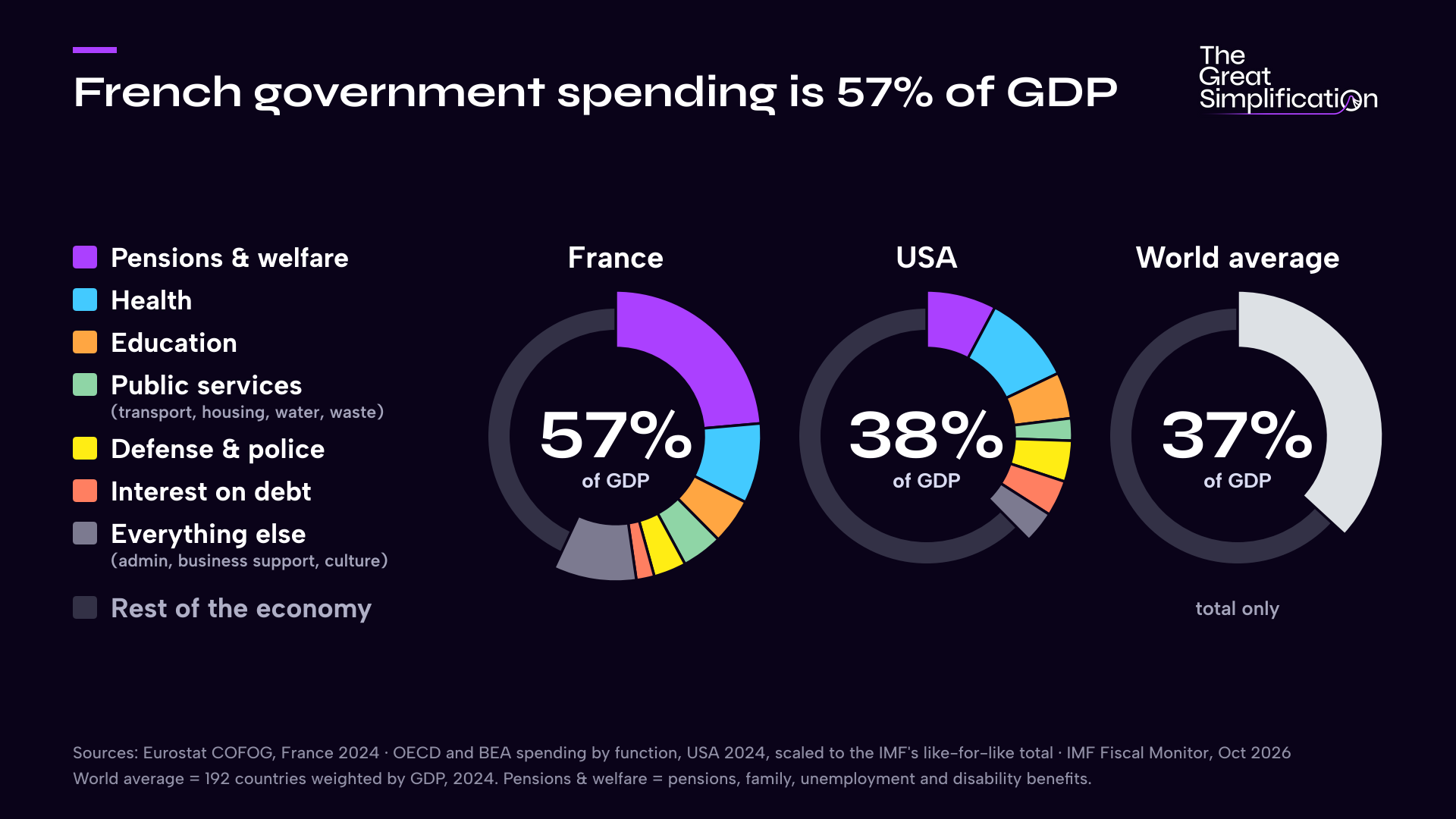
10:26 – French government spending at 57% of GDP, In-video figure
10:52 – Global financial crisis of 2008-09, 2020 COVID-19 recession and the central bank interventions that put a floor under both
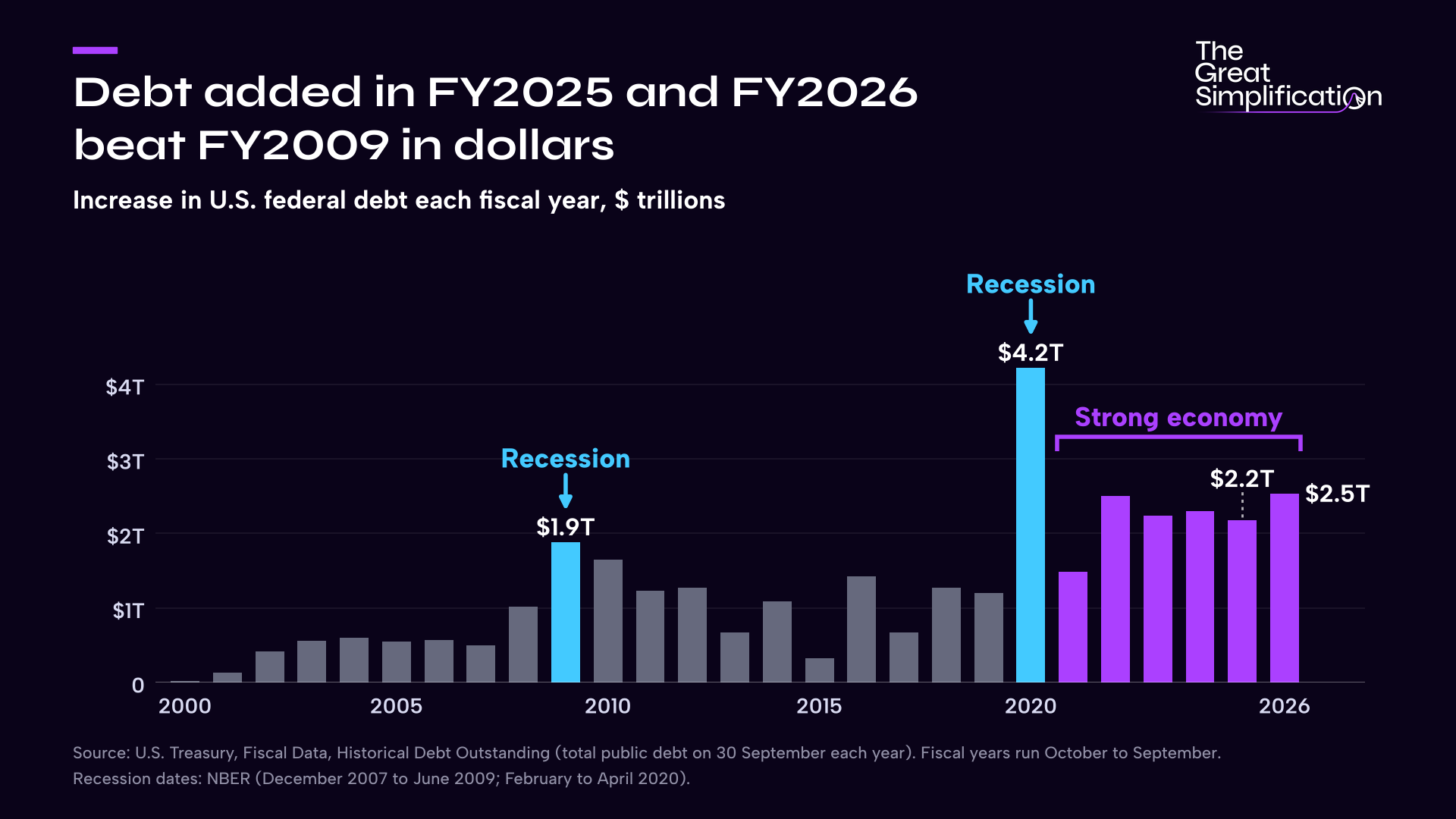
11:18 – U.S. federal debt rising more in fiscal 2025 and in fiscal 2026 than in fiscal 2009, in nominal dollars, In-video graph
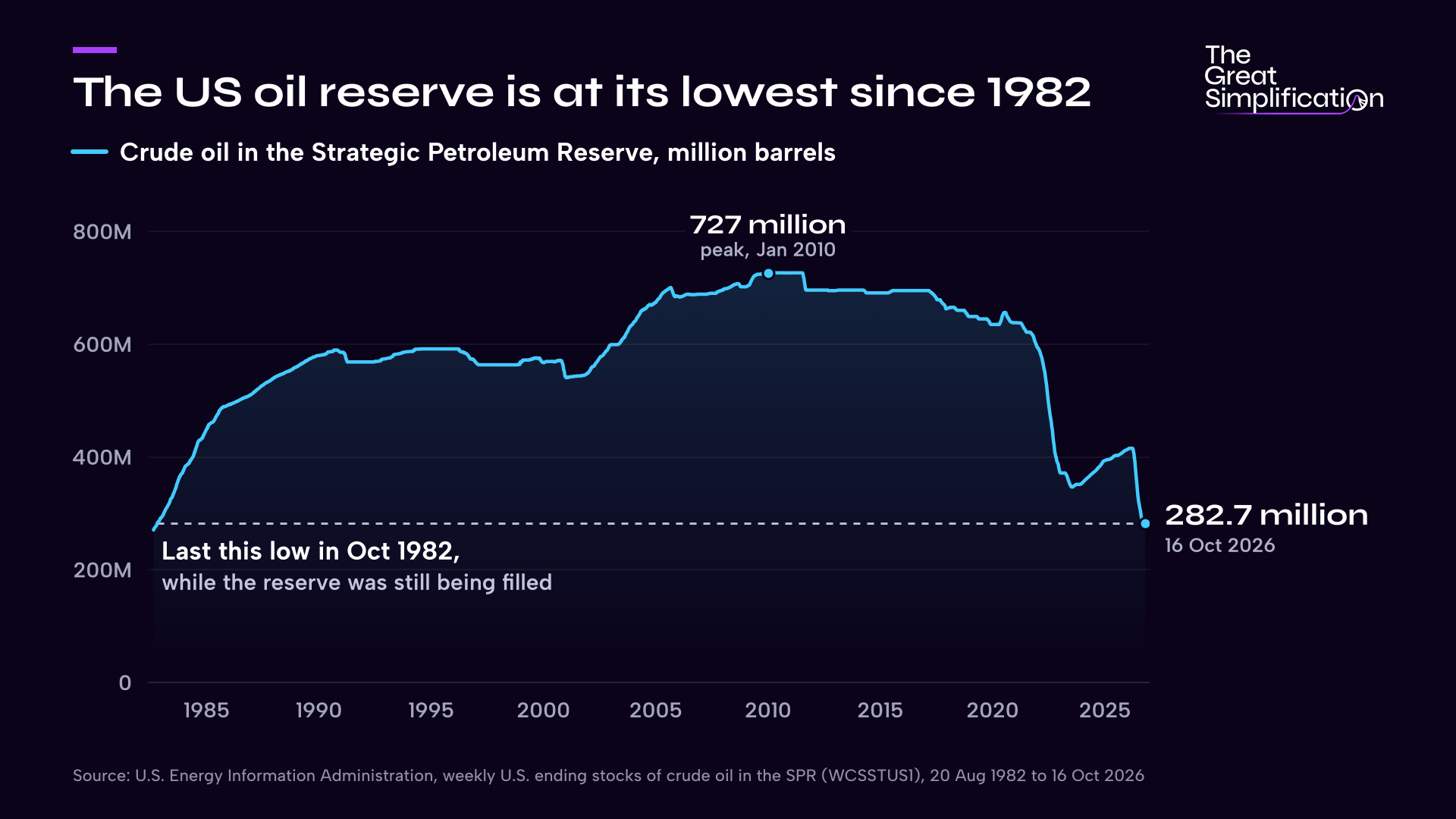
11:32 – Strategic Petroleum Reserve at 282.7 million barrels in mid-October 2026, its lowest since 1982, when it was still being filled, In-video graph
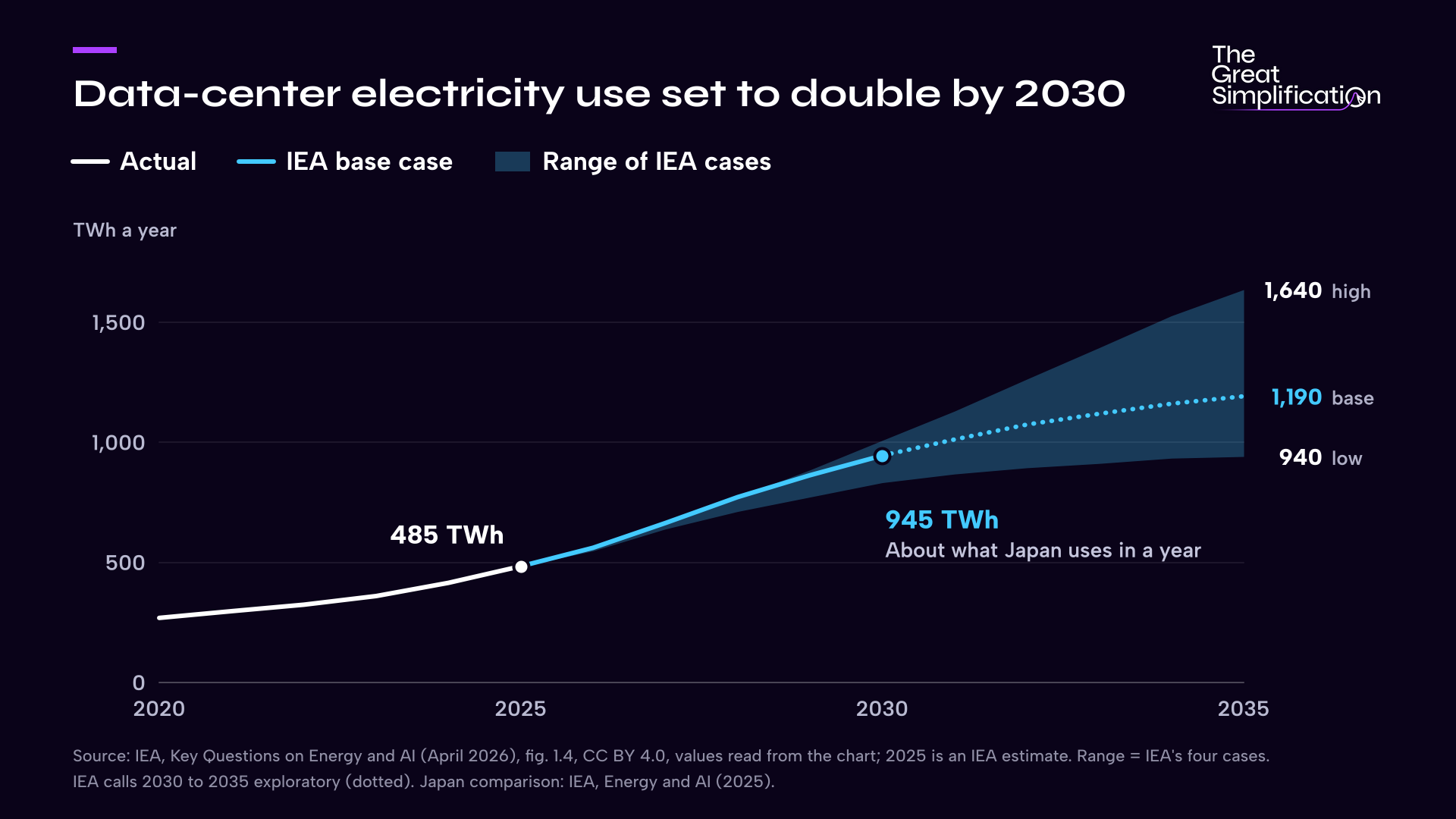
11:38 – AI build-out already short of power, transformers and copper, with public opposition to data centers growing, In-video graph
12:31 – Risk 1, biophysical musical chairs: the gap between financial claims and physical reality closing on its own
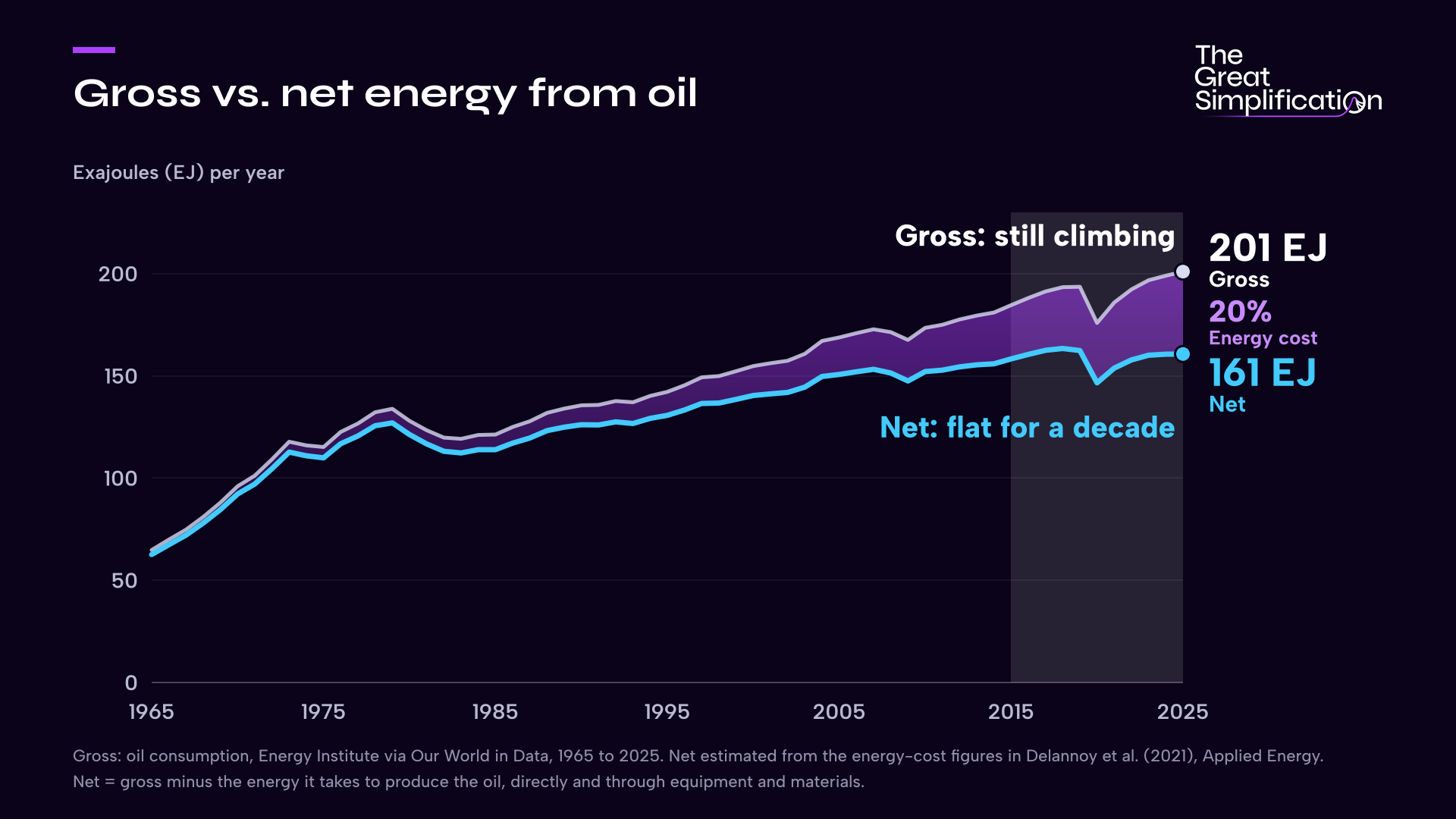
12:58 – Net energy from oil thinning even as gross production climbs
13:21 – Charles Mackay, Extraordinary Popular Delusions and the Madness of Crowds
13:36 – Inflationary reconciliation: monetizing the claims until the currency itself erodes
13:58 – Debt deflation (Irving Fisher’s The Debt-Deflation Theory of Great Depressions, 1933)
14:26 – Malinvestment: building more than can be afforded on cheap credit
14:43 – Money supply shrinking as debt is destroyed, as in the 1930s
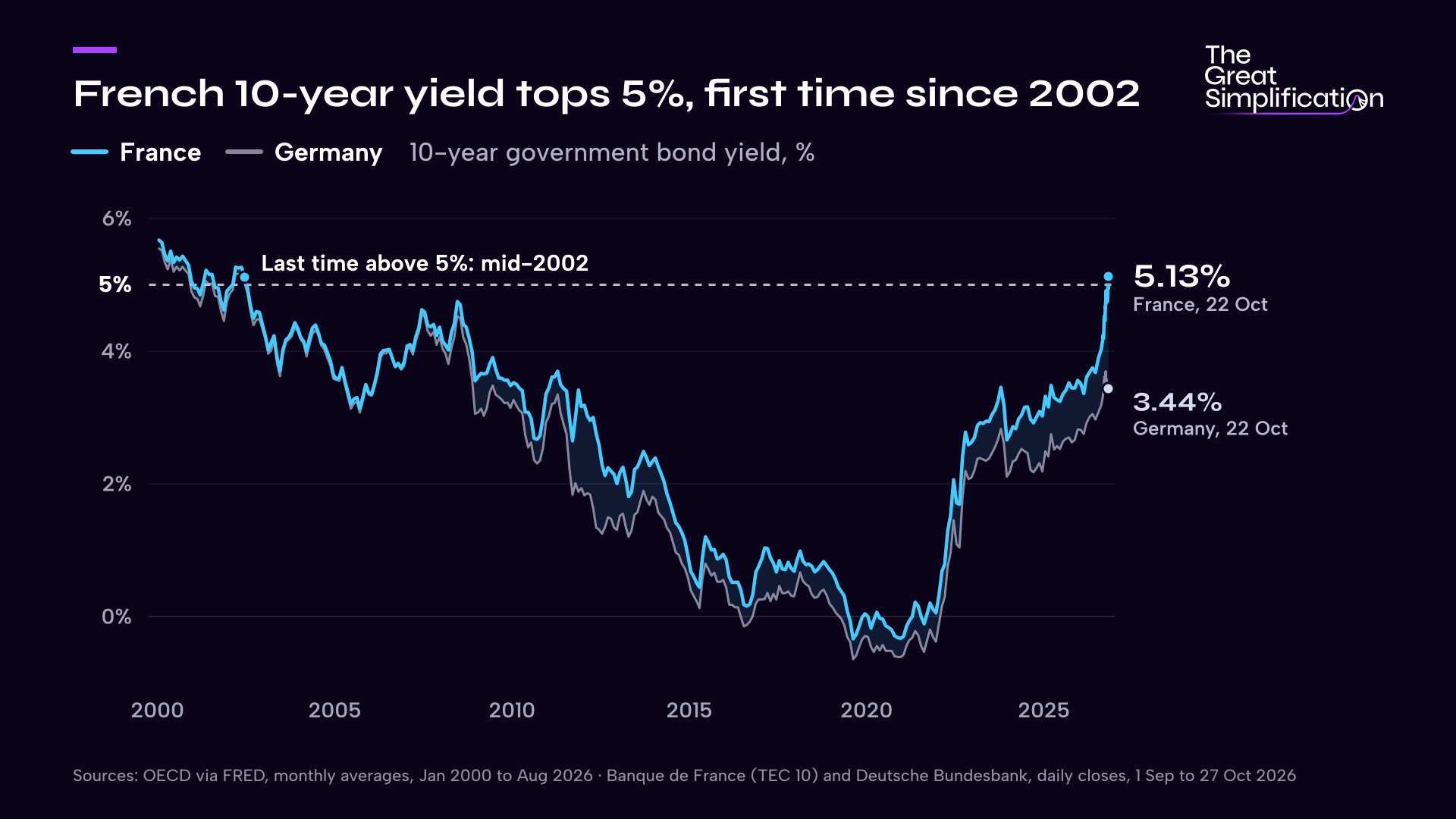
15:25 – French 10-year yield above 5% for the first time since 2002, the widest spread over German Bunds since the euro debt crisis and *the cost of insuring French debt against default at a 14-year high, In-video graph
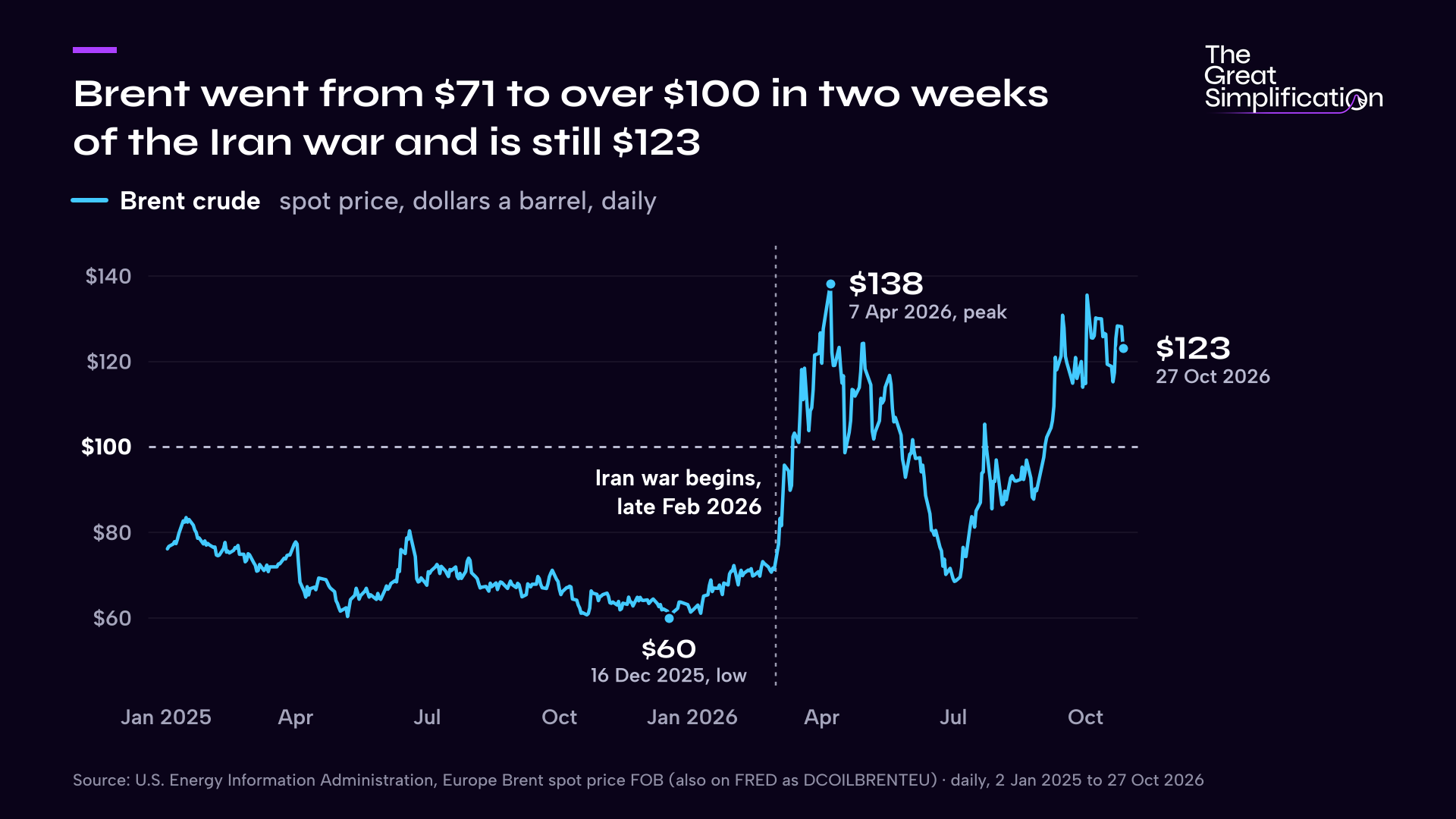
15:50 – France’s budget crisis and unrest, the Israel-U.S.-Iran war pushing up energy prices (Frankly #134: A World at the Edge of Change) and central banks responding with higher rates
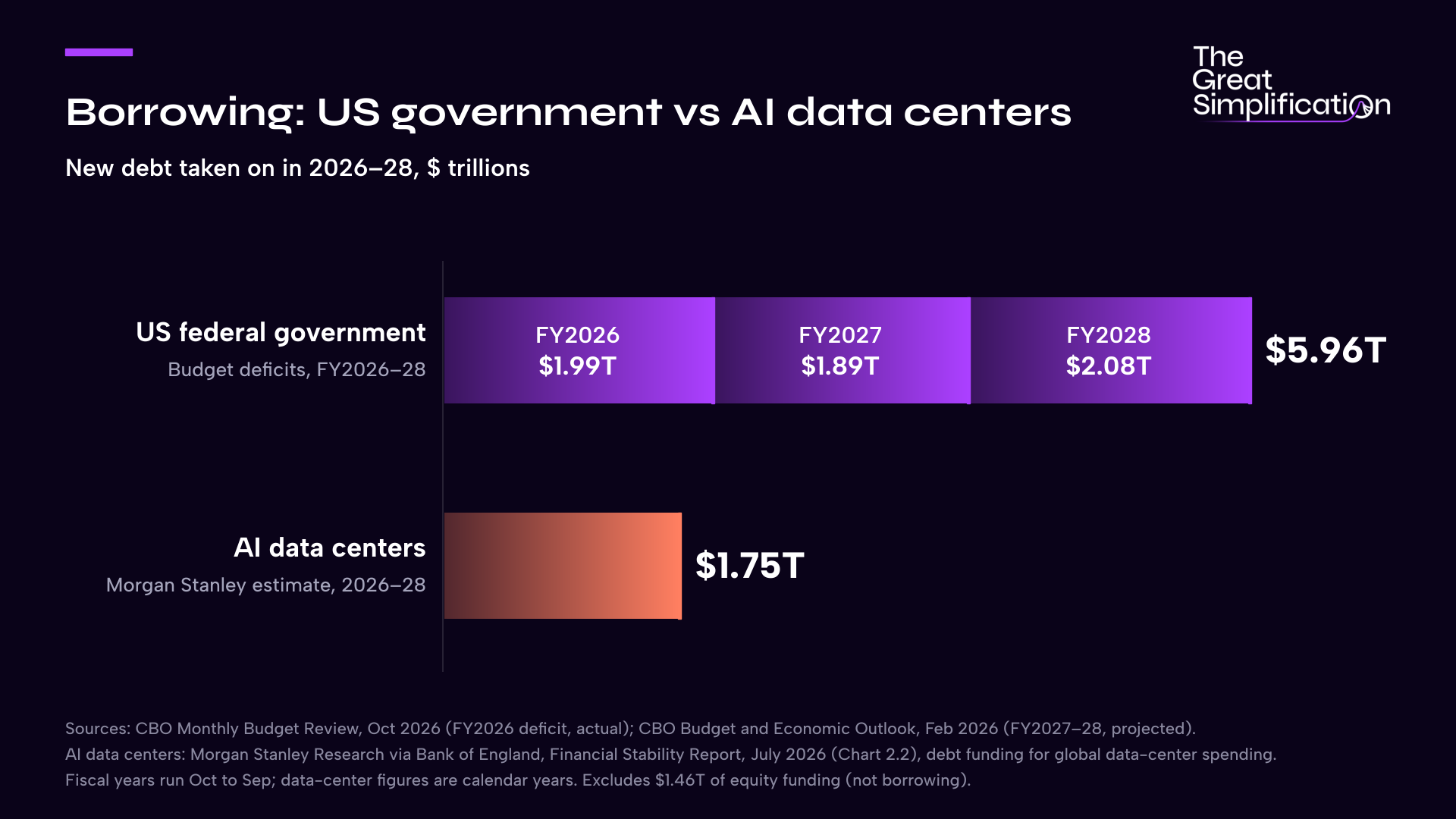
16:14 – AI borrowers competing with governments for the same lenders: the Bank of England on AI-related debt and sovereign debt markets (Governor Andrew Bailey’s warning over the AI borrowing binge)
16:24 – *Euro at a 17-month low, contagion to Italian and Spanish bond yields
16:41 – The EU importing more than half of its energy
16:47 – France as too big to save, and whether the ECB could step in
17:09 – Trillions of dollars flooding into AI infrastructure, AI borrowing on a scale that competes with the U.S. Treasury for lenders, In-video graph
17:34 – AI build-out increasingly funded by debt rather than free cash flow
17:40 – Circular AI financing: chipmakers funding the companies that buy their chips
17:51 – Lenders conceding the AI bet depends on energy: J.P. Morgan naming power the primary bottleneck for AI capex
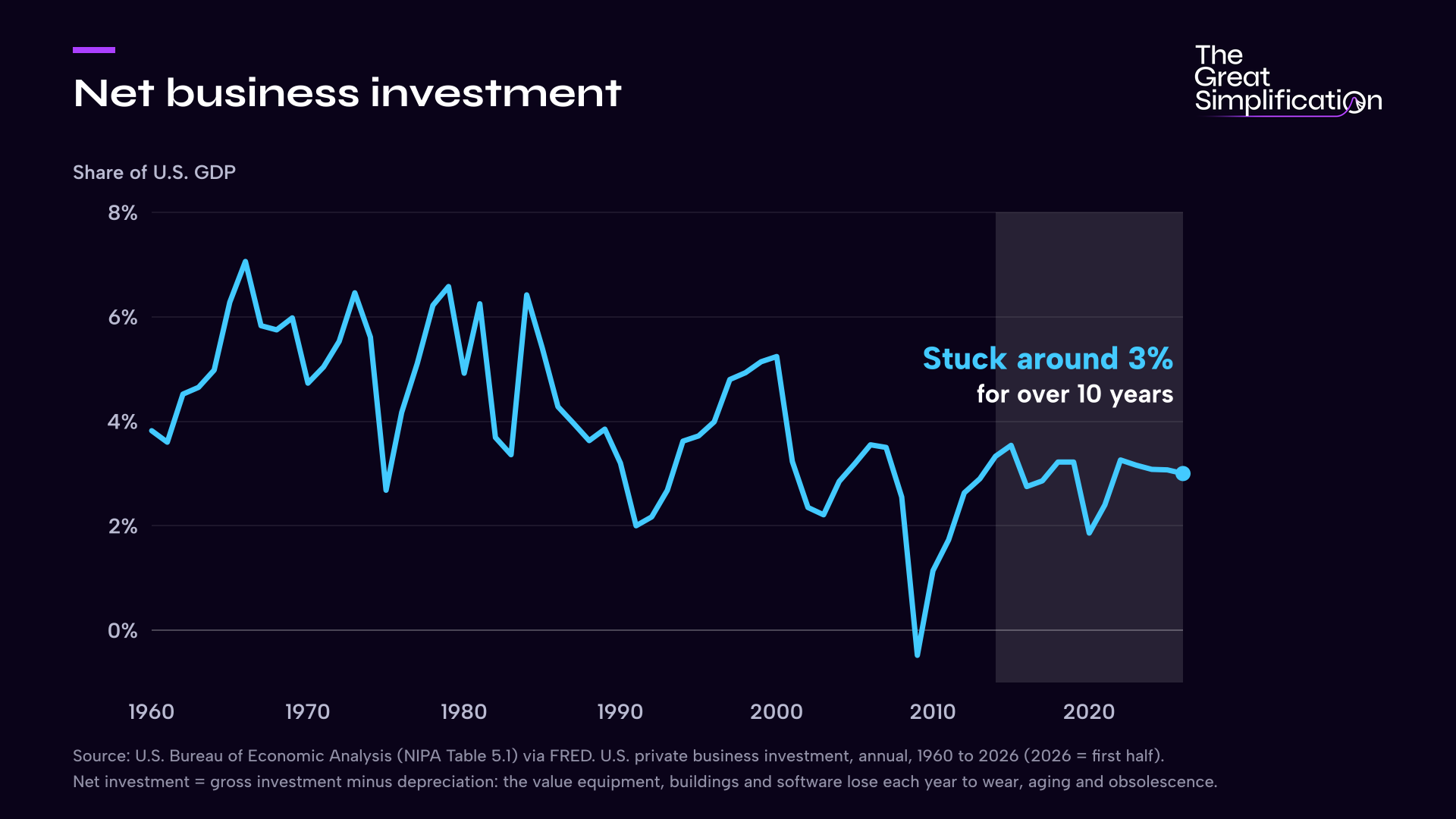
18:47 – Net private domestic business investment, near 3% of GDP for over a decade, In-video graph
18:56 – Net energy flat while gross energy production keeps climbing, In-video graph
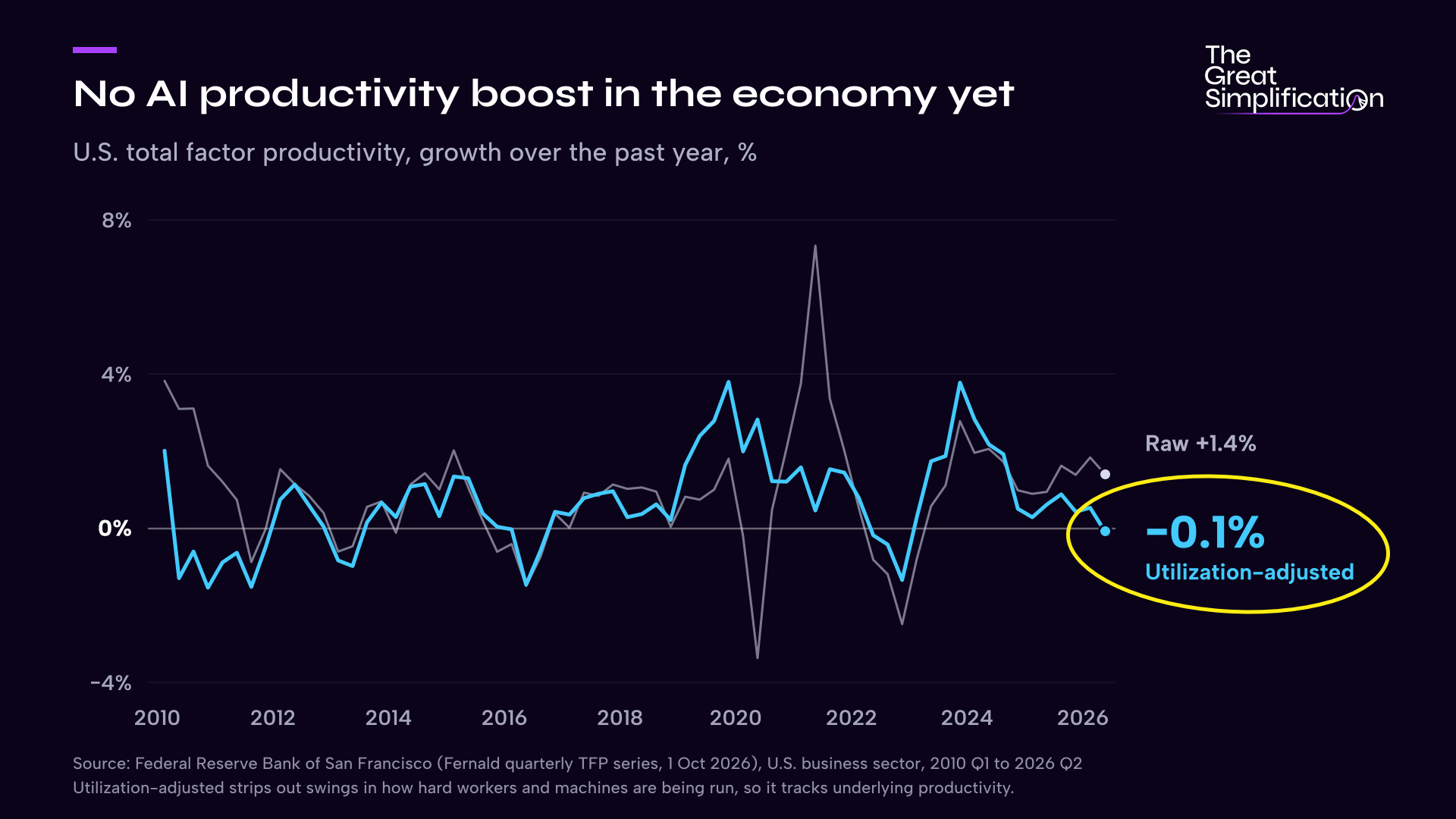
19:06 – Utilization-adjusted total factor productivity, slightly negative over the year to mid-2026 per the San Francisco Fed, In-video graph
19:34 – AI’s synthetic cognitive labor and its appetite for electricity, powered by armies of fossil laborers that are raising their rates and retiring
20:20 – Far more fossil fuel in the ground than can be burned within 1.5 °C of warming
20:30 – Affordability of the remaining oil versus the financial promises written against it
21:00 – Risk 2, a world war: great-power war unraveling currencies, trade and supply chains, letters of credit and trade finance, just-in-time global supply chains
22:05 – Nuclear war as the cause or multiplier of collapse: global famine from nuclear-war soot (The Great Simplification Ep 17 with Chuck Watson on nuclear war), the contested threat of a high-altitude nuclear EMP to the power grid
22:35 – Nassim Taleb’s turkey problem
22:50 – Risk 3, tearing it down from below: structural-demographic theory, or fights over who gets what as a society’s surplus shrinks (related The Great Simplification episode with Peter Turchin)
23:08 – Three directions of revolt: inequality leaving much of society behind, grievance politics and the wish to make someone pay, people with nothing left to lose: the “need for chaos”
24:17 – Fuel price shock from the Iran war, *hundreds of thousands in the streets and some 2,700 arrested over the weekend of 17 October, Limoges’s historic town hall gutted by fire, In-video graph
25:09 – Environmental concerns among France’s protesters: a 2025 survey of the “Bloquons tout” movement (in French)
25:21 – France as the second-largest economy in the EU, what a deliberate reduction in material throughput would take (related The Great Simplification episode with Giorgos Kallis on degrowth)
25:43 – How systems in overshoot behave (Frankly #68: Overshoot and its 7 Fundamental Drivers)
26:07 – Rube Goldberg machine, tightly coupled systems and Charles Perrow’s Normal Accidents
26:28 – Risk 4, holding it in place by force: global autocratization documented in V-Dem’s Democracy Report 2026
27:07 – Emergency powers, as tracked worldwide during COVID-19, expanding surveillance and muzzling of the media
27:38 – Recep Tayyip Erdoğan forcing Turkish interest rates down despite soaring inflation, the lira losing more than 80% of its value in five years
28:48 – Big AI companies merging with government, surveillance and the military: OpenAI’s Pentagon deal for classified systems
29:10 – Sci-fi dystopia: The Terminator, starring Arnold Schwarzenegger
29:24 – Risk 5, ecological limits: planetary boundaries (The Great Simplification Ep 134 with Johan Rockström)
29:33 – Global heating as a grind rather than a bang, a strong-to-very-strong El Niño now underway, according to NOAA’s 8 October 2026 update (The Great Simplification Ep 225 with Tad Patzek on the Super El Niño)
29:47 – Reduced crop yields, falling water tables, insurers pulling back from high-risk regions, wet-bulb temperature limits and up to 216 million climate migrants by 2050
30:21 – Degrading natural capital: soils, fisheries, forests, pollinators and the ecosystem services GDP leaves out
30:39 – Phosphate rock reserves concentrated in a few countries, led by Morocco
30:47 – Liebig’s law of the minimum (Nate and DJ’s book covering such)
31:51 – Risk 6, the thing from the outside: a solar superstorm frying transformers and satellites, a Yellowstone supereruption, an earthquake under Taiwan’s chip fabs, an asteroid impact, as in Bruce Willis’s Armageddon
32:35 – Carrington Event of 1859, the largest solar storm on record
32:59 – Lloyd’s on what a Carrington-class storm would do to today’s grid
33:20 – Risk 7, everything else: a pandemic worse than the last one, cyberattacks on the grid or the payment system with AI on both sides, complexity cascades in supply chains
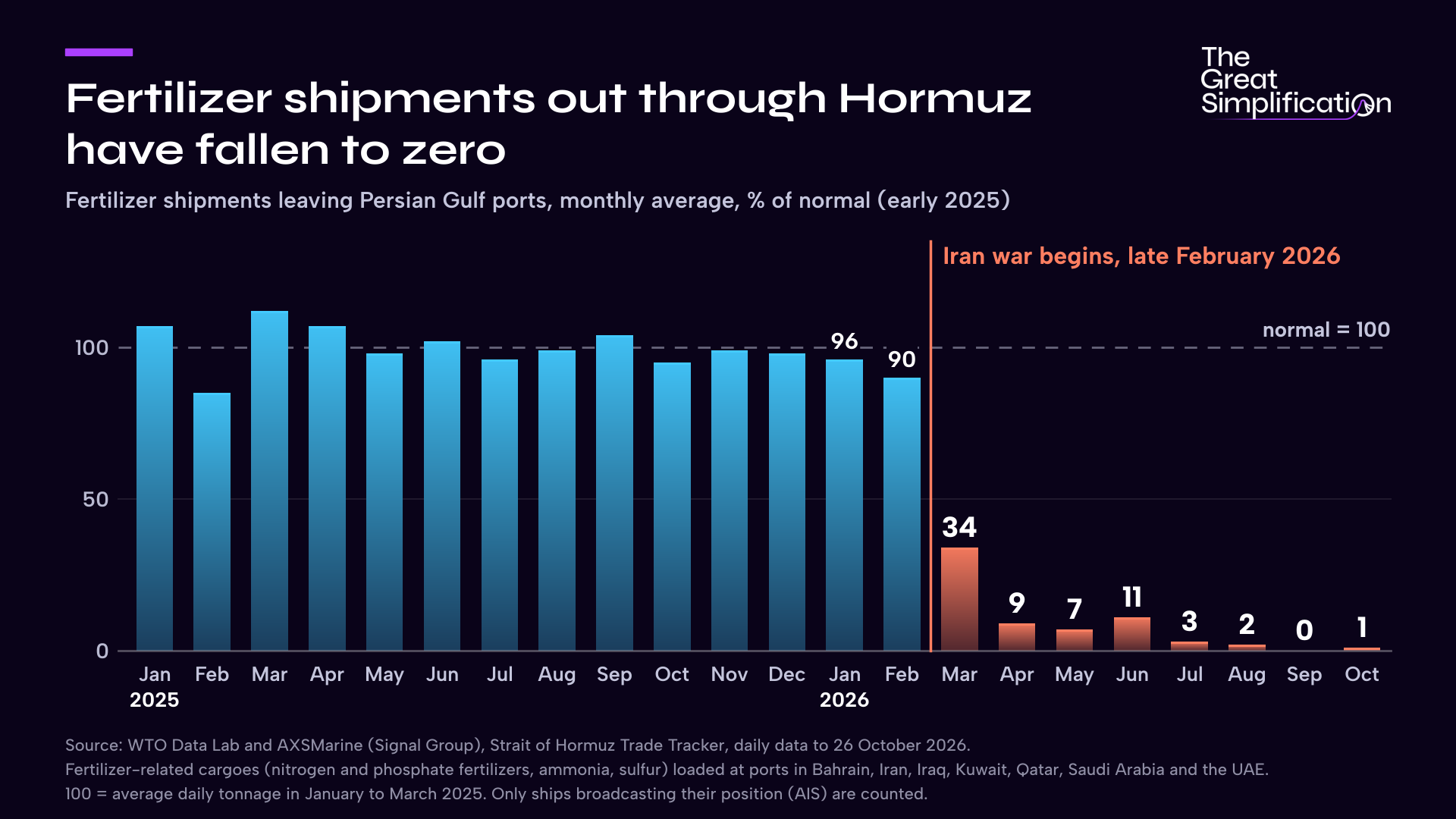
33:58 – *Gulf urea exports through Hormuz down about 83% year on year, the ingredients for a global food crisis (Frankly #61: The Strait of Hormuz and the Spice), In-video graph
34:05 – Sulfur supply as a looming bottleneck, high-purity quartz from Spruce Pine for chipmaking crucibles
34:15 – Collapse of shared reality and facts (Frankly #153: When Truth Becomes Hazardous)
35:24 – Donald Rumsfeld (referenced quote: “unknown unknowns”)
35:33 – AI as an accelerant behind several of the seven risks
36:57 – The law of aggregate probability, from Reality Blind
37:45 – Left and right as accelerator and brake: the public as thermostat, Charles Lindblom’s “muddling through” as built-in error correction
38:21 – Hollowing out of the political center
38:51 – Thomas Malthus (Nate and DJ’s book covering such)
38:53 – Paul Ehrlich (The Great Simplification appearance), The Population Bomb
38:55 – The Limits to Growth (The Great Simplification Ep 12 with Dennis Meadows), misunderstood rather than wrong: its scenarios checked against real-world data
39:21 – The carbon pulse: a one-time inheritance of buried ancient productivity
39:31 – Fossil-fueled agriculture feeding far more people than Malthus imagined
39:40 – Globalization: outsourcing resource use to other countries, “indebted demand”: debt pulling tomorrow’s spending into today
39:59 – Central banks as market-makers of last resort since the 2008-09 crisis
40:36 – Daron Acemoglu’s estimate of AI’s productivity effects
40:47 – Ecological overshoot from infinite growth in a finite system
40:59 – Cornucopian optimism: human ingenuity, markets and substitution (the Simon-Ehrlich wager)
41:41 – Net energy, or energy return on investment (EROI), as the master resource with no substitute
42:01 – The up-front energy cost of an energy transition, paid out of today’s surplus
42:32 – The Great Simplification as the air gap closing
42:46 – Back to the opening chart, at the peak of human material wealth: global average GDP per capita over the long run, In-video graph
44:45 – The same preparation, whichever risk turns out to be the trigger (Frankly #132: What to Do as the World Falls Apart)
44:59 – Carrying less personal and professional fragility, real wealth in soil, water and people over Frederick Soddy’s “virtual wealth”
45:17 – Becoming a rock in the river, building social capital with your neighbors
45:30 – Regenerating the living systems near you, helping other species through the coming bottlenecks, starting in your own yard (Frankly #114: Directional Advice for the More-Than-Human Predicament)
45:46 – The best things in life are free: time in nature, a shared meal, music (Frankly #35: The 10 Things That Bring Me Joy), someone’s hand or paw in yours (Frankly #156: An Antidote to Despair)
46:18 – Using the time left to build societal resilience: bend rather than break (Frankly #58: The Fellowship of the Ring, Bend Not Break)