#166 | Frankly
How the End of Energy Abundance Rewrites Civilization | Rules of the Downslope Part 1

This week, Nate explores the shifting rules of human civilization as society moves from the upslope to the downslope of the Carbon Pulse. The conditions of abundant fossil energy that have rewarded growth, scale, specialization, debt, and a relentless pursuit of efficiency are changing, and the systems that once thrived by consuming surplus may soon only survive by conserving it.
This transition signals a fundamental reorganization of the rules by which societies have operated for the past two centuries – where redundancy becomes insurance instead of waste, repair replaces buying new, and practical competence regains value as the energy supporting complex specialization becomes less reliable. Nate considers how societal tools like debt become more precarious when we can no longer assume that the future will be larger than the present, and how fairness becomes a defining condition of social cohesion when growth no longer lifts everyone. He questions the efficacy of artificial intelligence in providing guidance through these conditions, pointing out that its knowledge is entirely derived from the literature and logic of the carbon-fueled upslope. Overall, Nate invites a deeper reconsideration of what it means to be “prepared” for the world ahead as the advantages of scale and abstraction give way to the importance of embodied resilience, stewardship, and local knowledge.
As the Carbon Pulse declines, how might humans adapt to live by new rules? What happens when the strategies that made civilization successful become the very things that make it fragile? And how might “success” itself be redefined when the pursuit of more is no longer a viable measure of progress?
Show Notes & Links to Learn More
Download transcriptThe TGS team puts together these brief references and show notes for the learning and convenience of our listeners. However, most of the points made in episodes hold more nuance than one link can address, and we encourage you to dig deeper into any of these topics and come to your own informed conclusions.
Grab-and-Go Resources:
New? Start here:
– The Carbon Pulse (Nate and DJ’s book chapter)
– The Superorganism Explained in 7 Minutes (Frankly #97)
From the Archive:
– 7 Ways Growth Ends (Frankly #164)
– The Many Shapes of the Carbon Pulse (Frankly #44)
– Ep 230: Olivier Hamant, The Optimization Trap: Why Too Much Efficiency Makes Us Fragile
Episode Foundations:
– Nature’s Pulsing Paradigm (W.E., E.P. and H.T. Odum, 1995)
– A Prosperous Way Down (H.T. and Elisabeth Odum)
– GDP, Jobs, and Fossil Largesse (Nate’s essay on energy slaves)
Next Steps:
– Land-grant university directory: find your state’s Cooperative Extension
– How to start a tool lending library
– Share the rule changes you envision with The Great Simplification community on Hylo
Resources by Timestamp:
00:02 – Frankly #164: 7 Ways Growth Ends: the end of a historically anomalous period of growth, measured by material throughput, enabled by fossil energy surplus, and made invisibly fragile by debt
00:45 – Changing the initial conditions of the future
00:56 – Informed and engaged humans on the scout team of the more-than-human predicament
01:16 – Peaking and eventual decline of the surplus enabled by the Carbon Pulse (Frankly on the shapes of the carbon pulse)
01:32 – Upslope rules perceived as natural laws (Nate and DJ’s book on shifting baselines), phase shifts on the downslope
02:09 – Foresight for broader interventions, the transitions where our work resides
02:58 – Maximum power principle (Frankly on such)
03:08 – *What the winning organisms and ecosystems capture: the most energy per unit time (power)
03:18 – Alfred Lotka (1922 paper on the energetics of evolution), H.T. Odum
03:31 – Jevons paradox
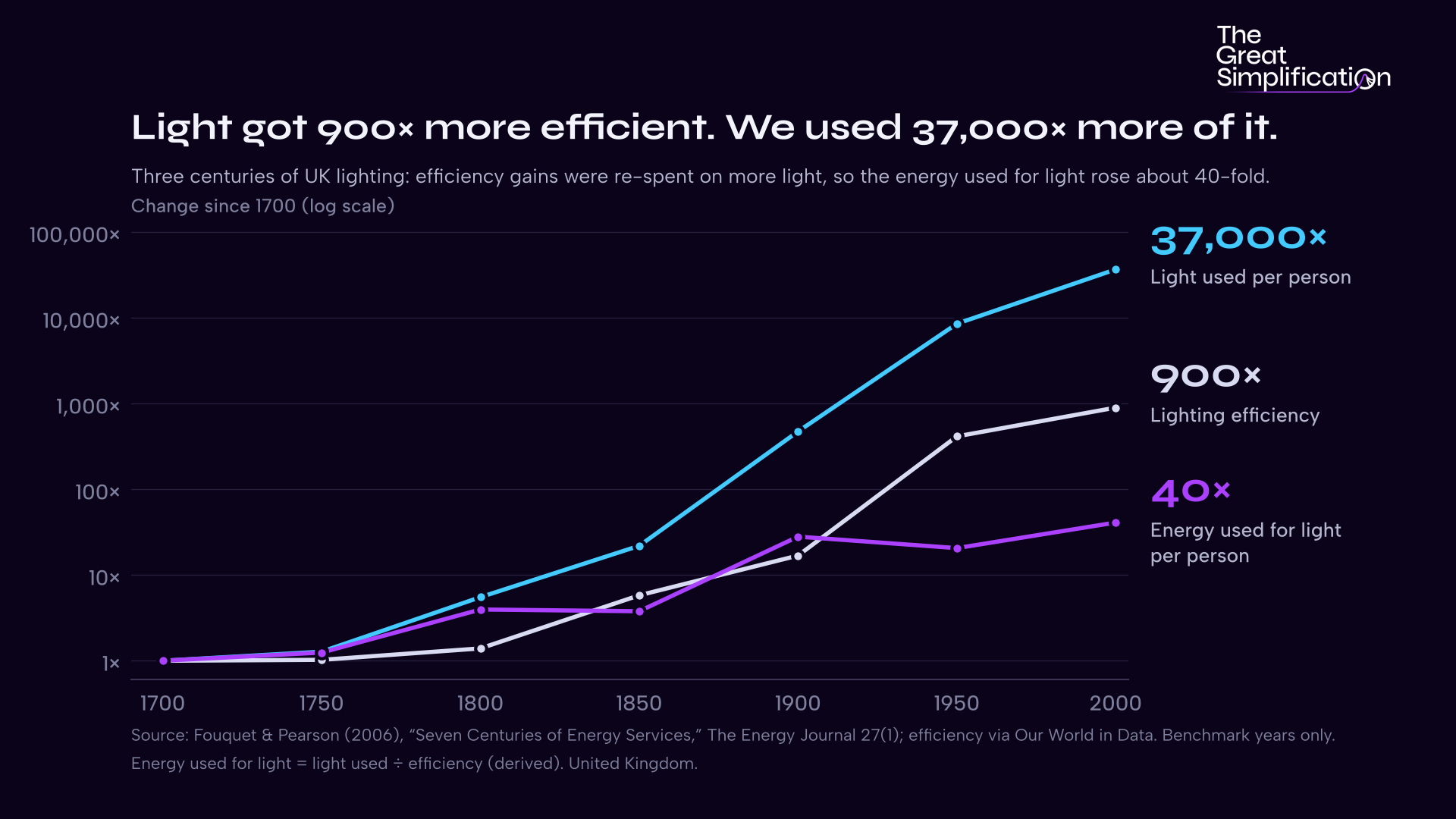
03:51 – Three centuries of lighting efficiency and global rebound: research by Tsao, Saunders and colleagues (UK data behind the on-screen chart: Fouquet and Pearson), In-video insert
04:11 – *Maximum power principle: whatever captures the most power wins, and what that looks like depends on the energy available
04:44 – Growth-phase strategies: algal blooms resulting from fertilizer runoff, startups burning cash to grab customers (blitzscaling), the rebound effect society-wide
05:16 – Squeezing the most work out of a smaller energy flow: kangaroo rats that never drink, cacti that store water, old-growth forests that recycle almost everything
05:58 – Black bears slowing their metabolism to about 25% of normal in hibernation
06:07 – H.T. Odum’s pulsing paradigm: surging when energy is abundant, conserving when it’s scarce (A Prosperous Way Down)
06:50 – Upslope savings spent on the next thing: bigger new houses, dopamine bling, Halloween costumes for pets (NRF Halloween survey)
07:08 – Downslope: efficiency savings as the margin for basic needs
07:55 – Jevons paradox as the maximum power principle in a growth phase: related research on when efficiency gains backfire
09:13 – Two kinds of efficiency: more useful work per unit of energy, running lean, just in time
10:14 – Downslope buffers: duplicate spare parts and backup suppliers, stored food
10:53 – Olivier Hamant (The Great Simplification appearance) on robustness over efficiency
11:28 – Riding out higher-variance shortfalls through reserves and buffers (Olivier Hamant on leaving the era of the mean for the era of the standard deviation)
11:57 – A barrel of oil does four to five years of human work (Frankly on such), replacing human labor with fossil energy
12:37 – The impact of higher energy prices on mechanization: Nate’s projection of rising operating costs as net energy declines
13:03 – Human and animal labor returning where fuel becomes scarce: a Cuban farmer turns to oxen as diesel prices idle his tractor during the 2026 energy crisis
13:21 – Energy slaves asking for significant pay raises
13:31 – Mulligans, throw-away society
13:58 – Repairing things as a hobby for MacGyver types
14:13 – Possessions as piles of past embodied energy, H.T. Odum’s emergy
14:42 – Fixing and maintaining things: right to repair, repair cafés
14:56 – In advanced economies, an estimated 80% of the building stock expected in 2050 has already been built (IEA, 2025), UK tax incentives favoring new construction over renovation
15:18 – Bigger was cheaper: economies of scale, how relatively inexpensive global shipping enabled international trade, with costs that can rise sharply during disruptions
15:43 – Food miles
15:58 – Six-continent supply chains that work only while energy is cheap
16:30 – Closer will mean cheaper and safer (Nate’s proposed downslope rule): research on the costs and resilience trade-offs of relocalization (OECD, 2025)
16:40 – The 2026 Strait of Hormuz disruptions, shipping delays, and rising tanker transport costs (IEA, October 2026) (Related Frankly)
16:46 – Ancestral generalists, Jacks and Jills of all trades, specialization and the division of labor
17:06 – Economic Superorganism (Nate’s paper)
17:21 – Competence became something we could buy: share of agriculture in total employment
18:04 – Households and communities with diverse capabilities: research on income diversification and household resilience to shocks in rural Vietnam, practical skills via land-grant university extension
18:31 – Debt as a social technology for borrowing from a bigger future (Nate and DJ’s discussion of debt)
18:56 – A bet that the future will be larger: mortgages, pensions, sovereign bonds, and the financial system
19:08 – Most broad money is created when commercial banks make loans (Bank of England), Nate and DJ’s explanation of money creation
19:22 – Two centuries of economic growth, rising long-term U.S. Treasury yields and the October 2026 bond-market sell-off
19:36 – Nate’s projection of declining future net energy and the growing risks of debt dependent on continued economic expansion (research on whether interest-bearing debt inherently requires growth (Jackson and Victor, 2015))
20:13 – Living off current flow and keeping the principal intact (The Great Simplification Ep with Herman Daly)
20:27 – Things that may retain practical value when money loses purchasing power: land, tools, friends, soil as a foundational resource, and MacGyver skills
20:46 – Lending with interest as a suspect practice: interest-bearing debt in ancient societies and historical debates over usury (Michael Hudson)
21:09 – Unpayable debts defaulted on or written off; biblical debt-release traditions: Deuteronomy 15:1-2 on debt remission and Leviticus 25 on Jubilee
21:20 – Who absorbs the losses: A rising tide lifts all boats, growth doing the hardest work of politics (Nate and DJ’s book covering such)
22:14 – When the pie stops growing: research on zero-sum perceptions and political attitudes; James and the Giant Peach
22:40 – Who gets what as the central political question (Nate and DJ’s book covering such)
22:46 – Fairness and political stability during contraction: evidence linking fiscal austerity and social unrest in Europe, 1919-2008 (Ponticelli and Voth)
23:10 – Joseph Tainter (The Great Simplification appearance), The Collapse of Complex Societies (Cambridge University Press, 1988)
23:13 – Peter Turchin (The Great Simplification appearance) on elite overproduction, End Times
23:33 – Hyper-agents: the biggest corporations, wealth holders and nation states
24:18 – Large language models trained on vast, but incomplete, collections of digitized human-generated text: estimates of available public training data (Epoch AI)
24:42 – The sources and dates of documents in a major web-text training corpus, C4 (Dodge et al., 2021)
25:27 – H.T. Odum’s energy systems language, Nicholas Georgescu-Roegen, The Limits to Growth (The Great Simplification Ep with Dennis Meadows)
25:43 – AI as a consensus machine: a 2024 experiment found that AI-assisted short stories became more similar to each other, even as individual story evaluations improved
26:00 – The energy requirements of AI, the cost of training frontier models, and retrieval-augmented generation as a way to supply updated knowledge without fully retraining a model
26:27 – Seeds that work in your valley (landraces), seed libraries, local knowledge passed human to human
27:05 – The human who knows things rather than the human who can search: research on externalizing memory to internet search (Sparrow, Liu, and Wegner, 2011)
27:15 – AI sycophancy
27:35 – AI in a civilization already in overshoot
27:47 – Small AI models capable of running locally (Frankly #92: AI in Service of Life), Related research: emotional and affective use of ChatGPT
28:35 – Coming in Part 2, human and cultural rules: extended childhood, extended retirement
29:04 – Share the rule changes you envision with The Great Simplification community on Hylo