#131 | Frankly
Preparing for a More Fragile World: Iran Effects and End of Empire?
Description
This week’s Frankly marks the second installment of Nate’s recurring series, ‘Uncomfortable Questions in Unsettled Times,’ where he poses questions about our shared future. While the first edition posed broad questions about civilizational trajectory, today’s episode is prompted by the Iran situation and what happens when geopolitics stops feeling distant and starts arriving as supply chain disruptions, rising prices, fear, and renewed stories about enemies and allies.
Nate walks through five questions that move from the practical to the interior. He begins with the gap between what is essential and what is merely familiar in modern life, asking listeners to identify what they depend on before scarcity makes the choice for them. From there, Nate turns inward to examine what the act of assigning blame actually does to our nervous systems and our capacity for response, and poses a larger geopolitical question about whether the collapse of U.S. global power would be net positive or net negative for the world. He then asks listeners to imagine their own town or community in 2050, and what actions they might take now with a few people around them. The episode closes with a reflection on fear as a force that narrows perception and collapses the potential for action, drawing on Frank Herbert’s Dune and Nate’s own honest response to watching a scenario he had long gamed out begin to move closer to reality.
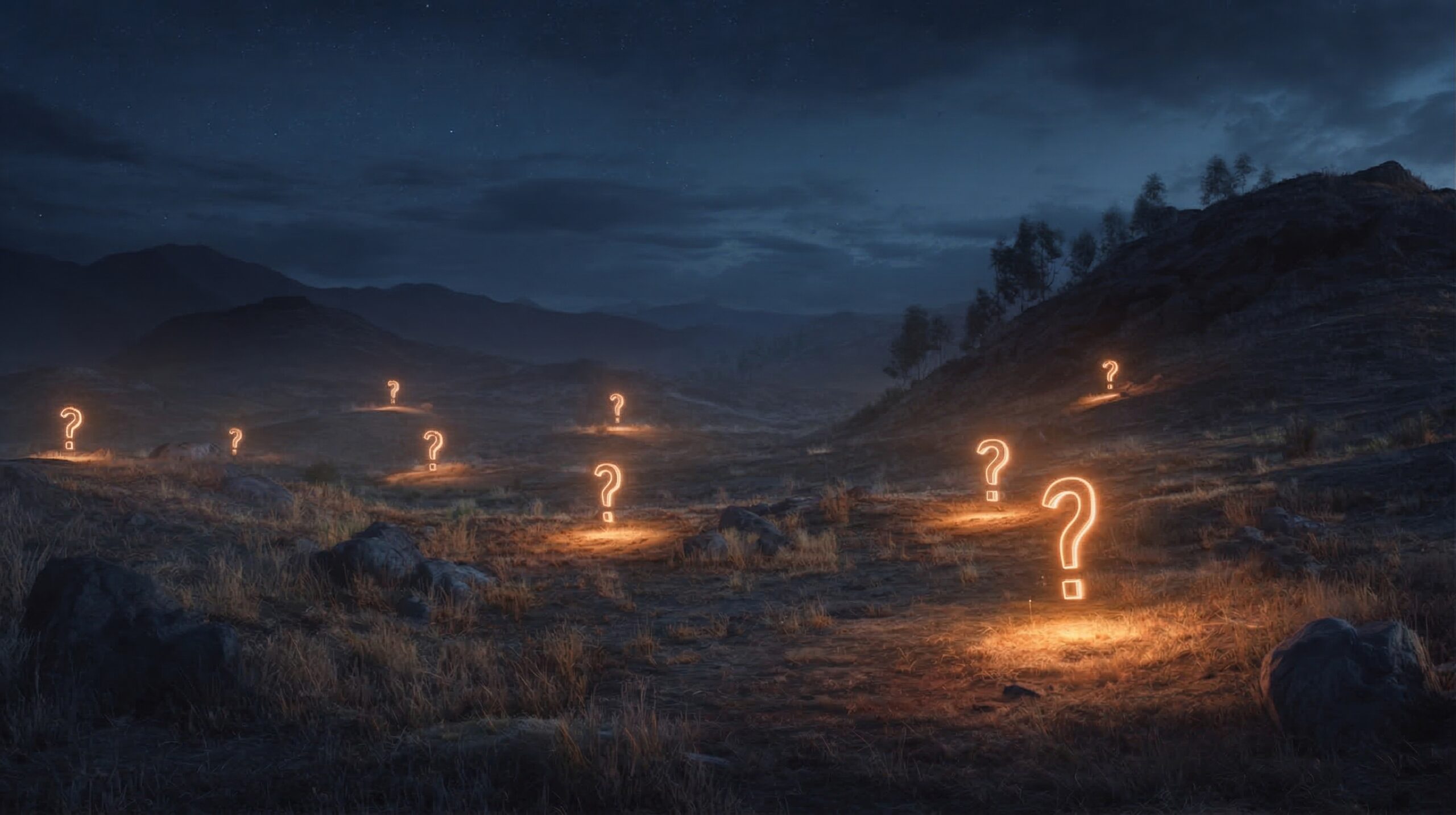
What fears about the future are quietly limiting your ability to act today, and which are actually helping you prepare? Is assigning blame increasing your capacity for meaningful action, or mostly giving shape to your distress? And if your future is going to become more local than you expect, what could you begin to do now with a few people in order to move toward the better end of the distribution?
Show Notes & Links to Learn More
Download transcriptThe TGS team puts together these brief references and show notes for the learning and convenience of our listeners. However, most of the points made in episodes hold more nuance than one link can address, and we encourage you to dig deeper into any of these topics and come to your own informed conclusions.
Today’s Uncomfortable Questions:
- If global supply chains were forced to simplify quickly due to the Strait of Hormuz or other bottlenecks, what are three things you could not do without, or would deeply miss? And what are three things you could reduce the consumption of now, before scarcity, price, or panic makes that choice for you?
- Whose fault do you think the major destabilizing events of the world are right now? And – after giving your answer – how does that answer make you feel? More clear? More helpless? More angry? More morally certain? Does assigning blame increase your capacity for meaningful action, or mostly give some shape to your current distress? Are we searching for blame in order to assign accountability, or to relieve ourselves of responsibility and the resulting agency?
- Would the collapse of the United States as a global power be net positive or net negative for the world? Not morally satisfying for some people in the short immediate run, but materially and systemically over the following decades and beyond? What would fill such a vacuum of power and coordination (and it does always get filled), and why are you confident that it would be “better” than what we have currently?
- Spend a few minutes imagining the town, village, city, or watershed where you live today, and what that might look like in 2050 – less than 25 years from now. What does the best case look like? What does the worst case look like? And what does the likely middle case look like, in your mind? If you take the most likely scenario seriously and backcast from then to now, what are two or three things you, with a few friends, family members, or colleagues, could begin now to slightly move toward better ends of the distribution?
- What fears about the future are quietly limiting your ability to act today? Which of those fears are actually helping you prepare versus merely making you smaller, more frozen, and more reactive?
01:32 – War in Iran causing supply chain disruptions, oil price inflation, and polarization
01:43 – In-group/Out-group
01:51 – Wide Boundary News on March 10, 2026, Wide Boundary News playlist, Wide-boundary perspective
03:18 – Complex supply chain, Globalization
04:02 – Strait of Hormuz
04:35 – Evolutionary psychology behind blame (More info)
04:59 – Frankly #126 | Humanity as Dr. Jekyll & Mr. Hyde: The Symptoms, Patterns, and Drivers
05:35 – Blame’s effects on our nervous system
06:55 – Global economy shift away from U.S. dominance
07:04 – U.S. involvement in wars and regime change, U.S. sanctions and treaty violations, U.S.-caused ecological damage, Hypocrisy of rules-based order
08:45 – Human capacity for abstract, fantastical, and wrong thinking
10:40 – Dune
10:45 – Frankly #61 | The Strait of Hormuz and ‘the Spice’
10:58 – Dune: Litany Against Fear, “Fear is the mind-killer.”