Great simplification pulsing lines

#9 | Frankly

Creatures United

Check out this podcast

Frankly

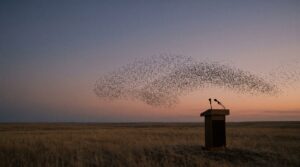
This week’s Frankly is a reflection in response to (and support of) Gerardo Ceballos’ new project Creatures United, launching this week at Stanford University..

The Earth is in the middle of a massive biodiversity and population loss – on the verge of a 6th Mass Extinction. Though most conversations and actions will revolve around the economy, poverty, finance, and geopolitics, the other creatures we share the planet with do not have a voice.

This short video reflection is a reminder that the natural world is a passenger on the human roller coaster ride.  It is my hope that (some, many?) humans can unite on behalf of our fellow creatures to preserve and support the amazing variety of life inhabiting the planet. From the great Blue Whale to the humble bumble bee, each animal is a part of our family – and what makes this planet home.

In French, we have a motto that says that a simple drawing is often better than a long explanation. Jean-Marc Jancovici Carbone 4 President

That’s very understandable because with left atmosphere thinking, one of the problems is that you see everything as a series of problems that must have solutions. Iain McGilchrist Neuroscientist and Philosopher

We can’t have hundreds and hundreds of real relationships that are healthy because that requires time and effort and full attention and awareness of being in real relationship and conversation with the other human. Nate Hagens Director of ISEOF

This is the crux of the whole problem. Individual parts of nature are more valuable than the biocomplexity of nature. Thomas Crowther Founder Restor

Show Notes & Links to Learn More

Download transcript

00:00 – Creatures United

00:23 – Humans are related to every other creature on earth (and percentages)

01:20 – Human driven habitat loss 

01:32 – We take 40% NPP for human systems

01:43 – There are 1.5 million known species of insects

01:50 – Insect ecosystem services

02:10 – We are losing insect biomass at 1-2%/year, faster than other organisms

02:34 – Major causes of insect decline

02:36 – There are 54000 known vertebrate animals

02:48 – We have lost 70% of vertebrate populations since 1970

03:12 – 50% of species were lost in the triassic, and 76% in the cretaceous 

03:47 – There are now 6,000 species of mammals

03:57 – Humans are 36% of global biomass, and livestock is another 60%

04:28 – Birds are descendants of dinosaurs

04:35 – There are 11,000 bird species and domestic poultry are 70% of birds by weight

04:55 – Ecuador has 15% of the world’s bird species, and half of the world hummingbird species

05:37 – There are 32,000 species of fish in the world

05:50 – North Atlantic Fish populations have now hit peak numbers

06:00 – Current ocean biodiversity decline is the greatest since a meteorite strike 65 mya

06:09 – Soon plastic will outweigh fish in the ocean

06:15 – Recent study found that 9% of fish have eaten plastic that blocked digestive tracts

06:38 – Shifting Baselines

06:49 – We are only 1% different in DNA than other primates

06:57 – Biologist continue to find new primate species

07:17 – We add 385,000 new babies to earth everyday, more than the other extant Great Ape populations (this stat is dated – linked are updated numbers)

07:45 – Humans have long encroached on wild nature

08:09 – Evolution designs us to reproduce and consume

08:29 – We are on the verge of a 6th mass extinction

09:40 – Human progress has been dependent on cheap fossil fuels
Back to episodes
Frankly#115 | Inflation, Deflation, & Simplification: The 8 Things That Influence Prices

In this week’s Frankly, Nate explores how the prices we encounter in our daily lives are influenced by not only how much money is in the system, but also by resource depletion, technology, affordability by 'the masses,' and trust within a complex global system.

Watch nowDec 5, 2025
Frankly#114 | Directional Advice for the (More Than) Human Predicament

In this week’s episode, Nate invites listeners into an exploration of what it means to navigate a growing predicament shaped by ecological limits, rapid technological changes, and shifting expectations of reality. Our complex world hosts an immense diversity of human (and non-human) circumstances, which demand responses that are adaptive, not static. Rather than offer misleadingly prescriptive answers, Nate lays out a set of “compass points” that serve to both challenge our assumptions, and to attune our values in the direction of 'better futures than the default.’

Watch nowNov 21, 2025
Frankly#113 | 11 Discoveries That Changed My Worldview

In this episode, Nate weaves personal reflections into an exploration of the human predicament, unpacking a series of chronological insights that have reshaped his worldview. What began years ago as an investigation into oil has morphed into a deep lifelong journey into the complex web of energy, psychology, evolution, and systems that drive today's society. By sharing stories and realizations from his own life, whether it’s the debunking of Wall Street energy illusions or unpacking how sexual selection is often as important a behavioral driver as natural selection, Nate invites listeners to step back and see the human story through a much wider lens.

Watch nowNov 14, 2025

Subscribe to our Substack

The Institute for the Study of Energy and Our Future (ISEOF) is a 501(c)(3) non-profit corporation, founded in 2008, that conducts research and educates the public about energy issues and their impact on society.

Support our work
Get in touch
x