

#143 | Frankly
A Guide to Staying Human (Part 3): The Default Mode Network and the Metacrisis

Description
In this week’s Frankly, Nate offers the third episode in his series on staying human, this time focused on presence. Nate shares a personal reflection on presence, and its importance in a reality where we are constantly living in anticipation of the future. What begins as a missed moment of coffee and a birdsong unfolds into an examination of the brain’s “default mode network” – one of the most studied structures in neuroscience, which supports functions like memory, future simulation, self-narrative, and wandering thought. Drawing from neuroscience, contemplative traditions, and his own decades spent modeling civilizational risk, Nate examines how the modern world – especially for those immersed in the metacrisis – pulls attention away from lived experience and into endless internal simulations about collapse, uncertainty, and what comes next.
He also reflects on the emotional burden carried by people who are deeply aware of ecological decline, social instability, and systemic fragility, while questioning the widely held assumption that constant preoccupation is equivalent to care. Through stories, research, and practical reflections, Nate offers five pathways back to embodied awareness through using sensory attention, taking pause, single-tasking, remaining open to beauty, and embracing the finitude of life itself. Ultimately, this episode asks whether protecting the future requires us to stop abandoning the present – and whether presence itself may be one of the most necessary forms of resilience in the years ahead.
How does the brain’s default mode network shape our experience of dread, distraction, and time? What do we lose when awareness of the metacrisis becomes a form of absence from our own lives? And how can people engaged in difficult, world-facing work use strategies to remain emotionally present for the relationships and moments directly in front of them?
Show Notes & Links to Learn More
Download transcriptThe TGS team puts together these brief references and show notes for the learning and convenience of our listeners. However, most of the points made in episodes hold more nuance than one link can address, and we encourage you to dig deeper into any of these topics and come to your own informed conclusions.
00:00 – A Guide to Staying Human series, Essay version of this Frankly
Resources:
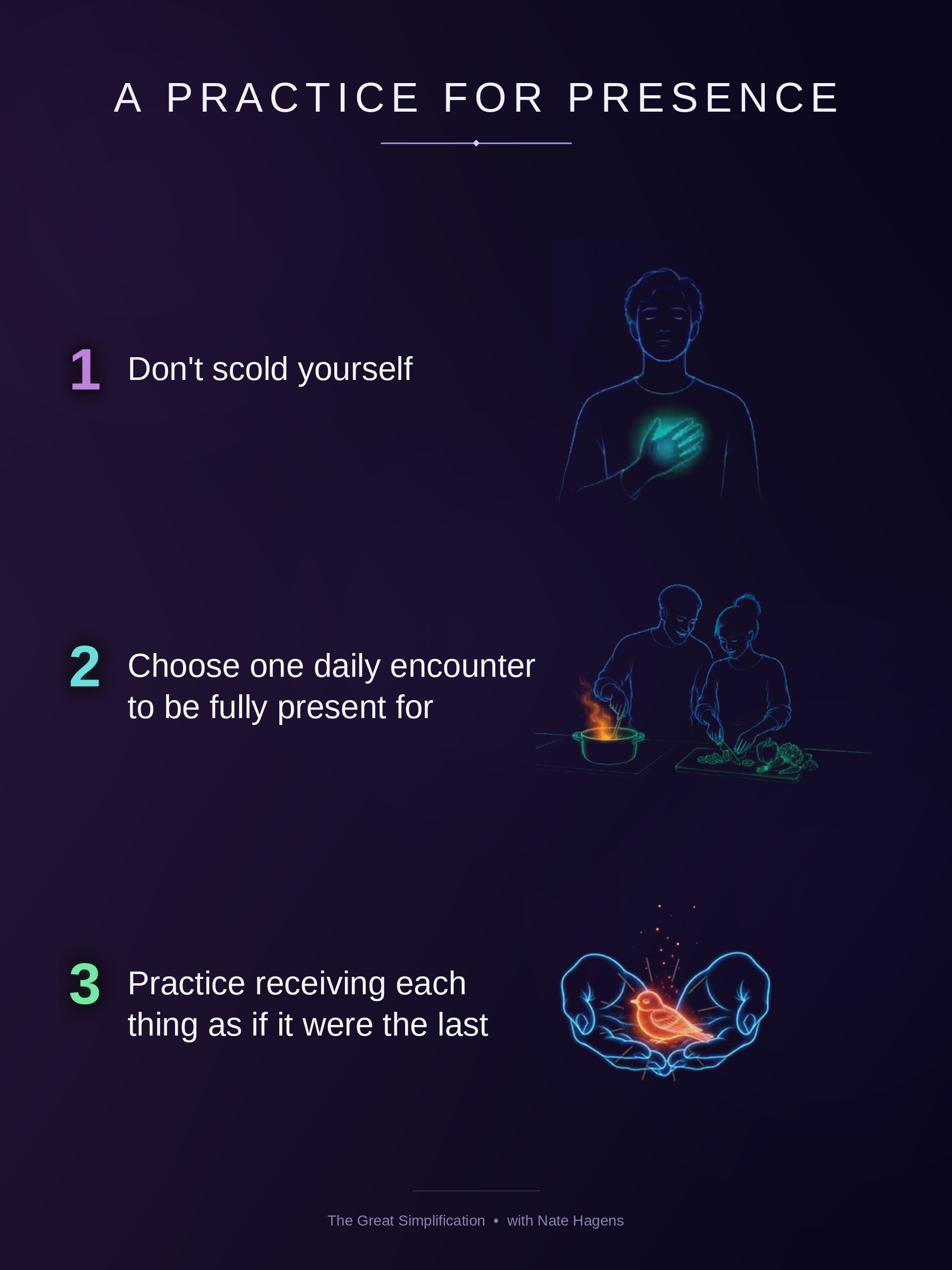
- A Practical Guide for Practicing Presence (Nate’s suggestions from this video)
- Checking in with the senses
- Pausing between the impulse and action
- Single-tasking
- Contemplation, Tree of contemplative practices
00:53 – Recent pressures on diesel market, Reporting on Toyota’s internal bulletin warning of motor oil shortages
01:20 – Challenges of fully present in the now, Strategies for presence
03:35 – More-than-human predicament (Metacrisis)
03:42 – Referenced study: A wandering mind is an unhappy mind, Study’s website/app: Track Your Happiness
05:00 – Referenced study: A default mode of brain function
05:30 – Default Mode Network (DMN)
05:55 – Taylor Guthrie, TGS Episode on Default Mode Network
06:00 – In-video image source
06:05 – Prefrontal cortex, Hippocampus, Neuroanatomy of the default mode network
06:19 – Self-referential processing, Theory of mind, Spontaneous thought, Mental time travel
07:10 – Hippocampus role in memory and future thinking, Damage to hippocampus inhibits ability to think about the future, Recent debate about role of hippocampus in future thinking
08:03 – Self-narrative gives life coherence, Theory of mind is the foundation of human cooperation
08:23 – An evolutionary gap in primate default mode network organization
08:45 – Chronic dominance of the DMN due to stress
09:00 – Task Positive Network (TPN)
09:15 – Relationship between DMN and TPN (anticorrelated)
09:38 – Attention economy
09:55 – Chronic DMN dominance leads to: Reduced grey matter in hippocampus, Increased rates of anxiety and depression, Diminished sensory processing
11:43 – “Shower thoughts” and creativity
12:14 – Time seems to accelerate as we age, Increase of DMN dominance with age, Children spend more time in TPN
14:35 – Psychological importance of feeling seen, Social isolation
16:45 – Effects of an absent parent
17:00 – DMN and inner time consciousness
18:30 – Some fertilizers up ~50% in cost
21:50 – Checking in with the senses and therefore reducing worry, Somatic attention
22:05 – Contemplation, Tree of contemplative practices
22:20 – Thich Nhat Hanh: Drink the tea, wash the dish, walk the path
22:45 – Pausing between the impulse and action
23:22 – Supernormal stimuli
24:05 – Single-tasking, Myth of multi-tasking
25:04 – Iain McGilchrist, Recent TGS episode on beauty, Other TGS Episodes: #165, #85
27:03 – Increasing risk of human-caused extinction of various species
27:07 – Forest fires are getting worse
27:10 – Institutions on the brink of collapsing including colleges
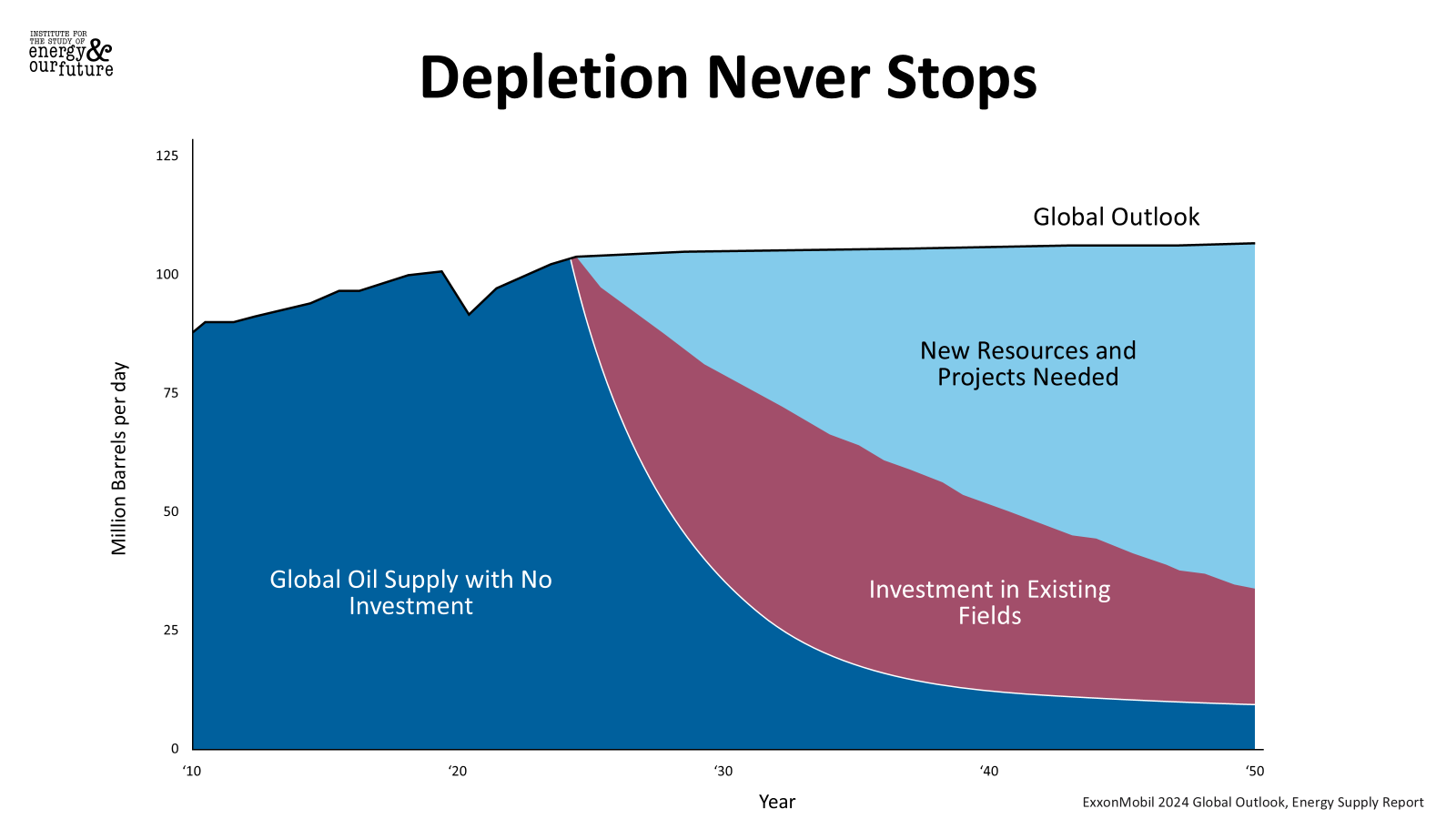
27:15 – Carbon Pulse (Possible future shapes of the Carbon Pulse), Fossil fuel depletion (IEA report on such), In-video graphic source
28:43 – Christian contemplative tradition, The Sacrament of the Present Moment by Jean Pierre de Caussade
29:25 – The Great Simplification
30:20 – A Practical Guide for Practicing Presence (Nate’s suggestions from this video)





: The Default Mode Network and the Metacrisis&p[url]=https://www.thegreatsimplification.com/frankly-original/143-a-guide-to-staying-human-part-3&p[images[0]=https://www.thegreatsimplification.com/wp-content/uploads/2026/05/Frankly-143-Podcast-Thumbnail-BG-scaled.jpeg)