Ep 140 | Jeffrey Sachs
Jeffrey Sachs: “U.S. Full Spectrum Dominance: Nuclear Risks and The End of Empire”
Show Summary
As the United States continues to play a major role in the conflict between Russia and Ukraine, the risk of a direct engagement, possibly leading to a nuclear exchange, may now be higher than ever.
In this episode, Nate is joined by Professor Jeffrey Sachs to discuss the escalating tensions between the United States and other world powers – and whether there are possible avenues towards a more peaceful world order.
Has the U.S. taken on the characteristics of an imperial state – under the pretenses of security at all costs? As the world continues to become more globalized, how should we change the way we govern within and across borders? Is it possible to transition from foreign policies focused on dominance and control to those emphasizing interconnectedness and the sovereignty of all nations?
About Jeffrey Sachs
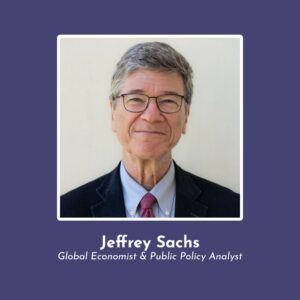
Jeffrey Sachs is widely recognized for promoting bold and effective strategies to address complex challenges including the escape from extreme poverty, climate change, international debt and financial crises, national economic reforms, and the control of pandemic and epidemic diseases.
Sachs serves as the Director of the Center for Sustainable Development at Columbia University, and was also Director of the Earth Institute there from 2002 to 2016. He is President of the UN Sustainable Development Solutions Network and Co-Chair of the Council of Engineers for the Energy Transition, Commissioner of the UN Broadband Commission for Development.
Based on his success in advising Poland’s anti-communist Solidarity movement away from central planning, he was invited first by Soviet President Mikhail Gorbachev and then by Russian President Boris Yeltsin to advise on the transition to a market economy.
He spent over twenty years as a professor at Harvard University, where he received his B.A., M.A., and Ph.D. degrees.
Show Notes & Links to Learn More
Download transcript00:00 – Jeffrey Sachs work + info, Center for Sustainable Development, UN Sustainable Development Solutions Network,
01:30 – Frankly on Nuclear Conflict
02:20 – Mikhail Gorbachev, Boris Yeltsin
04:35 – Noam Chomsky
07:35 – Biden’s willingness to negotiate in Gaza
07:42 – Interview with Tucker Carlson
07:56 – Casualties in Ukraine
08:50 – Nazi scientists employed by US: Operation Paperclip
09:15 – US-Soviet Alliance during WW2, Soviet casualties WW2
09:30 – US foreign policy towards the Soviet Union after the death of Roosevelt
09:53 – The end of the Cold War, Gorbachev: Glasnost and Perestroika
10:55 – US hegemony in World Politics
11:16 – Global US military deployment over last 70 years: infographics + data source, expansion of NATO over time
11:35 – US promises against NATO expansion
12:50 – Monroe Doctrine
13:45 – US missile site in Poland
14:05 – Kosovo war and NATO intervention, February 2014 Ukrainian coup
16:35 – US Defense Department: Full Spectrum Dominance
17:45 – Kant’s Categorical Imperative
18:35 – US military interventions since 1991: infographics + data source
19:10 – Annie Jacobsen, Nuclear War: A Scenario
22:15 – Winston Churchill on world governance
23:50 – Hitler’s ‘Lebensraum’, Thomas Malthus, Charles Darwin and Malthus
24:45- Malthus’ essay on the Principle of Population, relationship between fertility and wealth
25:10 – World population projections
26:00 – Albert Einstein on nuclear war
26:15 – John F. Kennedy’s 1963 Peace Speech
27:45 – Subsidiarity + subsidiarity in the EU
28:55 – International cooperation is needed for decarbonisation
29:45 – Nuclear Non-Proliferation Treaty
30:45 – US refusal to ratify international treaties
31:15 – Doomsday clock
33:05 – Healthcare costs twice as much in the US as it does in Canada
37:25 – 1947 National Security Act
37:40 – Daniel Ellsberg, the Pentagon Papers
38:15 – Cognitive Dissonance
39:00 – Russia has **5,580 nuclear warheads
40:30 – U.S. covert regime change operations
42:10 – Revenue of military corporations
46:15 – Value of US government military contracts 2023, US military budget 2024, the cost of war
47:12 – The average american consumes >200,000 kcals of energy per day