Ep 141 | Stefan Rahmstorf
Stefan Rahmstorf: “Global Heating 101: Rapid-Fire Answers to the Biggest Climate Questions”
Show Summary
The science surrounding our planet’s dynamic and complex climate can be difficult to understand, and perhaps even more challenging to decipher what the actual realities and trajectories are among so much media coverage. Yet the study of Earth’s systems has been ongoing for decades, with a majority of scientists reaching a consensus on the realities of human-driven global heating.
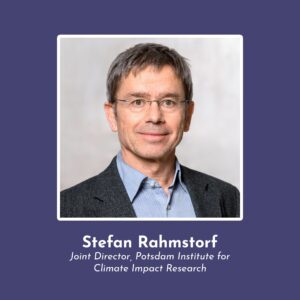
In this episode, ocean and climate physicist Stefan Rahmstorf joins Nate for an overview on the most common questions and misconceptions concerning the state of the climate, including the nuances of what our future planetary home might look like.
How can carbon dioxide – which makes up such a small percentage of the atmosphere – have such a large effect on the temperature of the whole planet? Why does warming have such huge ripple effects across the biosphere – from ocean currents and wind patterns to extreme weather and wildfires? What do projections for the future tell us about the survivability of some of Earth’s most populated regions – and how can communities and nations prepare and mitigate these challenges amid many other converging crises we face?
About Stefan Rahmstorf
Stefan Rahmstorf is Co-Head of the Research Department on Earth System Analysis of the Potsdam Institute for Climate Impact Research (PIK) and Professor of Ocean Physics at the University of Potsdam. His research focuses on paleoclimate, ocean circulation, sea level, extreme weather events and Earth System modeling.
After working at the New Zealand Oceanographic Institute and the Institute of Marine Science in Kiel, Stefan Rahmstorf joined PIK in 1996. From 2004 to 2013 Stefan Rahmstorf advised the German government as a member of its Advisory Council on Global Change (WBGU). He is not only an outstanding and highly cited scientist but also a sought-after science communicator and speaker, winning the Climate Communication Prize of the American Geophysical Union in 2017.
Show Notes & Links to Learn More
Download transcript00:00 – Stefan Rahmstorf works + info, Potsdam Institute for Climate Impact Research, book chapter: Climate and Weather at 3 Degrees More
00:32 – Climate week NYC
02:30 – Stefan Rahmstorf’s Twitter
04:15 – Physical Oceanography
04:53 – Most of Earth’s liveable habitat is in the oceans
05:56 – 71% of the Earth’s surface is covered by oceans
07:15 – Current CO2 level in the atmosphere is the highest in: at least 3 million years / 15 million years, 22nd July 2024 was the hottest day ever recorded on Earth, Eemian Interglacial
07:50 – Eemian interglacial reconstructed from ice cores, Paleoclimatology data
08:10 – The Holocene
09:35 – Atmospheric carbon dioxide data, ink in water comparison, atmospheric CO2 and global heating, total amount vs concentration of CO2 in the atmosphere
13:00 – Joseph Fourier, Fourier on the greenhouse effect
13:20 – Svante Arrhenius, Arrhenius’ paper on CO2 concentration and temperature change
14:06 – ExxonMobil scientists’ accurate climate projections 1977-2003, ExxonMobil’s climate denial
15:05 – World Radiation Center, solar activity has not gone up in the past *40+years
15:40 – Orbital cycles, current warming is 10 times faster than changes caused by orbital cycles, CLIMBER-2 climate model
16:20 – Milutin Milankovich, Milankovitch cycles
16:46 – Next orbital ice age would be due in 50,000 years
17:40 – Humans are emitting much more CO2 than the world’s volcanoes, volcanic eruptions have a cooling effect, Mount Pinatubo eruption, Hunga Tonga eruption
18:34 – Net Primary Productivity
19:35 – Global heating and sea level rise Page 15
20:13 – Population threatened by sea level rise, nuclear power plants threatened by global heating, sensitivity of agriculture to climate change
21:07 – Agricultural profile of Bangladesh, saltwater intrusion impacts in small island nations, Image: Bangladesh sea level rise risks Figure 4
22:45 – IPCC 1990 report
24:30 – James Hansen, 1988 congressional testimony
26:50 – Alternative for Germany (AfD)
28:46 – Distribution of CO2 emissions
30:47 – Book chapter: Climate and Weather at 3 Degrees More
32:00 – Temperature change graphic: State of the Planet pdf Slide 5
33:10 – Hurricane Sandy
37:50 – Study on human heat tolerance
38:53 – 2003 European heatwave, refrigerated tents in Paris, 70,000 heat fatalities, heat mortality graphic: State of the Planet pdf Slide 15
39:55 – Drought graphic: State of the Planet pdf Slide 18, California wildfires
40:42 – Clausius-Clapeyron law, rainfall distribution graphic: human-induced changes in the distribution of rainfall Figure 1, increasing rainfall extremes
41:10 – Projected flooding graphic: projections of United States high-tide flooding Figure 1, flooding in Germany, global flooding events
43:20 – Relative humidity, atmospheric moisture increases by 7% per degree celsius of warming, relative humidity and health impacts
44:42 – Wet bulb temperature, wet bulb temperatures above 35 degrees celsius are life threatening
46:50 – Study and graphic: future of the human climate niche Figure 4, heat stress risk to humans due to climate change, Hurricane Katrina, total emigration from New Orleans
47:45 – Drought and harvest failures, impact of extreme weather on crop yields in Germany, environmental migration forecasts
50:48 – Distribution of CO2 emissions in vegetation, oceans and atmosphere
52:10 – Global forest fires are getting worse, bark beetle infestations caused by drought, biomass decline in the Amazon, amplifying feedbacks at the end of the last ice age
54:40 – Tipping points in the Amazon, Carlos Nobre
56:35 – Climate projections since the Paris Agreement, Climate Action Tracker
59:58 – Thermal inertia in oceans, the role of oceans as carbon sinks, warming stops when we stop emissions
1:04:04 – We must halve emissions by 2030 to keep under 1.5 degrees warming
1:05:08 – Amplifying feedback loops and planetary thresholds
1:06:45 – Periods of history with higher temperatures and CO2 levels
1:07:10 – Tipping points: West Antarctic ice sheet + Greenland ice sheet
1:08:29 – Levke Cesar, TGS Episode
1:08:50 – The Atlantic Meridional Overturning Circulation (AMOC), article: is the AMOC approaching a tipping point?
1:12:10 – Heat storage in oceans, net energy uptake of the Earth system, heat capacity of the ocean vs the air
1:15:00 – The biological pump
1:15:51 – Ocean deoxygenation + more info
1:16:00 – Daniel Pauly, TGS Episode, gill oxygen limitation theory
1:16:22 – Matthias Hofmann, oxygen holes and marine ecosystems
1:19:37 – Potsdam Institute research on planetary boundaries
1:21:05 – Detection of microplastics in the human penis
1:21:44 – Ocean acidification
1:23:50 – IPCC on long-term consequences of current climate decisions B.5
1:26:24 – IPCC projected sea level rise
1:29:00 – Distribution of CO2 emissions by country, China leading deployment of renewable energy, China’s emissions could peak in 2024
1:30:08 – Johan Rockström, TGS Episode
1:31:58 – Deep Sea Biology Symposium, Convention on Biological Diversity
1:34:22 – EU nature restoration law