Ep 221 | Andrew Holecek
Darkness Deficit Disorder: How Constant Stimulation Has Shaped our Consumption
Description
Most responses to civilizational crises focus outward – policy levers, energy systems, geopolitical actors, and material flows – with little focus on how the humans inside these systems might change and grow in parallel. At the same time, the minds that built this complex and fragile world are also the instruments we must use to navigate its unraveling, making them a critical factor in defining humanity’s future. With that said, who will we be as simplification unfolds, and how do we prepare our inner terrains for what’s coming?
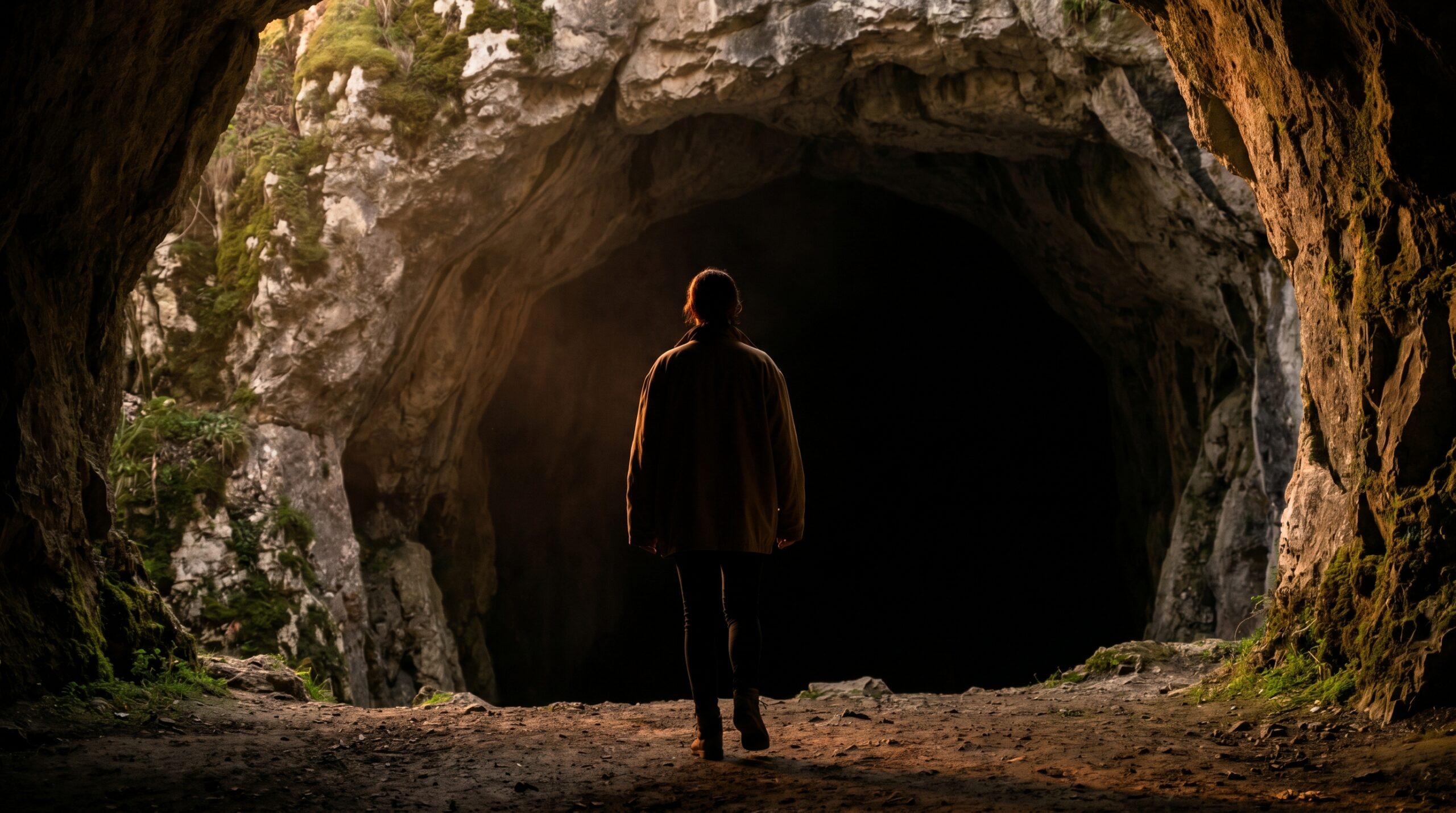
In this episode, Nate is joined by meditation practitioner, Andrew Holecek, for an exploration of the concept of dark retreats, periods of extended time in complete absence of light, as a practical path toward reflection and reconnection with ourselves and others. Andrew draws on decades of study in Tibetan Buddhism and non-dual wisdom traditions to explore how the external complexity of modern life is mirrored in the internal complexity of the modern mind. Central to his work is the concept of non-duality: a return from the fragmented display of self-versus-world toward a more unified, less suffering-prone relationship with reality. Andrew and Nate also explore the misleading entanglement of happiness and consumption, arguing that satisfaction arises not from acquiring what we want, but from the cessation of wanting itself.
What would it mean to practice darkness as a needed reprieve from constant light and stimulation, rather than deprivation? If the coming decades hold a forced reduction in external, material complexity, how could a deepening of our internal worlds make us more resilient, compassionate, and grounded? And could confronting fear – by learning to move through it rather than avoid it – be one of the most practical preparations for navigating future uncertainty and social fracture?
About Dr. Andrew Holecek
Andrew Holecek is an interdisciplinary scholar-practitioner in Tibetan Buddhism and other nondual wisdom traditions who has spent over thirty years helping people transform life’s greatest challenges into opportunities for awakening. A dedicated meditation practitioner who completed the traditional Tibetan Buddhist three-year retreat, Andrew is known for making profound contemplative practices accessible and practical.
He is actively involved in scientific research on dark retreat with the University of Wisconsin-Madison, as well as the Institute for Advanced Consciousness Studies where he serves as Resident Contemplative Scholar. Andrew is a member of the American Academy of Sleep Medicine, the author of several scientific papers on lucid dreaming, and was also the host of the now-concluded Edge of Mind podcast, where he interviewed guests to explore ancient teachings and modern topics about the nature of mind and reality.
Andrew’s newest area of focus is dark retreat, the ancient Buddhist practice of extended meditation in complete darkness. His most recent book, Total Eclipse of the Mind: Unleashing the Power of Darkness for Creativity, Healing, and Transformation, draws on more than thirty years of personal dark retreat experience. True to his approach, Andrew teaches dark retreat – and the more accessible gray retreat practice of weaving in and out of darkness – as a genuine path to healing, creativity, and self-understanding.
Show Notes & Links to Learn More
Download transcriptThe TGS team puts together these brief references and show notes for the learning and convenience of our listeners. However, most of the points made in episodes hold more nuance than one link can address, and we encourage you to dig deeper into any of these topics and come to your own informed conclusions.
00:00 – Andrew Holecek, Books, Dark Retreat,
- Andrew’s newest book published May 2026: Total Eclipse of the Mind: Unleashing the Power of Darkness for Creativity, Healing, and Transformation
Other Resources:
- Blackout meditation masks for dark retreat at home: Mindfold, Manta, Myhalos
- Dark retreat recommendations:
02:00 – “Darkness Deficiency Disorder”
03:47 – Nate’s work: Biophysical macroeconomics (More info)
04:22 – Tibetan Buddhism, Nondual wisdom traditions
04:37 – Lucid dreaming, Meditation in darkness
04:52 – John Archibald Wheeler: ”The universe doesn’t exist ‘out there’.”
05:07 – Space, time, and causality as constructs
06:07 – Nonduality and the root of suffering
06:47 – Dualism in non-human great apes
07:07 – A-duality (pre-personal) vs. Non-duality (transpersonal)
07:27 – Phylogenetic, Ontogenetic
07:32 – Metacognition
08:27 – Rosicrucian “veil of forgetfulness”
08:35 – Alfred North Whitehead: “Western philosophy but footnotes to Plato”
08:42 – Anamnesis: the path of remembrance
09:17 – Tibetan teachings on primordial trauma and source of forgetfulness: Andrew’s riffs on The 12 Nindanas & Bardos
10:10 – Money as representation of energy, Social status by shows of conspicuous consumption
11:17 – Hermetic principle: As above, so below
11:37 – Universality and self-similarity in chaos and complexity theory
11:40 – Recursive reality hypothesis
12:17 – Reciprocal hermeneutic
12:47 – Whitehead and evolutionary metaphysics
13:37 – Spinoza – Einstein’s favorite philosopher
13:47 – Dual aspect monism
14:37 – Samsara
14:47 – William Blake and double vision
16:02 – Joseph Tainter’s The Collapse of Complex Societies – Tainter on The Great Simplification podcast, Solving problems by adding complexity is a dead end
16:47 – Gandhi
17:47 – Hungry ghosts and consumerism
17:52 – Dopamine reward loop of clicking and buying, The wanting is stronger than the having
18:42 – Frankly #123: The Consumption Pyramid
19:02 – More happiness once you stop wanting
19:50 – How to stop “the wanting”
20:02 – Cessation and negation in wisdom traditions: Nirvana, Nirodha, Nirguna, Nisprapancha, Nirvikalpa
21:00 – Dark Retreat
21:27 – Sylvia Boorstein: Happiness Is an Inside Job
22:02 – Nondual maxim: hiding in plain sight
23:50 – Theories of conscious evolution
24:22 – Ken Wilber: Sex, Ecology, Spirituality: The Spirit of Evolution
25:15 – AI and consciousness
25:32 – Loss of depth, authenticity, intimacy, and connectivity
27:25 – Light pollution, Light pollution map
27:37 – Kali Yuga: the Hindu Dark Age
28:17 – Light pollution increasing roughly 9-10% per year – satellite vs. ground
28:47 – Sleep hygiene, Blue light and melatonin suppression
30:17 – Enantiodromia
31:02 – The Metacrisis
32:22 – Meister Eckhart on subtraction over addition
32:37 – Anna Lembke on dopamine (The Great Simplification appearance)
33:20 – Scientific study on effectiveness of dark retreats
35:00 – Addiction withdrawal
35:30 – Sky Cave Retreats with Scott Berman in Oregon
35:35 – Caves are viewed as feminine
36:47 – Big Bang
37:07 – Blackout meditation masks: Mindfold, Manta, Myhalos
38:00 – Gray retreat
39:42 – Mantak Chia
42:30 – Yin-Yang and its relation to dark and light
43:07 – Heraclitus
43:27 – Carl Jung and Greek wisdom traditions
43:45 – Take something to its extreme and it flips into its opposite
44:27 – Pratyahara: yogic sense withdrawal
44:50 – Tomb transforms into “a womb with a view”
46:05 – Rangbop: mind falling into itself
46:27 – Archeology of the unconscious
48:07 – Mahamudra meditation
49:17 – Dark retreat as preparation for death in Tibetan Buddhism
50:12 – Rudy Gobert: “Dark retreat is meditation times 1000”
50:47 – Chögyam Trungpa Rinpoche: “Meditation isn’t a sedative, it’s a laxative”
51:20 – Etymology of psychedelic: “mind-manifesting”
51:57 – Estimates that ~95% of behavior is driven by the unconscious
52:07 – Jung’s process of individuation
52:52 – T.S. Eliot: “Humankind cannot bear very much reality”
53:05 – Dangers of mindfulness practices if you aren’t “ready”
53:47 – Tenzin Wangyal Rinpoche
54:20 – Science behind dark retreats
54:52 – Karl Friston, Active inference and the free energy principle
55:25 – Dark retreat recommendations:
- Sky Cave Retreats with Scott Berman in Oregon
- The Power of Dark Retreat (Drala Mountain Center)
- Dark Retreat Center Map (not comprehensive)
58:32 – Tibetan word “gom” – to become familiar with
1:02:07 – Total Eclipse of the Mind by Andrew Holecek
1:02:15 – Ego (self-concept)
1:02:47 – Eckhart Tolle: “Ego as exclusive identification with form”
1:03:50 – Transcending ego as part of human evolution, Ego-development theory
1:04:05 – Hegelian transcend-and-include
1:04:40 – Non-human primates with ego?, Mirror self-recognition test
1:05:22 – Some primate species do* have some metacognitive traits
1:05:37 – Frontal cortex in humans vs. other primates
1:07:12 – Echolocation
1:08:37 – Ego as contraction onto form
1:09:57 – Pema Chödrön: “Ego is just a funny way of looking at things”
1:10:07 – Ego death vs. ego transcendence
1:11:15 – Contraindications to dark retreat: Some medical issues, Dissociative/psychotic issues, Potential dangers with mindfulness practices
1:12:12 – Nyctophobia (fear of the dark) and evolutionary origins
1:13:12 – Joseph Campbell
1:13:32 – Pema Chödrön on facing fear
1:15:07 – Meditation as habituation to openness
1:15:27 – Fight, flight, freeze, fawn response
1:15:52 – Rumi: “widening rings of being”
1:16:17 – Nate’s work on how psychological biases might hinder us in a world with less
1:17:37 – Temple of Apollo at Delphi: “Know thyself”
1:18:57 – Fear as the basis of political and marketing messaging
1:20:07 – Mindfulness can reduce impulsivity
1:23:02 – Nisargadatta Maharaj: “Wisdom tells me I am nothing, love tells me I am everything”
1:23:37 – Ramana Maharshi: “What others?”
1:25:37 – Socrates: “The unexamined life is not worth living”
1:27:47 – Timothy Leary
1:28:02 – The Maharishi Effect
1:28:13 – Richard Davidson, Center for Healthy Minds at the University of Wisconsin-Madison
1:28:47 – Iain McGilchrist (The Great Simplification Episodes: #217, #165, #85)
1:28:52 – Aldous Huxley‘s “Mind at Large”
1:29:02 – Bodhisattva ideal
1:29:27 – Rupert Sheldrake
1:33:01 – Upcoming research on darkness retreat for youth led by Dr. Charles Raison
1:34:12 – The Buddha on the alleviation of suffering
1:36:22 – Near-death experience
1:36:32 – Lucid dream, Cognitive neuroscience of lucid dreams