Ep 146 | Bill Plotkin
Bill Plotkin: “Ecological Awakening: A Path Toward Holistic Adulthood”
Show Summary
Where have all the elders gone? As the world grapples with its unfolding economic and energy crises, it can often feel like we lack capable guides to help our societies navigate these transitions. How can we cultivate ourselves as individuals to become balanced, true adults who are fully equipped to contribute to our communities, the planet, and the massive changes ahead?
In this episode, Nate is joined by eco-depth psychologist Bill Plotkin to explore the profound themes of human development, the urgent need for ecological awakening, and the importance of art and nature in navigating the crises of modern society. Plotkin also outlines his eight stages of eco-centric human development to foster a healthier future for humanity and the planet.
What circumstances have led to generations of individuals stuck in psychological adolescence? What role does the concept of the soul play in shaping our life purpose? How do we implement a cultural regeneration that aligns with the natural world and the stages of human development, ultimately helping us prioritize the health of the planet, people, and all species?
About Bill Plotkin
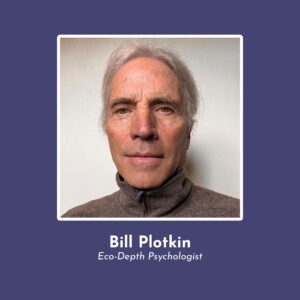
Bill Plotkin, PhD, is an eco-depth psychologist, wilderness guide, and agent of cultural regeneration. As founder of southwest Colorado’s Animas Valley Institute, he has, since 1980, guided thousands of people on the journey of soul initiation and is the training director of the Soulcraft Apprenticeship and Initiation Program. He’s also been a research psychologist (studying non-ordinary states of consciousness), rock musician, and white-water river guide.
In 1979, on a solo winter ascent of an Adirondack peak, Bill experienced a “call to spiritual adventure,” leading him to abandon academia in search of his true calling. He is the author of Soulcraft: Crossing into the Mysteries of Nature and Psyche (an experiential guidebook), Nature and the Human Soul: Cultivating Wholeness and Community in a Fragmented World (a nature-based stage model of human development), Wild Mind: A Field Guide to the Human Psyche (a nature-based map of the psyche), and The Journey of Soul Initiation: A Field Guide for Visionaries, Evolutionaries, and Revolutionaries (a guidebook for the descent to soul). His doctorate in psychology is from the University of Colorado at Boulder. Visit him online at www.animas.org.
Show Notes & Links to Learn More
Download transcript00:00 – Bill Plotkin info + works, Animas Valley Institute, Soulcraft Apprenticeship & Initiation Program, book: Nature and the Human Soul
All images are provided by the Animas Valley Institute and can be found here.
04:15 – David Whyte, ‘All the True Vows’ poem
12:58 – Parasympathetic Nervous System
14:48 – Samantha Sweetwater + TGS Episode, Joanna Macy
18:35 – Ecocentric/Soulcentric stages of human development
31:13 – Thomas Berry, The Dream of the Earth
33:45 – Riane Eisler + TGS Episode, Partnership societies
34:47 – Malidoma Somé, Dagara people
35:18 – Martín Prechtel, Maya people
35:46 – Gregory Cajete, Look to the Mountain
37:00 – Immersions + Training Programs
40:00 – Eco-Awakening
44:02 – Ecopsychology + Depth Psychology
45:22 – The unconscious mind
46:14 – Defining ‘Soul’
46:30 – Stephen Harrod Buhner
48:31 – Ecological Niche
55:15 – The Carbon Pulse
1:0:44 – Joseph Campbell, The Hero’s Journey
1:02:11 – Deep Time
1:03:00 – Ishmael
1:03:05 – The Parable of the Tribes, Andrew Schmookler
1:03:10 – Paul Shepard + books
1:14:13 – Vanessa Andreotti + TGS Episode, Hospicing Modernity
1:16:19 – Dimensions of the Great Turning
1:16:46 – Bottlenecks of the 21st Century
1:18:49 – Wild Mind, Soulcraft
1:20:01 – The Journey of Soul Initiation
1:20:29 – Nature Connection
1:31:18 – Richard Schwartz, Internal Family Systems
1:32:40 – Wild Mind training
1:33:37 – Forest schools