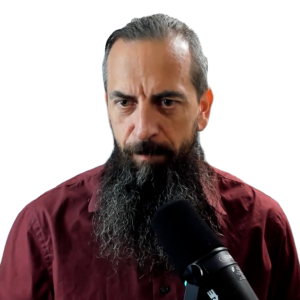
Ep 212 | John Cook
How to Inoculate Against Misinformation: Breaking Down Misleading Arguments & Why Science Communication Fails

Humans aren’t rational. We don’t evaluate facts objectively; instead, we interpret them through our biases, experiences, and backgrounds. What’s more, we’re psychologically motivated to reject or distort information that threatens our identity or worldview – even if it’s scientifically valid. Add to that our modern media landscape where everyone has a different source of “truth” for world events, our ability to understand what is actually true is weaker than ever. How, then, can we combat misinformation when simply presenting the facts is no longer enough – and may even backfire?
In this episode, Nate is joined by John Cook, a researcher who has spent nearly two decades studying science communication and the psychology of misinformation. John shares his journey from creating the education website Skeptical Science in 2007 to his shocking discovery that his well-intentioned debunking efforts might have been counterproductive. He also discusses the “FLICC” framework – a set of five techniques (Fake experts, Logical fallacies, Impossible expectations, Cherry picking, and Conspiracy theories) that cut across all forms of misinformation, from the denial of global heating to vaccine hesitancy, and more. Additionally, John’s research reveals a counterintuitive truth: our tribal identities matter more than our political beliefs in determining what science we accept – yet our aversion to being tricked is bipartisan.
When it comes to reaching a shared understanding of the world, why does every conversation matter – regardless of whether it ends in agreement? When attacks on science have shifted from denying findings to attacking solutions and scientists themselves, are we fighting yesterday’s battle with outdated communication strategies? And while we can’t eliminate motivated reasoning (to which we’re all susceptible), how can we work around it by teaching people to recognize how they’re being misled, rather than just telling them what to believe?
About John Cook
John Cook is a Senior Research Fellow at the Melbourne Centre for Behaviour Change at the University of Melbourne. He is also affiliated with the Center for Climate Change Communication as adjunct faculty. In 2007, he founded Skeptical Science, a website which won the 2011 Australian Museum Eureka Prize for the Advancement of Climate Change Knowledge and 2016 Friend of the Planet Award from the National Center for Science Education. John also created the game Cranky Uncle, combining critical thinking, cartoons, and gamification to build resilience against misinformation, and has worked with organizations such as Facebook, NASA, and UNICEF to develop evidence-based responses to misinformation.
John co-authored the college textbooks Climate Change: Examining the Facts with Weber State University professor Daniel Bedford. He was also a coauthor of the textbook Climate Change Science: A Modern Synthesis and the book Climate Change Denial: Heads in the Sand. Additionally, in 2013, he published a paper analyzing the scientific consensus on climate change that has been highlighted by President Obama and UK Prime Minister David Cameron. He also developed a Massive Open Online Course in 2015 at the University of Queensland on climate science denial, that has received over 40,000 enrollments.
Show Notes & Links to Learn More
Download transcriptThe TGS team puts together these brief references and show notes for the learning and convenience of our listeners. However, most of the points made in episodes hold more nuance than one link can address, and we encourage you to dig deeper into any of these topics and come to your own informed conclusions.
00:00 – John Cook, Works, Curriculum Vitae, Melbourne Center
- Skeptical Science
- Misinformation Game: Cranky Uncle
- The Debunking Handbook
- Five Techniques of Denial (FLICC)
01:25 – Gamification
02:20 – Science communication
03:15 – Science behind global heating, Global heating since 1880, A 485-million-year history of Earth’s surface temperature
04:07 – Backfire effect
05:27 – Motivated reasoning
06:50 – Information deficit model
09:00 – Study that communicated global heating in 2 different ways based on political solution
10:40 – Communicating a problem without solutions can be ineffective
12:20 – Cognitive bias – Nate’s work on cognitive bias, Cognitive biases and global heating
14:25 – John Cook’s PhD study – Closing the “consensus gap”
14:45 – Growing polarization through misinformation
15:20 – Old cigarette ads with doctor’s smoking
16:30 – Humans don’t like to be tricked or misled
17:30 – History of the five techniques of science denial
18:10 – Five techniques of denial (FLICC):
19:00 – Impossible expectations: “Climate models can’t predict the weather next week, how will they predict it in multiple years?”
19:18 – Cherry-picking: “Global warming hasn’t happened this year, so it has stopped.”
19:40 – Global heating conspiracy theories
20:10 – Single-cause logical fallacy: “Climate has always changed.”
20:55 – Money’s influence in narrative control, Oil and gas advertising strategy
21:58 – Naomi Oreskes, Merchants of Doubt, Study: The Scientific Consensus on Climate Change
22:40 – Narcissism correlated with climate change conspiracy beliefs, Psychology of contrarians
23:00 – Cognitive biases: In-group/Out-group, Authority bias
25:50 – Yale and George Mason surveys find attitudes toward climate change have improved over time
26:50 – Funding from industries to misinformation organizations is over $1 billion, Robert J. Brulle documentation on this
28:05 – Human capacity for self-deception, Salary and understanding quote
28:45 – Institutional* science is “new” for our species, Age of Enlightenment
32:15 – Anthropogenic global heating, Methane and CO₂ releasing from natural systems (wetlands, melting permafrost, tropical forests) as a result of anthropogenic climate change, The anthropogenic greenhouse era began thousands of years ago | Ruddiman et. al
32:48 – Logical Fallacy – False dichotomy: “Rising temperature leads rising CO₂, not the other way around”: Ice cores in Antarctica showing temperature rises first and then CO₂
34:20 – Earth’s orbit changes cause warming, Feedback loops that bring the Earth out of ice ages
35:45 – Ice albedo (reflectivity)
36:15 – The scale and rate at which climate change is currently happening is larger and faster than in all of Earth’s history, Humans emit 100-300 times more CO₂ than volcanoes, Humans are emitting CO₂ at a rate 10 times faster than the End Permian and the PETM
36:38 – Frankly on CO₂ and plants
36:45 – Myth: “CO₂ is plant food, so more in the atmosphere is good for plants”
37:40 – Myth: “It’s colder than usual where I live, so global heating must not be real,” but globally we are experiencing warmer temperatures
38:55 – Myth: “CO₂ is only a small part of the atmosphere, so it shouldn’t have such a major effect”
39:05 – Current atmospheric CO₂ is around 430 parts per million, Gigatons of CO₂ in atmosphere and ocean, Blood alcohol content (BAC) (small number, big effect), BAC legal limits in the U.S. and Australia
40:20 – Types of inoculation, Forgetting curve
42:25 – Study: Fighting against fading knowledge
43:50 – Anecdote fallacy: “Hot weather proves global warming”
44:18 – Cowspiracy and critiques, Carbon-intensiveness of industrial agriculture
45:15 – Ad hominem attack, Related study
46:00 – Critical thinking
50:25 – Strength of social identity
51:30 – Study: Political affiliations are a stronger driver of climate attitudes than political beliefs
51:45 – Humans are incredibly social animals
52:35 – UNICEF, Cranky Uncle for vaccines
53:20 – Additional logical fallacies: Appeal to nature, False cause (post hoc ergo propter hoc)
55:20 – Metacognition
1:02:00 – Designing the Cranky Uncle game for different countries
1:04:08 – Cranky Uncle game was more effective for older populations than younger
1:04:50 – Jonathan Haidt (TGS Episode) – Social Media Is Harming Young People at a Scale Large Enough to Cause Changes at the Population Level, Relationship between academic achievement and social media use, Social media and attention
1:05:15 – Ocean acidification
1:08:40 – Sisyphean battle
1:08:50 – Monumental paper: 97% scientific consensus on climate change, Obama’s Tweet about the paper on May 16, 2013
1:09:40 – A previous study showing the same, Most recent studies show slight increase
1:11:05 – Micheal Mann and the Serengeti strategy
1:12:40 – Polycrisis
1:16:50 – Science funding recent update: *U.S. Congress set to reject Trump’s sweeping science budget cuts
1:17:35 – The long road to slavery abolition in the U.S.
1:18:45 – The power of fiction
1:19:10 – Kim Stanley Robinson’s “cli-fi” book, TGS Episode, Wet-bulb temperature