Ep 24 | Jason Bradford
Jason Bradford: “A Hybrid Path to the Future of Farming”
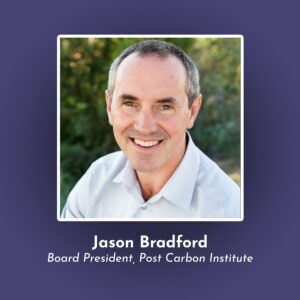
On this episode we meet with author, activist, farmer, and teacher, Jason Bradford, who discusses the energy intensity of our modern industrial agriculture system.
How do we feed billions of people with depleting energy systems? How do we also protect existing biodiversity and ecosystem health? We also discuss what makes for healthy soil, why we’re losing it, and how small farms can help get it back – while creating higher yields of healthier foods for fewer inputs.
About Jason Bradford
Jason Bradford has been affiliated with Post Carbon Institute since 2004, first as a Fellow and then as Board President. He grew up in the Bay Area of California and graduated from U.C. Davis with a B.S. in biology before earning his doctorate from Washington University in St. Louis, where he also taught ecology for a few years. After graduate school he worked for the Center for Conservation and Sustainable Development at the Missouri Botanical Garden, was a Visiting Scholar at U.C. Davis, and during that period co-founded the Andes Biodiversity and Ecosystem Research Group (ABERG). He decided to shift from academia to learn more about and practice sustainable agriculture, and in the process, completed six months of training with Ecology Action (aka GrowBiointensive) in Willits, California, and then founded Brookside School Farm.
Show Notes & Links to Learn More
Download transcript00:35 – Jason’s info + book, Post Carbon Institute, Farmland LP, CSAs
02:57 – What is a CSA
04:39 – Biodiversity and geography of the Amazon rainforest and the Andes
05:14 – How will the Amazon and Andes change with climate change
06:17 – The Future is Rural
06:56 – Net energy positive
07:18 – Optimal foraging theory
08:46 – Chewing the cud and ruminant digestion
09:32 – Fiber, cellulose and human digestion
10:16 – NPK (Nitrogen, Phosphorus, Potassium/Potash)
11:01 – Haber Bosch process
14:30 – The Law of Return
15:11 – What is soil? Is it different from dirt?
16:30 – Hydroponics
17:10 – What makes healthy soil? (structure, microbiome, nutrients)
17:24 – Malabon soil
19:49 – How many farms are managing for healthy soils
20:10 – At the current rate our topsoil will be gone in 60 years
20:54 – What percentage of the US labor force are farmers? (~1%)
21:22 – How has the labor force shifted from pre-industrial times? (70-90%)
22:35 – Modern agriculture is an energy sink
23:17 – Past food systems were energy positive (10:1-5:1)
23:35 – The Oil Drum essay (EROI on Nate’s potatoes)
25:04 – It takes 10-14 calories to produce, process, and transport every 1 calorie of food we eat
26:50 – Over the last hundred years we have had more energy available every year
27:03 – Trophic pyramids
27:51 – Entropy
31:01 – Supply chain disruptions
31:55 – Fossil fuel depletion
33:48 – Conventional crops no longer have the genes to be grown in organic agriculture
37:16 – Heavy mechanization has led to heavy specialization and regionalization
39:27 – Smaller farms have higher energy returns and higher yields
44:27 – ½ a hectare is needed to feed one person (variation from 2/10th to a whole hectare)
47:46 – Dennis Meadows TGS Episode
51:33 – Potato Famine in Ireland
53:03 – Problems with modern industrial animal agriculture (CAFOs)
54:31 – Diets were tailored to fit the land they’re based in
56:13 – In Minnesota there are more pigs than people
56:20 – Population numbers of our livestock
1:00:05 – Energy blindness
1:00:23 – Norman Borlaug and Paul Ehrlich
1:01:09 – Permaculture
1:07:34 – The world’s amazing and diverse life
1:09:03 – Chuck Watson TGS Episode 1 and 2 on Nuclear Risk
1:10:20 – Nature is remarkably resilient
1:10:37 – Building back healthy soil