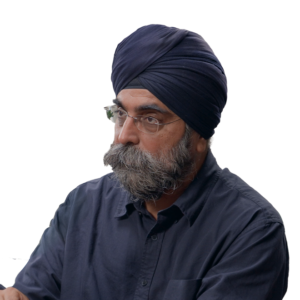
Ep 217 | Iain McGilchrist
Wisdom in a World in Crisis: The Counterintuitive Need to Slow Down and Find Spaciousness
Description
For many of us, our instinctual response to rising conflict and instability might be to recede further into pragmatism as a way to survive. Yet, if our cultural values and ways of life are what got us here, rooted in narrow-boundary, cold, and logical thinking – then perhaps moments of turbulence like these actually call on us to change our way of thinking entirely. Is this moment our opportunity to pivot toward worldviews that emphasize the intangible qualities of life, and could that shift cause a cascade through our actions and decisions, leading to more balanced decision-making for the betterment of everyone?
In this episode, Nate is rejoined by philosopher and neuroscientist Iain McGilchrist for discussion on how our left-brain dominance obscures our sense of value, especially for abstract qualities such as truth, goodness, and beauty. As a way to reclaim an appreciation for these things, he urges us to slow down, create spaciousness, embrace silence and deep listening, and resist the mania for productivity in our modern culture. Nate and Iain also discuss consciousness, panpsychism, and panentheism, exploring the thread that there might be some form of universal current running through everything, uniting us all. Bringing everything together, Iain calls for a recovery of humility, compassion, awe, and wonder and insists that even a small percentage of people genuinely living differently could begin to shift cultural consciousness.
How do the things we choose to pay attention to affect our ability to see what’s important in the world – and subsequently what we value and prioritize? What would it feel like to treat each day as a gift rather than a problem to solve, and how might that shift our relationship with time, mortality, and meaning? Most of all, is it possible for some subset of humans to reground ourselves and our behavior in the interconnectedness of life, and could those small changes add up to meaningfully alter humanity’s current trajectory?
About Iain McGilchrist
Dr. Iain McGilchrist is a Quondam Fellow of All Souls College, Oxford, an Associate Fellow of Green Templeton College, Oxford, a Fellow of the Royal College of Psychiatrists, a Fellow of the Royal Society of Arts, and former Consultant Psychiatrist and Clinical Director at the Bethlem Royal & Maudsley Hospital, London.
Iain has been a Research Fellow in neuroimaging at Johns Hopkins Hospital, Baltimore and a Fellow of the Institute of Advanced Studies in Stellenbosch. He has published original articles and research papers in a wide range of publications on topics in literature, philosophy, medicine and psychiatry.
Iain is the author of a number of books, but is best-known for The Master and his Emissary: The Divided Brain and the Making of the Western World (2009); and his book on neuroscience, epistemology, and ontology called The Matter with Things: Our Brains, Our Delusions and the Unmaking of the World (2021).
Show Notes & Links to Learn More
Download transcriptThe TGS team puts together these brief references and show notes for the learning and convenience of our listeners. However, most of the points made in episodes hold more nuance than one link can address, and we encourage you to dig deeper into any of these topics and come to your own informed conclusions.
00:00 – Iain McGilchrist
- Books: The Master and His Emissary, The Matter With Things
- Previous TGS Episodes:
01:11 – More-than-human predicament
04:30 – Paramount importance of value
05:10 – Upcoming Sheldonian Theatre Oxford lectures on truth, beauty, and goodness
06:00 – Power and the left hemisphere of the brain
06:30 – Importance of spirituality, meditation, sense of transcendence
07:15 – Cultural mitochondria
07:35 – Panentheism, Pantheism
07:55 – Panentheism and compatibility with Buddhism and Christianity
09:25 – Saint Augustine on the limits of understanding God
10:00 – Hebrew tradition: God is the unnamable, Tao Te Ching, The Tao that can be named
10:45 – Eastern Orthodox Christianity, Transcendence and immanence
12:15 – Two accounts of creation in Genesis – What is meant by “subdue”?
15:05 – Recent AI technology advances and biosphere degradation
15:30 – Left hemisphere versus right hemisphere overview
17:00 – Evolutionary origin of hemispheric lateralization
17:10 – Broad vigilant attention (right brain) versus narrow focused attention (left brain)
18:25 – Left hemisphere world: fragments, categories, the explicit
18:53 – Right hemisphere world: nothing is ever entirely fixed or certain, everything is interconnected
19:20 – Implicit knowledge degraded when made explicit
21:25 – Cultural differences in human brain activity
22:35 – Halakha and Aggadah in Jewish tradition
22:45 – Rabbi Abraham Joshua Heschel – The Sabbath, The Sabbath
24:30 – Three civilizational cycles of hemispheric balance in Western history (Greeks → Romans → Postmodernism)
25:00 – Sixth-century Athens, Rome, Renaissance as right-hemisphere flourishing
26:50 – Attention as fragmented commons
28:00 – 99.4% of brain activity is unconscious
28:45 – Religious references to people as sleepwalkers
29:15 – Inattentional blindness, Gorillas in Our Midst experiment
31:00 – Attention is guided by what we value
31:15 – Polycrisis → metacrisis, The Metacrisis/Polycrisis
32:50 – Cultivating internal openness
33:45 – Meditation and prayer as right hemisphere practices, Saint Francis views on prayer
36:00 – Aristotle, humans as social animals, Humans are highly social animals
36:10 – Belonging to a social group is vital for human flourishing
36:40 – Roseto effect, community health despite poor lifestyle
38:25 – Parable of the Two Builders
38:43 – Definition of embodiment, Embodiment and Human Development
40:25 – Luc de Clapiers, marquis de Vauvenargues on emotion and reason, Antonio Damasio on emotion and reason
41:35 – Imagination vs. fantasy
41:50 – Mathematical beauty, Darwin on beauty, The Descent of Man
42:20 – Intuition
43:00 – Hegel and Schelling on imagination, Wordsworth and Coleridge on imagination
43:55 – AI as narrowing imagination and reducing aperture of awareness
44:30 – Savoir versus connaître, two kinds of knowing
46:25 – Brazen head
46:40 – Asymptotic analysis
47:20 – Cultural speciation from intensive AI use
47:30 – Cultural speciation with AI use
48:00 – How AI impacts our brains, How social media and smart phones affect a developing human’s brain
48:40 – Process philosophy, relations rather than things
49:30 – Connection with nature as foundation of human flourishing
50:05 – Modern art’s repudiation of beauty
51:15 – The Matrix
51:30 – Frankly on soft feudalism, The Superorganism
52:45 – Misconceptions about feudalism
53:00 – Medieval peasant life, 180 holidays per year
53:35 – Industrial Revolution and capitalism brought about a new kind of human exploitation
55:25 – Frankly on spaciousness and agency
58:50 – Dietrich Bonhoeffer, His morning prayer
1:01:30 – Agency (Self-leadership), Self-efficacy: The exercise of control
1:01:45 – Duke conference: Cognitive Liberty, Iain’s lecture
1:03:10 – Bhagavad Gita, hell is more and faster
1:03:40 – Unity of opposites
1:04:15 – Buddhism: Non-doing
1:04:30 – Śūnyatā, emptiness as fertile space in Buddhism
1:05:00 – Psychology of creativity – Incubation
1:06:30 – Hypnagogia, Shower thoughts
1:07:25 – Obsession with extending human life with technology
1:09:00 – Death as fulfillment, mortality, and meaning
1:10:50 – Cryogenics, Transhumanism
1:11:30 – Concept of consciousness continuation after death
1:11:50 – Schelling, Whirlpool as metaphor for selfhood
1:13:20 – Johann Wolfgang von Goethe, Quote referenced
1:13:40 – Hegel, Quote referenced
1:14:05 – David Bohm, Wholeness and the Implicate Order
1:14:40 – Nicholas of Cusa
1:16:20 – Entropy and dissipative structures, Evolution
1:16:45 – Aristotle on telos, Teleology in biology
1:18:15 – Alfred North Whitehead on being alive versus persistence
1:19:55 – Beauty, love, and truth are not human concepts, they are innate
1:20:30 – The Universe is creative and relational
1:21:38 – Humans have been here for 300,000 years
1:22:20 – Nonhuman beings recognize beauty and have capacity for self-sacrificial goodness
1:22:50 – Truth, German etymology
1:23:35 – Panpsychism
1:24:45 – Consciousness has always existed
1:24:55 – Pan-experientialism
1:26:30 – Consciousness and its Place in Nature
1:30:50 – Nate’s Framework for Action, A Guide to Staying Human (Part 1)