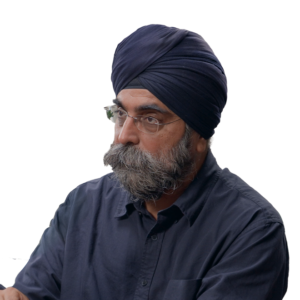
Ep 216 | Sam Harris
Navigating the Metacrisis: Finding Calm in the Storm through Awareness and Meditation

Description
Between global crises and personal problems, modern life is overflowing with things to worry about, including many issues that feel too big to even address. Yet, our ability to influence these problems and how much we worry about them are not equal to each other – and in fact, getting lost in thoughts of anxiety can reduce our ability to act. Given the direct line between individual inner states and civilizational dysfunction, what global change might be possible if we train ourselves to observe thought, rather than be unconsciously consumed and paralyzed by it?
In this episode, Nate is joined by philosopher and neuroscientist Sam Harris to explore how cultivating inner awareness could help us – both as individuals and a society – navigate civilizational crises. Sam argues that virtually all human suffering flows from one source: the mind’s incessant, largely unnoticed identification with thought. Sam makes the case that, at scale, these distracted minds cumulate into people who are helplessly identified with their own inner worlds, their tribes, and their identity rather than able to hold a broader view. He offers a deep dive on the foundations of meditation, mindfulness, and awareness techniques as a way to help navigate our thoughts and remain grounded in the present. Ultimately, he suggests that in order to steer toward better futures, we might need to invest in cultivating both saner individuals and wiser systems in parallel.
Whether the threat is a cancer diagnosis or civilizational overshoot, the question is the same: how much suffering do you have to carry between now and the future? What if the inner work of moving through grief toward equanimity is actually a precondition for effective action? And if the most consequential decisions in human history are being made by people who have never once examined the nature of their own minds, how will their own mental states reflect onto the reality of our shared outcomes?
About Sam Harris
Sam Harris is the author of five New York Times best sellers. His books include The End of Faith, Letter to a Christian Nation, The Moral Landscape, Free Will, Lying, Waking Up, and Islam and the Future of Tolerance (with Maajid Nawaz). The End of Faith won the 2005 PEN Award for Nonfiction. His writing and public lectures cover a wide range of topics – neuroscience, moral philosophy, religion, meditation practice, human violence, rationality – but generally focus on how a growing understanding of ourselves and the world is changing our sense of how we should live. He also hosts the Making Sense Podcast, which was selected by Apple as one of the “iTunes Best” and has won a Webby Award for best podcast in the Science & Education category.
Sam received a degree in philosophy from Stanford University and a Ph.D. in neuroscience from UCLA. He has also practiced meditation for more than 30 years and has studied with many Tibetan, Indian, Burmese, and Western meditation teachers, both in the United States and abroad. Sam has created the Waking Up app for anyone who wants to learn to meditate in a modern, scientific context.
Show Notes & Links to Learn More
Download transcriptThe TGS team puts together these brief references and show notes for the learning and convenience of our listeners. However, most of the points made in episodes hold more nuance than one link can address, and we encourage you to dig deeper into any of these topics and come to your own informed conclusions.
00:00 – Sam Harris, Podcast, Waking Up App, Books
Resources:
- Meditation Resources: Free guided meditations (More here)
- Practicing Gratitude
00:50 – The Great Simplification
04:00 – Meditation, Effectiveness and safety
04:05 – Meditation relieving physical and mental suffering, Mechanisms of suffering, Buddhism and suffering
06:05 – Brain State Model
06:25 – Nature of feelings
06:50 – Contemplative practices
07:00 – Psychedelics and mindfulness, The dangers
08:10 – Nature of consciousness
08:50 – Self-transcendence, Illusion of the “self” (Additional opinion, TGS Episode on the importance of the “self”)
11:40 – Entropy
13:03 – Enlightenment (philosophical concept), Other definitions, Awakening
14:11 – Equanimity
15:05 – Robert Sapolsky, TGS Episode, Books
15:37 – Peak experiences
16:15 – Dopamenergic experiences, TGS Episode on dopamine
18:15 – Couples taking psychedelics together or meditating together
20:00 – Getting rid of regret
20:15 – Wisdom vs. Ignorance
20:20 – Neuroticism
25:20 – Mind–body problem, Depersonalization-derealization disorder
27:30 – Concentration practices
27:50 – Nondualism: Spiritual & Philosophical
28:45 – The importance of “negative” emotions
30:40 – Dual vs. Non-dual meditation, Toward an understanding of non-dual mindfulness
32:15 – Proprioception
32:40 – Neurogravity
34:30 – How to pay attention to the breath
36:15 – Subject and object (philosophy)
38:00 – Other animals have thoughts and consciousness
40:00 – The nature of dreams
41:40 – Psychosis
43:00 – Observing animals as meditation
44:00 – Anything can be an act of meditation
45:50 – Distraction, ”Distraction” vs. “A Wandering Mind”, Perception, Reality, and Distractions (pg 4), Attention
48:30 – Never been more distracted than today
50:00 – AI exacerbating attention issues, Rise of short-form content
59:30 – Pre-tragic, Tragic, and Post-tragic – The metacrisis
1:01:25 – Global Catastrophic Risks, TGS Episode on Existential Risk
1:06:00 – Current incentives don’t reward good ethics, Psychopathy in positions of power, Role of policy in changing incentives
1:09:25 – Sympathetic joy
1:10:25 – Zero-sum game
1:14:30 – Traits we think are unique to humans but really aren’t:
- Capacity for rational thought
- Tool use
- Culture
- Self-awareness and Consciousness
- Language
- Art
- Religion
1:14:50 – Consciousness on a single cell level
1:20:45 – Human behavior: Tribalism, Identity politics, Dogmatism
1:25:15 – Philosopher John Rawls, A Theory of Justice
1:37:00 – Religious sectarianism