Great simplification pulsing lines

Ep 10  |  Nora Bateson

Nora Bateson: “Complexity Between the Lines”
Check out this podcast

TGS10 Nora Bateson The Great Simplification

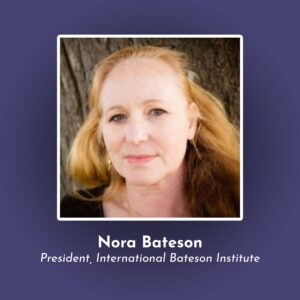
On this episode, we meet with award-winning filmmaker, writer, educator, and President of the International Bateson Institute, Nora Bateson.

Nora brings us beyond the descriptions of the physical science that underpins our predicament to the nuance and perception of the complexity that we live within. How can we improve our relationships with others, as well as the broader world?

Nora helps us understand how systems dynamics inform our predicament. How does an ecosystem develop and mature through mutual learning? What are ways we can apply this thinking to our profit-focused superstructure?

About Nora Bateson

Nora Bateson is an award-winning filmmaker, writer and educator, as well as President of the International Bateson Institute, based in Sweden. Her work asks the question “How can we  improve our perception of the complexity we live within, so we may improve our interaction with the world?”

An international lecturer, researcher and writer, Nora wrote, directed and produced the award-winning documentary, An Ecology of Mind, a portrait of her father, Gregory Bateson. Her work brings the fields of biology, cognition, art, anthropology, psychology, and information technology together into a study of the patterns in ecology of living systems. Her book, Small Arcs of Larger Circles, released by Triarchy Press, UK, 2016 is a revolutionary personal approach to the study of systems and complexity.

In French, we have a motto that says that a simple drawing is often better than a long explanation. Jean-Marc Jancovici Carbone 4 President

That’s very understandable because with left atmosphere thinking, one of the problems is that you see everything as a series of problems that must have solutions. Iain McGilchrist Neuroscientist and Philosopher

We can’t have hundreds and hundreds of real relationships that are healthy because that requires time and effort and full attention and awareness of being in real relationship and conversation with the other human. Nate Hagens Director of ISEOF

This is the crux of the whole problem. Individual parts of nature are more valuable than the biocomplexity of nature. Thomas Crowther Founder Restor

Show Notes & Links to Learn More

Download transcript
Back to episodes
If Anyone Builds It, Everyone DiesWith Nate SoaresThe Great SimplificationEp 203 | Nate Soares

Technological development has always been a double-edged sword for humanity: the printing press increased the spread of misinformation, cars disrupted the fabric of our cities, and social media has made us increasingly polarized and lonely. But it has not been since the invention of the nuclear bomb that technology has presented such a severe existential risk to humanity – until now, with the possibility of Artificial Super Intelligence (ASI) on the horizon. Were ASI to come to fruition, it would be so powerful that it would outcompete human beings in everything – from scientific discovery to strategic warfare. What might happen to our species if we reach this point of singularity, and how can we steer away from the worst outcomes?

Watch nowDec 3, 2025
Reimagining Ourselves at the End of the WorldWith Samantha SweetwaterThe Great SimplificationEp 202 | Samantha Sweetwater

Over the past decade, the world has become increasingly chaotic and uncertain – and so, too, has our cultural vision for the future. While the events we face now may feel unprecedented, they are rooted in much deeper patterns, which humanity has been playing out for millennia. If we take the time to understand past trends, we can also employ practices and philosophies that might counteract them –  such as focusing on kinship, intimacy, and resilience – to help pave the way for a better future. How might we nurture the foundations of a different kind of society, even while the end of our current civilization plays out around us?

Watch nowNov 24, 2025
Two Ways of KnowingWith Rosa Vásquez EspinozaThe Great SimplificationEp 201 | Rosa Vásquez Espinoza

For centuries, modern science has relied on the scientific method to better understand the world around us. While helpful in many contexts, the scientific method is also objective, controlled, and reductionist – often breaking down complex systems into smaller parts for analysis and isolating subjects to test hypotheses. In contrast, indigenous wisdom is deeply contextual, rooted in lived experience, and emphasizes a reciprocal, integrated relationship with the rest of the natural world, viewing all parts of the system as interconnected. What becomes possible when we combine the strengths of each of these knowledge systems as we navigate humanity’s biggest challenges? 

Watch nowNov 19, 2025

Subscribe to our Substack

The Institute for the Study of Energy and Our Future (ISEOF) is a 501(c)(3) non-profit corporation, founded in 2008, that conducts research and educates the public about energy issues and their impact on society.

Support our work
Get in touch
x