Great simplification pulsing lines

Ep 10  |  Nora Bateson

Nora Bateson: “Complexity Between the Lines”
Check out this podcast

TGS10 Nora Bateson The Great Simplification

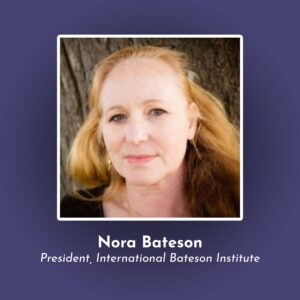
On this episode, we meet with award-winning filmmaker, writer, educator, and President of the International Bateson Institute, Nora Bateson.

Nora brings us beyond the descriptions of the physical science that underpins our predicament to the nuance and perception of the complexity that we live within. How can we improve our relationships with others, as well as the broader world?

Nora helps us understand how systems dynamics inform our predicament. How does an ecosystem develop and mature through mutual learning? What are ways we can apply this thinking to our profit-focused superstructure?

About Nora Bateson

Nora Bateson is an award-winning filmmaker, writer and educator, as well as President of the International Bateson Institute, based in Sweden. Her work asks the question “How can we  improve our perception of the complexity we live within, so we may improve our interaction with the world?”

An international lecturer, researcher and writer, Nora wrote, directed and produced the award-winning documentary, An Ecology of Mind, a portrait of her father, Gregory Bateson. Her work brings the fields of biology, cognition, art, anthropology, psychology, and information technology together into a study of the patterns in ecology of living systems. Her book, Small Arcs of Larger Circles, released by Triarchy Press, UK, 2016 is a revolutionary personal approach to the study of systems and complexity.

In French, we have a motto that says that a simple drawing is often better than a long explanation. Jean-Marc Jancovici Carbone 4 President

That’s very understandable because with left atmosphere thinking, one of the problems is that you see everything as a series of problems that must have solutions. Iain McGilchrist Neuroscientist and Philosopher

We can’t have hundreds and hundreds of real relationships that are healthy because that requires time and effort and full attention and awareness of being in real relationship and conversation with the other human. Nate Hagens Director of ISEOF

This is the crux of the whole problem. Individual parts of nature are more valuable than the biocomplexity of nature. Thomas Crowther Founder Restor

Show Notes & Links to Learn More

Download transcript
Back to episodes
End of Year ReflectionsWith Nate HagensThe Great SimplificationEp 205 | Nate Hagens

In this week’s episode, Nate reflects on four years(!) of the podcast by answering listener-submitted questions, which cover a broad range of topics related to The Great Simplification. He invites subscribers to investigate how they navigate a complex and ever-changing world, while avoiding overly prescriptive solutions that brush aside personal agency and the inherent uncertainty that exists in our world.

Watch nowDec 17, 2025
Fighting for a Livable FutureWith Kelly ErhartThe Great SimplificationEp 204 | Kelly Erhart

While current conversations about global heating tend to center around a few well-established pieces of science, we don’t often hear about the scientists and leaders working at the frontier of what is still unknown about Earth’s systems. This includes unpredictable tipping points and cascading effects of our rapidly changing climate, as well as the unconventional adaptation strategies that might help us maintain a stable planet. What is the newest climate science being researched right now, and what areas are we still needing to explore as we fight for a livable future? 

Watch nowDec 10, 2025
If Anyone Builds It, Everyone DiesWith Nate SoaresThe Great SimplificationEp 203 | Nate Soares

Technological development has always been a double-edged sword for humanity: the printing press increased the spread of misinformation, cars disrupted the fabric of our cities, and social media has made us increasingly polarized and lonely. But it has not been since the invention of the nuclear bomb that technology has presented such a severe existential risk to humanity – until now, with the possibility of Artificial Super Intelligence (ASI) on the horizon. Were ASI to come to fruition, it would be so powerful that it would outcompete human beings in everything – from scientific discovery to strategic warfare. What might happen to our species if we reach this point of singularity, and how can we steer away from the worst outcomes?

Watch nowDec 3, 2025

Subscribe to our Substack

The Institute for the Study of Energy and Our Future (ISEOF) is a 501(c)(3) non-profit corporation, founded in 2008, that conducts research and educates the public about energy issues and their impact on society.

Support our work
Get in touch
x