Ep 152 | Helen Thompson
Helen Thompson: “Energy Crises & Global Power Shifts: The Struggle for Stability in Israel, Iran, and Beyond”
(Conversation recorded on November 11th, 2024, prior to a ceasefire declared between Israel and Lebanon on November 27th, 2024)
Show Summary
If you’ve followed TGS for some time, you’ve heard Nate speak about The 5 Horsemen – the biggest risks for humans and civilization in the coming decade. Today’s episode delves into one of the most rapidly escalating: geopolitics.
Today, Nate is joined by Political Economy Professor Helen Thompson to explore the evolving understanding of energy’s role in international relations, particularly in the context of recent conflicts in the Middle East. They discuss the challenge of anticipating the volatile changes in energy supplies, the complexities of navigating information in a rapidly changing geopolitical landscape, and the role of global powers like BRICS and OPEC.
How will resource conflicts continue to shape the long-standing tensions in the Middle East? What would a transition from a unipolar world to a multipolar world mean for the global geopolitical landscape and its energy implications? Given how connected these issues are to the delicate balance of our world, how can we increase awareness and preparation for future crises?
About Helen Thompson
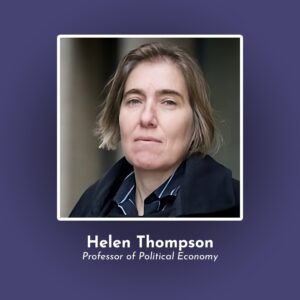
Helen Thompson has been Professor of Political Economy at Cambridge since 1994. Her current research concentrates on the political economy of energy and the long history of the democratic, economic, and geopolitical disruptions of the twenty-first century. She is a regular panelist on Talking Politics and a columnist for the New Statesman. She is a co-presenter of UnHerd’s podcast, These Times, and recently published Disorder: Hard Times in the 21st Century.
Show Notes & Links to Learn More
Download transcript00:00 – Helen Thomspon info + works, prior TGS Episode
01:30 – Russian IRBM missile
03:52 – Russian invasion of Ukraine + impact on global energy landscape
04:19 – Middle East crisis
05:17 – Risk Homeostasis
06:00 – World’s recoverable oil reserves + in the Middle East
06:55 – Red Sea disruptions and oil flows + world oil transit chokepoints
07:00 – China’s weak oil demand
07:14 – China’s energy transition + more info
07:38 – Israel oil imports + more info
07:49 – Turkey and Azerbaijan-Israel oil trade
08:52 – 2019 attack on Saudi oil facilities
09:57 – Israel assures it will not attack Iranian oil or nuclear sites
10:37 – Gulf states’ airspace needed for Israeli attack on Iran
11:22 – Putin’s mockery of US after Saudi oil facility attack
11:33 – World’s top oil producers
11:47 – Assassination of Qasem Soleimani
12:39 – Saudi-Iranian rapprochement + more info
13:26 – Israel’s new defense minister
14:10 – Gallant’s critique of Netenyahu’s attack on Iran
14:38 – Gallant on conscription
16:41 – Israel government coalition + more info
17:00 – Divided Israeli politics
17:40 – Conscription in Israel + Haredi men
18:14 – Conscription in Russia + ethnic minorities
19:37 – Vietnam War draft
21:50 – Podcast: These Times
24:09 – Nord Stream pipelines sabotage + Andromeda yacht
27:58 – Public opinion towards Israel in Europe + in US
28:30 – European energy crisis
29:00 – European countries reopen power stations to burn more coal
29:50 – European LNG market developments
33:22 – Trump encourages Israel to target Iran’s nuclear sites
33:40 – Trump’s criticisms against John Bolton
34:11 – Iran sanctions under Trump administration
34:40 – Iran’s oil exports to China and US sanctions
35:00 – European special payment systems to bypass US sanctions on Iran
35:14 – Recent trends in Iran’s oil exports + Iran’s oil production
35:42 – Trump and oil prices
36:44 – The Strait of Hormuz as an oil chokepoint + more info + Frankly
39:20 – Energy consumption of AI
40:39 – US energy independence
40:42 – Shale oil accounts for *64% of US oil production, production decline for shale oil + more info
41:11 – Growth in oil production in Iran + Iraq
43:01 – Depletion of the Permian Basin
44:15 – The potential for shale oil production in Russia
45:00 – Arctic LNG 2 sanctions
45:39 – Amazon tipping to Savannah
46:00 – BRICS represents *45% of global population and 35% of GDP
46:17 – BRICS countries control *approx 43% of global oil production
46:32 – Sunni-Shia divide
48:29 – OPEC+
50:35 – The creation of Great Britain
53:50 – History of US oil production
54:14 – Oil and geopolitics in the 1970s
54:28 – Oil price crash and the collapse of the Soviet Union
56:53 – Nuclear power phase out + more info
56:55 – France as an outlier in nuclear power + nuclear-powered submarines
57:49 – Nuclear power and the electricity demands of AI
1:01:55 – UK LNG imports
1:02:00 – Ansar Allah (Houthis) + attack on Israel
1:04:17 – There are *approx 12,100 nuclear warheads in the world