Show Summary
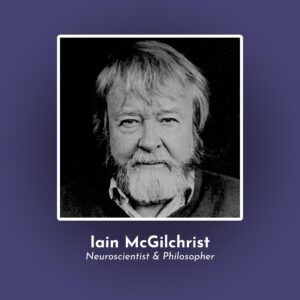
On this episode, literary scholar and psychiatrist Iain McGilchrist joins Nate to discuss the way modern culture teaches and encourages us to use – and not use – the two lobes of our brains. While most functions require the use of both sides of our brains, each side is specially attuned to see and interact with the world in certain ways: the left side acts as a narrow problem solving executor, while the right side is a broadly open contextualizer. What happens when we humans – in aggregate – become imbalanced in our use of these two critical functions? Have we divided the Earth into pieces to be optimized rather than a whole (which we’re a part of) to be stewarded? Can we learn to bring these two components of our brains back into balance and in turn heal fractures in ourselves, and ultimately in our communities, Earth, and her ecosystems?
About Iain McGilchrist
Dr. Iain McGilchrist is a Quondam Fellow of All Souls College, Oxford, an Associate Fellow of Green Templeton College, Oxford, a Fellow of the Royal College of Psychiatrists, a Fellow of the Royal Society of Arts, and former Consultant Psychiatrist and Clinical Director at the Bethlem Royal & Maudsley Hospital, London. He has been a Research Fellow in neuroimaging at Johns Hopkins Hospital, Baltimore and a Fellow of the Institute of Advanced Studies in Stellenbosch. He has published original articles and research papers in a wide range of publications on topics in literature, philosophy, medicine and psychiatry. He is the author of a number of books, but is best-known for The Master and his Emissary: The Divided Brain and the Making of the Western World (2009); and his book on neuroscience, epistemology and ontology called The Matter with Things: Our Brains, Our Delusions and the Unmaking of the World (2021).
Show Notes & Links to Learn More
Download transcript00:00 – Iain McGilchrist Info, The Master and His Emissary, and The Matter with Things
03:02 – Peter Whybrow + TGS Episode
03:25 – Daniel Schmachteberger + TGS Episodes
04:58 – The brain is divided into asymmetrical hemispheres
05:42 – Corpus Callosum
10:02 – Dunning-Kruger Effect
15:15 – Daniel Schmachtenberger episode on AI
16:04 – Humans are social animals and altruistic
16:20 – Human evolution has been about cooperation and competition together
20:28 – Alfred North Whitehead
23:35 – Animist religions
23:46 – Nate’s work on the Superorganism
24:06 – Agricultural Revolution
26:01 – Pantheism
27:12 – Transcranial magnetic stimulation
29:55 – Disproved thinking on left vs right hemispheres
32:08 – Kretschmer
33:50 – Ayahuasca and other psychedelics
34:05 – Frontal Lobe
35:35 – Pharmaceutical involvement in promotion of psychedelics
40:29 – Dispositional Belief
42:05 – GK Chesterton
44:38 – Patrick Ophuls, Immoderate Greatness + TGS Episode
46:08 – Taoism, Buddhism, Vedanta
47:33 – Humans evolved to value fitness more than truth
47:45 – Nate’s Reality 101 course
56:03 – Dan Kahneman
58:10 – Rates of Stress and Trauma
1:01:57 – Feldenkrais Method
1:02:21 – Viktor Frankl
1:05:17 – Tomas Björkman – Inner Development Goals
1:07:45 – Mindfulness
1:23:38 – The rise of thinking of the brain as a computer
1:28:49 – Examination (Prize) Fellowship of All Souls
1:29:50 – The greatest discoveries came when hitting a dead end
1:36:29 – Mechanistic Determinism
1:37:40 – Managerial culture that began in the 80s
1:39:17 – Heraclitus, Alan Watts
1:41:44 – Onondaga of the Iroquois
1:44:41 – Homo Habilis
1:48:44 – St. Paul