Ep 147 | Indy Johar
Indy Johar: “The Foundational Challenge: Stewardship, Responsibility, and Designing a New System”
Show Summary
While humans, like all animals, are subject to certain fundamental realities, we also possess the unique ability to shape the world around us through physical infrastructure, laws and institutions, and our economic and social systems. And yet, it’s important to remember that, as today’s guest would say, what we design designs us back. In short, the systems and structures we build influence our cultures, values, and identities.
Today, Nate is joined by architect and professor of planetary civics, Indy Johar, to explore the relationship between system design and human behavior – and what might be possible for transformational change. Along the way, they discuss the impact of sunk costs on our ability to change, the importance of new language to describe and respond to our human predicament, and envision future governance and economies that could enable the full spectrum of what it means to be human.
What sorts of unconventional ideas, like self-owning land and technology, could lead to economies that are capable of sustaining humans as well as foster a healthy planet? How do our current societies prevent us from embodying and living into our greatest gifts as human beings? Is it possible to intentionally redesign our systems at the physical, structural, and psychological levels in service of all the entangled life inhabiting the Earth?
About Indy Johar
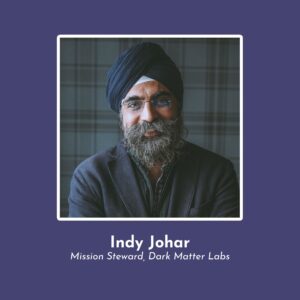
Indy Johar is co-founder of Dark Matter Labs, as well as the RIBA award winning architecture and urban practice Architecture00. He is also a founding director of Open Systems Lab, seeded WikiHouse (open source housing), and Open Desk (open source furniture company).
Indy is also a non-executive international Director of the BloxHub, which is the Nordic Hub for sustainable urbanization. He has taught & lectured at various institutions from the University of Bath, TU-Berlin; University College London, Princeton, Harvard, MIT and New School. He is currently a professor at RMIT University.
Show Notes & Links to Learn More
Download transcript00:00 – Indy Johar info, Dark Matter Labs, Project 00 + Architecture 00, Open Systems Lab, Blox Hub
02:26 – Emerge
03:45 – WikiHouse + Opendesk, Impact Hubs
05:32 – Theory of property + Property Law
07:35 – The Code of Capital, Katharine Pistor
08:22 – Churchill on our buildings shaping us
09:12 – Impact of studying economics on behavior, Homo Economicus
10:25 – Classification theory
10:48 – Africa is more genetically diverse than anywhere else
11:26 – The Agricultural Revolution, Hernán Cortés, Aztec Civilization
15:50 – James Lovelock, Novacene
17:16 – Marvin Harris’ cultural materialism
19:13 – Path dependence
20:55 – Indigenous worldviews opening up new possibilities in Canada
21:27 – Locations of tipping elements
23:30 – Only 176,000 homes per year can be built within Europe’s carbon budget, projected construction is over 1.5 million homes
24:20 – Extreme rain in North Carolina
24:40 – Insurance companies and Hurricane Helene
25:40 – Extreme weather, insurance and housing
28:19 – Ed Conway + TGS Episode
28:30 – Daniel Schmachtenberger + Bend Not Break series, TGS Episode on Naive Progress
32:32 – Economic Superorganism
34:09 – Rivers given legal agency in New Zealand
37:09 – Life-Enobling Economics
41:20 – Research on quantum computation in the human brain
41:55 – Fermi paradox
46:05 – Intentional community + examples
47:35 – Multi capital value, Situational Intelligence
49:05 – Conditions enabling the Industrial Revolution in the UK
49:52 – TGS Episode on Artificial Intelligence
51:00 – The idea of the corporation + the role of the corporation in society
1:00:20 – Jayne Engle, Mi’kmaw Native Friendship Center
1:00:55 – Cities committing to tree canopy strategies, the survival of community-planted trees
1:04:30 – 19 terawatt economy
1:06:05 – Energy efficiency of plant based diets
1:06:44 – Soil health and nutrient density from regenerative agriculture
1:07:38 – Autonomous three wheelers
1:08:20 – Vacant real estate in Europe
1:09:10 – Afforestation and carbon sequestration + afforestation and soil properties
1:09:55 – Material passports
1:14:15 – Othering
1:15:23 – The free rider problem
1:22:25 – Biological weapons, existential risk
1:28:36 – Noun-based vs verb-based languages
1:30:36 – Reimagining labor
1:35:29 – Dark Matter Labs publications