#119 | Frankly

Technology and Wealth: The Straw, the Siphon, and the Sieve

Check out this podcast

Frankly

Description

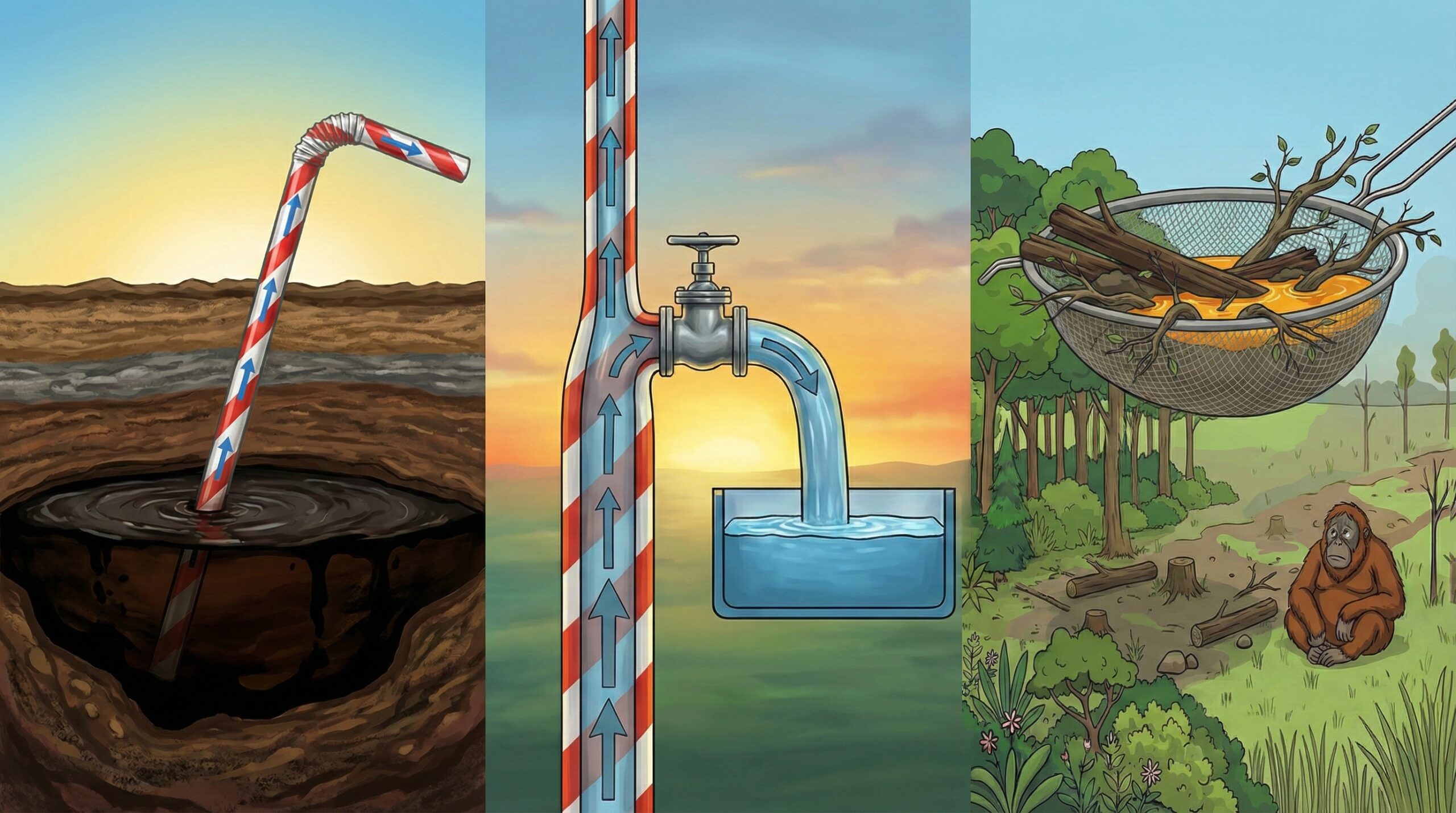
In this week’s Frankly, Nate explores the relationship between technology and wealth when viewed through a global biophysical lens. He uses the visualization of a straw, siphon, and sieve to describe how technology enables the acceleration of physical resource extraction and the concentration and filtering of resulting ‘wealth’ towards the human species. Running contrary to the commonly-held idea that technology automatically creates monetary wealth (and therefore prosperity), this episode asks listeners to view real wealth as the underlying stocks and flows that make life on Earth possible – whether in the form of forests, social trust, or entire functioning ecosystems. 

Nate also discusses the ways that technologies have been deployed to rearrange natural systems around narrow, growth-centric priorities throughout much of human history. Utilizing examples regarding agriculture, finance, and artificial intelligence, he suggests that tools effective at small scales might behave very differently when applied globally – setting us on the path to overshoot that we find ourselves walking today.

If technology reflects human priorities, what does current innovation and development reveal about what we currently value? What would it mean to shift towards prioritizing life-giving flows within natural systems and away from accelerating the liquidation of Earth’s stocks? Finally, how can societies and individuals begin to distinguish between innovation that serves to borrow from our future versus genuine progress toward a more stable world?

In French, we have a motto that says that a simple drawing is often better than a long explanation. Jean-Marc Jancovici Carbone 4 President

That’s very understandable because with left atmosphere thinking, one of the problems is that you see everything as a series of problems that must have solutions. Iain McGilchrist Neuroscientist and Philosopher

We can’t have hundreds and hundreds of real relationships that are healthy because that requires time and effort and full attention and awareness of being in real relationship and conversation with the other human. Nate Hagens Director of ISEOF

This is the crux of the whole problem. Individual parts of nature are more valuable than the biocomplexity of nature. Thomas Crowther Founder Restor

Show Notes & Links to Learn More

Download transcript

The TGS team puts together these brief references and show notes for the learning and convenience of our listeners. However, most of the points made in episodes hold more nuance than one link can address, and we encourage you to dig deeper into any of these topics and come to your own informed conclusions.

00:01 – Frankly #56: Peak Oil, AI, and the Straw, Frankly #113: 11 Discoveries That Changed My Worldview

03:45 – Money represents the real capital of the natural world

07:44 – Haber-Bosch process

08:09 – Today over 80%* of the nitrogen in our bodies originates from Haber-Bosch process

10:19 – Labor share of income

10:29 – Corporate profit as percent GDP, Market concentration in agricultural sector

10:45 – Top American companies in market capitalization

11:23 – Findings on how AI is affecting labor

14:42 – Human consumption of net primary production

14:58 – Biomass of humans and livestock surpasses that of wild mammals, Human-made mass exceeds all living biomass


16:43 – Debt is a claim on future resources

Back to episodes
Frankly#118 | The Things We Take for Granted

In this week’s Frankly, Nate shares reflections on what we take for granted in life at multiple scales: from personal health to meaningful work to relative ecological stability. The things that keep our everyday lives functioning often go unnoticed until they’re needed or suddenly absent, suggesting that real wealth might come in the form of reliability rather than material gain.

Watch nowJan 9, 2026
Frankly#117 | Behavioral Thermodynamics Part 1: Beyond the 4th Law?

In this week’s Frankly, Nate takes thermodynamics out of the physics classroom, utilizing its principles to explain the invisible forces behind growth, competition, and complexity in our world. Competing life systems build organization out of chaos in order to maximize power usage today, even if it potentially undermines survival tomorrow. Within our energetic reality of finite and destabilizing fossil fuels, this tendency towards instant power accelerates us towards planetary overshoot. 

Watch nowDec 19, 2025
Frankly#116 | Sunk Cost and the Superorganism

In this week’s episode, Nate unpacks the pervasive behavioral pull of sunk cost as a force shaping our material reality, identities, and collective expectations about the future. Past investments – in careers, possessions, and cultural narratives – lock us into patterns of defending what might no longer actually serve us. This tendency becomes more and more relevant as the world shifts in ways that demand adaptability rather than stagnancy. Deep loyalty to former choices, even as we absorb new information about our lived environments, can limit our ability to make wiser, more future-oriented decisions.

Watch nowDec 12, 2025

Subscribe to our Substack

The Institute for the Study of Energy and Our Future (ISEOF) is a 501(c)(3) non-profit corporation, founded in 2008, that conducts research and educates the public about energy issues and their impact on society.

Support our work
Get in touch
x