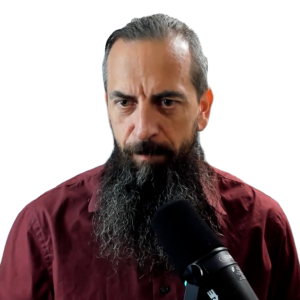
Ep 167 | Francis Weller
Francis Weller – The Lost Art of Grieving: Grief as Ritual, Resistance, and Resilience

Summary
Western culture, particularly in the United States, is often characterized by a profound discomfort and suppression of grief. Without healthy outlets to process loss and pain – especially in communal settings – many of us end up caught in cycles of loneliness and emotional distress. How might incorporating intentional spaces and rituals to process our grief regularly help us navigate the more systemic challenges we face?
In this conversation, Nate is joined by psychotherapist Francis Weller to discuss the essential human need for grief. Among many poignant topics, they delve into how modern individualism impacts our ability to grieve and form deep connections with others, and how that can keep us feeling stuck individually and as whole societies. Francis also explains his concept of ‘the five gates of grief’ and explores the cultural variations in grieving practices, physiological aspects of loss, and the vital role of community in healing.
How can intentional rituals help us process grief – including for the loss and destruction of biodiversity and healthy ecosystems? In what way could expanding the role of grief in our life paradoxically lead to greater room for love and joy? Ultimately, how can facilitating rituals and deeper social connections strengthen the bonds of community, leading to more emotionally resilient people and societies?
About Francis Weller
Francis Weller, MFT, is a psychotherapist, writer, and soul activist. For over forty years, he has worked as a psychotherapist and developed a style he calls soul-centered psychotherapy, synthesizing diverse streams of thought from psychology, anthropology, mythology, alchemy, indigenous cultures and poetic traditions.
Francis is the author of the bestselling, ‘The Wild Edge of Sorrow: Rituals of Renewal and the Sacred Work of Grief,’ ‘The Threshold Between Loss and Revelation’ (with Rashani Réa), and ‘In the Absence of the Ordinary: Soul Work for Times of Uncertainty.’ He founded and directs WisdomBridge, an organization that offers educational programs that seek to integrate the wisdom from indigenous cultures with the insights and knowledge gathered from western poetic, psychological, and spiritual traditions.
Show Notes & Links to Learn More
Download transcript00:00 – Francis Weller, Books, 5 Gates of Grief
06:15 – History of and reflections on grief in western culture
07:06 – Naomi Klein
07:21 – Root origin of the word Grief
07:53 – Evolutionary influence on grief in humans
09:06 – Depth psychology
10:10 – Individualism/communalism
12:47 – Average American uses 100x the exosomatic energy than is needed by our bodies
15:52 – Alchemy, seasons of change
16:41 – Bill Plotkin, TGS Episode
17:11 – Grief in the Black Baptist Community
21:35 – Congestive heart failure in the US
22:04 – Cognitive Dissonance, Leon Festinger
23:50 – Male/masculinity and emotion in western culture
26:47 – Daniel Quinn, The Great Forgetting
29:24 – Wide Boundary Sovereignty Frankly
31:38 – Ongoing 6th mass extinction, Fish swimming poleward, 70% reduction in animal populations
32:17 – Mutual of Omaha’s Wild Kingdom
36:36 – Wendell Berry
40:52 – Duane Elgin, Choosing Earth
41:45 – Rough Initiation
44:01 – Gulf Oil Spill
44:40 – Carl Jung
52:10 – Visual representations of mourning across cultures
57:16 – Jeannette Armstrong
1:11:18 – Dark Triad
1:25:01 – Cremation of Care rituals, Bohemian Grove
1:26:00 – Lindworm fairytale