Ep 180 | Zak Stein
Zak Stein — AI’s Unseen Risks: How Artificial Intelligence Could Harm Future Generations

Description
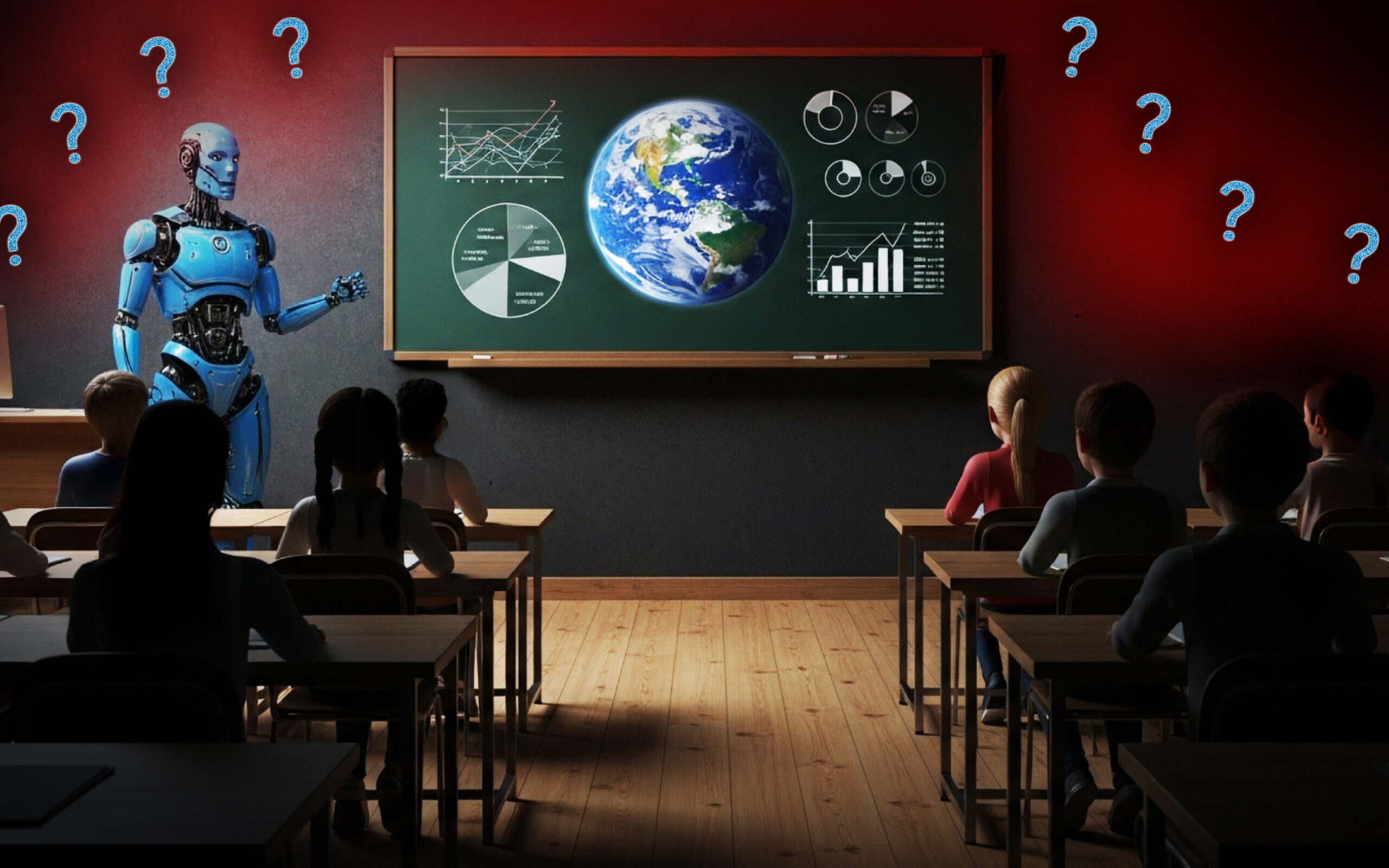
While most industries are embracing artificial intelligence, citing profit and efficiency, the tech industry is pushing AI into education under the guise of ‘inevitability’. But the focus on its potential benefits for academia eclipses the pressing (and often invisible) risks that AI poses to children – including the decline of critical thinking, the inability to connect with other humans, and even addiction. With the use of AI becoming more ubiquitous by the day, we must ask ourselves: can our education systems adequately protect children from the potential harms of AI?
In this episode, Nate is joined once again by philosopher of education Zak Stein to delve into the far-reaching implications of technology – especially artificial intelligence – on the future of education. Together, they examine the risks of over-reliance on AI for the development of young minds, as well as the broader impact on society and some of the biggest existential risks. Zak explores the ethical challenges of adopting AI into educational systems, emphasizing the enduring value of traditional skills and the need for a balanced approach to integrating technology with human values (not just the values of tech companies).
What steps are available to us today – from interface design to regulation of access – to limit the negative effects of Artificial Intelligence on children? How can parents and educators keep alive the pillars of independent thinking and foundational learning as AI threatens them? Ultimately, is there a world where Artificial Intelligence could become a tool to amplify human connection and socialization – or might it replace them entirely?
About Zak Stein
Dr. Zak Stein is a philosopher of education, as well as a Co-founder of the Center for World Philosophy and Religion. He is also the Co-founder of Civilization Research Institute, the Consilience Project, and Lectica, Inc. He is the author of dozens of published papers and two books, including Education in a Time Between Worlds. Zak received his EdD from Harvard University.
Show Notes & Links to Learn More
Download transcript00:00 – Zak Stein: Works, Previous TGS Episode, Civilization Research Institute, Consilience Project, Center of World Philosophy and Religion, Education in a Time Between Worlds
00:30 – Artificial Intelligence (AI), AI Risk
02:45 – Standardization vs. Personalization in Education
04:05 – Intergenerational Knowledge Transmission, Recent examples, Study on the topic
04:29 – Technology: Printing Press, Electricity, Radio, Television, Digital Technologies
05:10 – Algorithmic bias,
Understanding User Beliefs About Algorithmic Curation in the Facebook News Feed,
The Impact of Curation Algorithms on Social Network Content Quality and Structure
05:25 – Technology can isolate students from teacher
05:45 – Covid-19 Pandemic
06:13 – Technology should be scaffolding human-to-human interaction in person
06:46 – Education in the Metacrisis
07:51 – Ivan Illich
08:57 – Forbes Study: 80% of Gen Zers Would Marry An AI
09:55 – Updated list of AI lawsuits
10:09 – AI Anthropomorphism
10:25 – Daniel Schmachtenberger (TGS Episodes)
11:19 – Using GPS can negatively impact spatial memory
11:40 – Cognitive atrophy and AI usage
12:00 – Kurt Fischer, Marc Gafni, Ken Wilbur, Daniel Schmactenberger + (TGS Episodes)
13:07 – History of AI
13:20 – Frankly on Attention
14:19 – David J. Temple, Exit the Silicon Maze
14:43 – Conversation as Cosmos, Logos Mysticism
15:35 – Whiteheadian Frame, Holonic Theory, Evolution, Emergence
16:20 – Conversational Pressure: Normativity in Speech Exchanges
16:50 – Speech Act theory
17:19 – Carbon Pulse, Social Status
18:05 – Sycophantic AI
18:14 – Psychometric AI
18:50 – Domestic Robots, Augmented Reality
19:15 – Elon Musk predicts domestic robots will be in every household
19:40 – Extremely wealthy people already have access to domestic robots
20:00 – Wozniak’s “Coffee Test”, Turing test
20:30 – Attachment Theory Applied to Machines, Language Acquisition Process
22:15 – Supernormal Stimuli
22:45 – Ideal Parent Figure Protocol by Dr. Daniel P. Brown
24:13 – Jonathan Haidt, TGS Episode, Cognitive abilities of students has declined
24:40 – Red Pill vs. Blue Pill
25:05 – Tristan Harris, TSG Episode, The Social Dilemma, Center for Humane Technology
26:29 – AI: Cheating vs. Tool Use
27:50 – Who’s Accountable When AI Fails?
28:15- AI Personhood, Freedom of Speech, 14th Amendment and corporations
29:05 – Education, Democracy, and Propaganda: An Epistemological Crisis
31:00 – References Zak mentions in episode from a Harvard AI Conference
31:10 – Cognitive Decline
32:50 – Digital Attachment, Emotional Addiction to AI, Internet and Technology Addicts Anonymous
33:27 – Pornongraphy Addiction TEDx Talk
35:25 – Moloch, Superorganism: paper, video, Eye of Sauron
36:00 – Tech-Driven Evolution of Schools: Family-Farm, One-room Schoolhouse, Factory Model School, Charter School, Technoptimist Classrooms
37:40 – Feudalism, Technofeudalism
38:18 – Existential Risk, Nuclear weapon
38:50 – Technocracy, Walter Lippmann, B.F. Skinner
39:43 – Facebook as Behavior Modification Empire, Facebook sold personal data
40:45 – Overton Window, Self-Driving Cars,
41:41 – 220 million college students globally
42:55 – White-Collar worker
44:15 – Blackouts, Brownouts, and Their Frequency Globally
44:28 – Chinese Finger Trap, One-Way Car Spikes, Bifurcation
45:20 – Epistemic Supply Chain, Book Burning
47:10 – Multipolar Trap
48:45 – Synthetic Intelligence
49:55 – AI Optimism
51:48 – Parenting and Technology
52:27 – Commodity Fetishism
53:00 – AI lawsuit over teen’s suicide, Adolescents can detect deception
53:45 – Lack of Parental Controls for LLMs, Global Pornography Restrictions
54:51 – Psychotic Breaks via LLM Interaction (Rolling Stone article), Narcissism and AI
58:17 – OpenAI, OpenAI Lawsuit List
1:01:14 – Uniqueness of Human Childhood Duration
1:01:49 – Brain Development, Cortex Development Timeline
1:01:54 – Legitimate Teacherly Authority
1:02:45 – Youth learning starts physiologically and emotionally, Supporting students socially and emotionally
1:05:20 – What Is Coding? How Do Computers Work?
1:06:11 – Collective Action Problem
1:06:31 – Supermajority
1:07:05 – Central Nervous System
1:07:43 – OpenAI/MIT Study on AI Use and Emotional Harm
1:09:54 – Mistake Theory vs. Conflict Theory
1:10:41 – Transhumanism
1:12:35 – AI Hallucination
1:14:04 – Matthew 5:5
1:14:51 – Replacing educational relief work with AI
1:15:15 – AI Colonialism
1:16:20 – Information Epistemology
1:22:11 – Rationalization
1:23:09 – The Eye of Value
1:23:31 – Thomas Aquinas
1:24:45 – Narrow- vs. Wide-Boundary Wisdom
1:25:20 – Ecosystem Functions
1:28:41 – The Meaning Crisis, The Metacrisis
1:29:11 – Postmodernism
1:29:44 – Merlin bird app
1:30:19 – Malleable human nervous system, Becoming unaddicted
1:33:30 – Stockholm Syndrome
1:37:27 – Age limits on social media and porn in Australia
1:39:03 – Designated Drivers
1:39:30 – Waldorf Schools
1:40:26 – Sisyphean Task
1:41:15 – Speciation Event
1:43:33 – Exponential growth
1:44:30 – Kissinger’s question in Genesis
1:46:56 – What it Means to Be Human – “The Last Educators” chapter by Zak Stein