#148 | Frankly
Mordor to the Long Repair: How Might Daily Life Feel in the Next Decades? | How to Think About the Future Part 4
Description
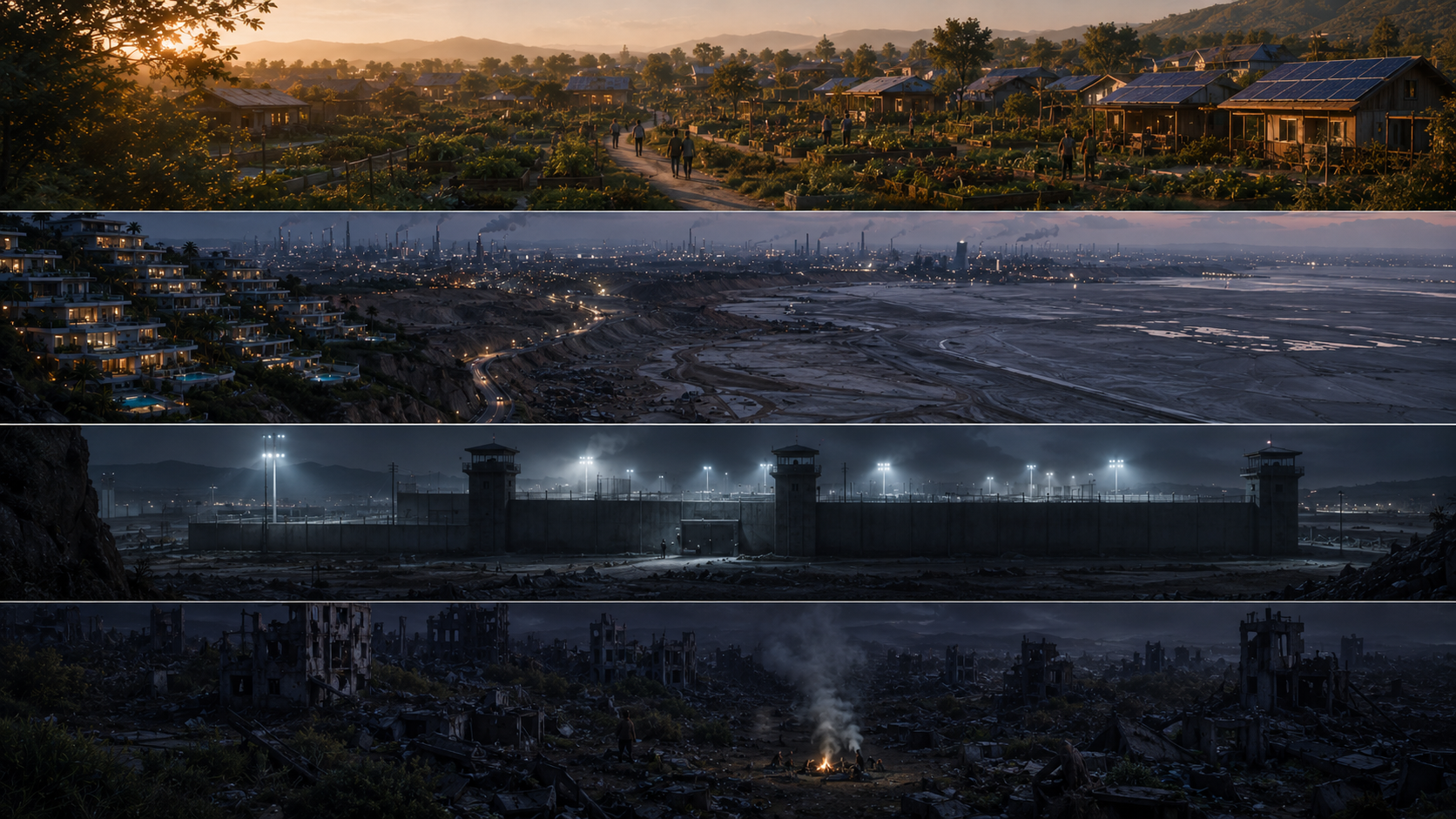
This week, Nate continues his “How to Think About the Future” series, where he invites listeners to imagine what it’s like to live in different versions of the reality that lies ahead. In today’s edition, Nate builds upon the frameworks outlined in part three to create four distinct future worlds – composites that emerge from various combinations of economic conditions, geopolitical scenarios, power structures, and Earth systems stability. The resulting worlds are not meant to serve as a prediction, but as a set of thought experiments designed to stretch our imagination and to sharpen our understanding of how societal shifts show up in our everyday lives.
Along the way, Nate also explores why some of these futures seem more stable than others, why economic contraction does not necessarily mean collapse, and why power distribution may matter more than the economic headlines. As Nate unpacks the logic of the four potential worlds, he emphasizes that we are not yet locked into any one outcome – the choices made by communities, regions, and institutions today still determine which valleys remain reachable tomorrow. This episode is an invitation to think beyond conventional narratives of progress and to consider what conditions make a future not just stable, but worth living in.
What would daily life actually feel like in a world of managed contraction, ecological overshoot, authoritarian control, or systemic breakdown? Which institutions and practices are most important to preserve today, while the future remains unwritten? And why might the most desirable future also be the one that looks least like progress by today’s economic measures?
Show Notes & Links to Learn More
Download transcriptThe TGS team puts together these brief references and show notes for the learning and convenience of our listeners. However, most of the points made in episodes hold more nuance than one link can address, and we encourage you to dig deeper into any of these topics and come to your own informed conclusions.
00:00 – “How to Think About the Future” Series Playlist: Part 1, Part 2, Part 3
00:13 – Coupled systems (more info), Phase shifts and tipping points, Shortfall risk
00:30 – Scenario planning, How to do scenario analysis, Scenario Thinking: A Historical Evolution of Strategic Foresight
01:20 – Energy constraints, Resource depletion, Debt saturation, and Ecological overshoot
01:30 – Sustained, aggregate global physical growth cannot be sustained
02:30 – Planetary Health Check, Ecological overshoot and human overpopulation
03:30 – Just-in-time, Six-continent supply chains
03:45 – Iran War 2026
05:15 – The Great Simplification (Movie), Post-growth (More info)
06:10 – Forces that push governments toward authoritarianism
06:40 – Autarky
06:45 – Drivers of public trust
07:10 – How to reduce the carbon footprint of your diet
07:27 – Importance Local governance and Decentralization
08:09 – David Graeber, “Bullshit jobs”
08:20 – Transition towns (more info), Regional food networks , Community land trusts, Municipal energy cooperatives, Makerspaces, Repair cafes
08:40 – Islands of coherence
09:03 – Frankly about Nate’s Lebanese friend
09:30 – How to build trust:
10:00 – Mordor
10:45 – Captured democracy
11:40 – Soils, Pollinators, Fisheries diminishing, Water tables dwindling
14:00 – Maritime trade chokepoints, Hormuz crisis
14:10 – Efficiency decreases resilience and room for error
16:08 – Modern-day feudalism
16:40 – AI/Robotics policy in the U.S.
17:30 – The Hunger Games
18:20 – Humans can normalize nearly anything
18:50 – AI and energy demand
19:00 – Fall of the Roman Empire, Joseph Tainter’s The Collapse of Complex Societies (The Great Simplification episode)
20:15 – Mad Max
22:05 – Humans are social animals
23:45 – Nate’s energy/economic synthesis: The Superorganism
25:19 – Cancer growth
28:15 – More-than-human predicament
30:30 – Switchbacks (from “How to Think About the Future” Part 3)
31:20 – How to regenerate the biosphere in your own backyard/locality (The Great Simplification Episodes on such: #222, #178)