Ep 37 | Martin Scheringer
Martin Scheringer: “The Growing Threat from Chemical Pollution”
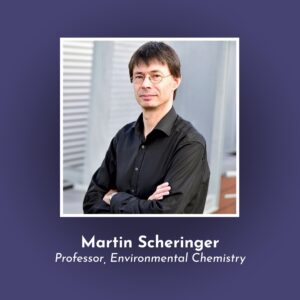
On this episode, Professor of environmental chemistry Martin Scheringer joins Nate. Together, they discuss Scheringer’s most recent paper on PFAS – the ‘forever chemicals, their ubiquity in waterways all over the globe, and their numerous critical health effects.
More broadly, they outline the risks and scenarios of plastic pollution to planetary futures – and what we might do about it. Is it possible to live in a (mostly) plastic free world, and do we really have any other option?
About Martin Scheringer
Martin Scheringer is a professor of environmental chemistry at Masaryk University, Brno, Czech Republic, and works in the research program on Environmental Chemistry and Modeling at RECETOX. He holds a diploma in chemistry from the Johannes-Gutenberg University, Mainz, Germany, and a doctoral degree and a habilitation from the Swiss Federal Institute of Technology (ETH) in Zürich, Switzerland.
Show Notes & Links to Learn More
Download transcript00:37 – Martin’s works + info
01:03 – PFAS
02:14 – Outside the Safe Operating Space of a New Planetary Boundary for Per- and Polyfluoroalkyl Substances (PFAS) – Martin’s newest paper
03:07 – Plastic outweighs all animals on earth
03:19 – Micro plastics
04:13 – Health advisory levels for PFAS
04:52 – PFAS Chemicals move with the water and outgas
05:16 – All the products PFAS are used for + more
06:16 – Plastic containers last 700-800 years, and then once degraded last longer
06:34 – PFAS never degrade into anything and will never go away
08:30 – There are 5,000 chemicals of that type, and up to 300,000 chemicals on the market globally all with different properties and unknown health effects
11:01 – ‘The solution to pollution is dilution’
11:08 – The Graduate
12:45 – Chemical Health Advisories by the EPA
12:58 – These chemicals can lower immune response in babies
13:17 – Chemicals can lower sperm counts in men
13:49 – Health effects of PFAS
14:29 – Dupont teflon production facility releasing PFAS waste water into open waters
15:42 – Dark Waters
16:09 – Endocrine disrupting chemicals
17:45 – Increase in non-communicable diseases over the last 15-20 years
18:03 – Increasing climate effects shown
19:22 – Endocrine disruptors on non-humans
19:59 – The challenge of communicating science
20:45 – Metabolic diseases potentially having origins from chemicals
23:00 – Steep discount rates
24:06 – Packaged food contains lots of these chemicals
24:10 – Food Packaging Forum
24:54 – We create 300 million tons of plastic each year, and half of that is single use plastic
25:35 – The chemicals added into plastics
25:53 – PVC, phthalates
27:22 – All the products that come from a barrel of oil
28:37 – Art Berman + TGS Episode
29:09 – Plastic takes ~12% of oil production
30:32 – Negatives of plastic alternatives
33:11 – 500 billion fossil workers added per year
33:35 – How did people used to live without plastic products?
34:29 – Making glass thinner and lighter
34:55 – Our supply chains are going to have to localize and regionalize
35:45 – Nate’s story on The Great Simplification
36:29 – Potential of small scale farms feeding everyone in the world
36:40 – The centrality of fertilizers and pesticides
37:50 – Petrochemicals in pharmaceuticals
39:54 – RoundUp controversy – Patrick Moore willing to drink it and then refusing to
41:05 – PCBs
41:18 – PCB damage to whales, Orca found dead on beach with high level of PCBs
42:08 – Mercury Biomagnification in fish
43:06 – Average golden retriever in 1950s lived to 15 years old
43:35 – Prevalence of cancer currently
44:50 – List of diseases connected to PFOA
46:30 – Persistent chemicals
47:37 – Environmental Justice and chemical pollutants
48:46 – Persistence and Spatial range
49:25 – Ocean acidification
49:45 – Chemical stressor effects on animal populations and recent study: Impacts of endocrine disrupting chemicals on reproduction in wildlife and humans
50:18 – Insect down by 50-70% in mass
51:28 – Higher temperatures cause chemicals to outgas more easily
51:51 – There is very minimal testing of chemicals before they are released as products
56:45 – The New Car smell is phthalate, flame retardants, EDCs…
58:20 – Standing stock in the US grows at 2.5-2.8%/year
1:01:27 – IPCC, IPCC biodiversity, IPCC for chemicals
1:09:06 – Fridays for Future
1:11:55 – Destruction of the Amazon