Ep 43 | Betsy Taylor
Betsy Taylor: “Finding Hope in Nature-Based Solutions”
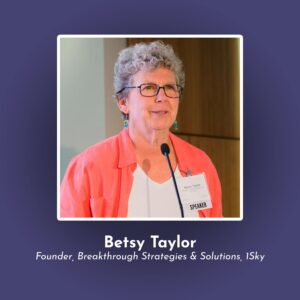
In this episode, Nate is joined by environmental and social activist Betsy Taylor. She and Nate have a wide ranging conversation about climate, consumption, culture, nuclear war, agriculture and the future. How has the environmental movement evolved over the past couple decades and how has it interacted with other social change movements? Why is reconstructing our food system more important now than ever?
About Betsy Taylor
Betsy Taylor has long been an icon in the environmental and culture change fields. She founded the climate network 1Sky, which established the domestic base and ultimately merged with 350.org. She ran the Center for a New American Dream and more recently Breakthrough Strategies and Solutions. Recently, Betsy has moved to supporting the field of regenerative agriculture, promoting the potential of our lands to sequester carbon pollution while boosting food security and habitat protection.
Show Notes & Links to Learn More
Download transcript00:38 – Betsy Taylor Info + Works
11:45 – Center for a New American Dream
14:52 – Tina Hobson + Education on saving energy and thoughtful consumption
15:39 – Behavior centered on the self is a product of energetic abundance
16:20 – Carbon Pulse
20:07 – Daughters for Earth
23:17 – Economic system is rooted in consumption and growth
23:45 – Rio Summit
23:55 – Bill Clinton’s task force on consumption and population
23:55 – Paul Hawken’s book, Shumacher books
24:32 – How many young people think the system isn’t working, how many BIPOC
26:17 – 1Sky (the foundation for 350.org, which it eventually merged with)
28:06 – Fred Krupp
30:12 – Manchin + recent IRA
32:49 – Philip Stern
33:10 – Globalization and Wealth Consolidation
33:25 – Recent Supreme Court rulings
34:33 – Secretary of States penalizing banks that won’t loan to fossil fuel companies
34:56 – Divestment in Fossil Fuels over the past few decades
35:05 – In the interview it’s stated that 30% of energy use globally was renewable. The reality is it was 28% of ELECTRICITY in 2021. And of that 16% was hydro leaving 12% as ‘other renewables’ (solar, wind, biomass). However, electricity is only ~20% of global energy use, so e.g solar, wind is only around 3-4% of global energy use
35:58 – The entire system is based on fossil fuels
36:18 – 6% decline rate on global oil fields – equivalent to billions of people’s labor
39:17 – Economic growth is 99% tethered to energy
40:50 – Martin Scheringer TGS Episode
42:19 – IPCC reports, James Hansen and Michael Mann
45:36 – Paris Climate Accords
45:52 – We would need to bring down emission 40% by 2030 to stay below 2 degrees celsius
46:16 – ⅓ of people have symptoms of long covid
46:53 – James Hansen
47:48 – Trump tried to limit James Hansen’s agency
48:45 – Emission drop in 2020, with resurgence in 2021
51:20 – Range of estimates of carbon sequestration from rebooting natural ecosystem processes
52:49 – Protect our Winters
52:58 – Youth initiative out of made about getting urban kids out on the land
53:42 – Tree cover reducing urban heat
56:05 – Capturing food and animal waste to create compost would massively increase carbon sequestration
47:27 – Whendee Silver on compost increasing sequestration
58:20 – No-till, cover crops, benefits of planting legumes, crop rotations, benefits of perennial deep rooted crops, Land Institute
59:20 – Food grown in healthy soil is more nutritious
1:00:38 – Jason Bradford TGS Episode
1:02:13 – 400 million farms are <1 hectare
1:05:05 – Large agroecology movement in parts of Africa, Latin America, and SE Asia
1:05:59 – 20 billion dollars towards regenerative agriculture promotion
1:06:55 – Bill Gates and agriculture
1:07:40 – Ayan Mahamoud TGS Podcast
1:08:35 – Resurgence of young people going into farming and agriculture
1:17:59 – Chuck Watson TGS Episode on nuclear war
1:18:39 – US modernizing nuclear arsenal