
Episodes

The Great Simplification with Nate Hagens shines a light on the foundations of the human predicament, revealing how energy, the environment, economics, human behavior, and systems science intertwine.

Filter


Type
All
Guest Interviews
Frankly
Reality Roundtable
Wide Boundary News
Subject
All
Energy Systems
Human Behavior
Ecology and Environment
Economics and Monetary
Systems Science
Geopolitics
Saving Bats to Save OurselvesWith Iroro TanshiThe Great SimplificationEp 241 | Iroro Tanshi

In this episode, Nate is joined by Nigerian bat biologist Iroro Tanshi to explore how the rediscovery of a bat species unseen in Nigeria for 45 years – and a wildfire that destroyed half its habitat just days later – launched a community-led fire prevention program. Iroro explains how listening to farmers, who no longer knew when it was safe to burn their fields, led to a simple fire danger warning system that local leaders then backed with their own bylaws, directly addressing tragedy-of-the-commons dynamics. She also shares what it’s like to navigate conversations about climate and biodiversity with rural Nigerian communities, and how her team is now scaling their fire management solution across the tropics.

Watch nowNov 4, 2026
A Shattered Market?With Rory JohnstonThe Great SimplificationEp 240 | Rory Johnston

In this episode, Nate welcomes back oil market analyst Rory Johnston for an update on how the crisis has evolved since April. Rory explains why diesel is now the epicenter of the crisis, with crack spreads running five to six times their historical norm, driven by both the Iran war and Ukraine’s strikes on Russian refineries. He also unpacks one of the unexpected moves that lessened the severity of the energy shortage: China’s unprecedented 45% cut in crude imports, which he calls the “Beijing Swing.” Tying these trends together, Rory and Nate explore how soaring shipping costs have fractured a once-global oil market into regional pockets and how the poorest nations are bearing the brunt of demand destruction.

Watch nowOct 28, 2026
Earth's Oldest TeachersWith Robin Wall KimmererThe Great SimplificationEp 239 | Robin Wall Kimmerer

In this episode, Nate is joined by Robin Wall Kimmerer to explore what we can learn from some of Earth’s oldest and smallest beings: plants. Robin weaves together her experience as a botanist and a Citizen Potawatomi Nation member to offer what she’s learned about living well within nature’s limits, including practices such as the Honorable Harvest and the importance of restraint and reciprocity. She also shares the Potawatomi prophecy of the Seventh Fire, in which humanity stands at a fork between a scorched path and a green one, and can only move forward by walking back to recover what was lost along the way. Robin frames this moment as the age of remembering – an invitation to restore the land and our relationship with it.

Watch nowOct 21, 2026
Optionality CollapseWith Indy JoharThe Great SimplificationEp 238 | Indy Johar

In this episode, Nate welcomes back Indy Johar, co-founder of Dark Matter Labs, for an exploration of how coupled systemic risks are reshaping capital, institutions, and what it means to invest for the future.

Watch nowOct 14, 2026
A World-Changing EventWith Art BermanThe Great SimplificationEp 237 | Art Berman

In this episode, Nate welcomes back petroleum geologist Art Berman for a follow-up to their May conversation, to take stock of what's changed since the war upended Middle East energy flows.

Watch nowOct 7, 2026
Climate UncertaintyWith Zeke HausfatherThe Great SimplificationEp 236 | Zeke Hausfather

In this episode, Nate is joined by climate scientist Zeke Hausfather to break down the numbers and metrics within climate science, and translate what they will actually feel like for humanity.

Watch nowSep 30, 2026
The Escalation TrapWith Robert PapeThe Great SimplificationEp 235 | Robert Pape

In this episode, Nate welcomes military historian and political scientist Robert Pape for an in-the-moment breakdown of the Iran war's trajectory.

Watch nowSep 23, 2026
Radical SimplicityWith Sarah WilsonThe Great SimplificationEp 234 | Sarah Wilson

In this episode, Nate is joined by philosopher and author Sarah Wilson for an exploration of the emotions that come from learning about, processing, and then embodying the full extent of the metacrisis.

Watch nowSep 16, 2026
“Don’t Build Gods”With Roman YampolskiyThe Great SimplificationEp 233 | Roman Yampolskiy

In this episode, Nate is joined by Dr. Roman Yampolskiy, one of the earliest researchers in AI safety, to lay out why “controllable superintelligence” is a misguided goal, destined to lead to an entity smarter than all of humanity – and possibly our own extinction.

Watch nowSep 9, 2026
The Collapse of Our MythologyWith Charles EisensteinThe Great SimplificationEp 232 | Charles Eisenstein

In this episode, Nate welcomes author and philosopher, Charles Eisenstein, for a long-requested conversation on the mythologies underneath civilization.

Watch nowSep 2, 2026
The Psychotic Selection HypothesisWith Greg ElliottThe Great SimplificationEp 231 | Greg Elliott

In this episode, Nate is joined by Greg Elliott, a systems theorist and author of the Psychopathic Selection Hypothesis (PSH), to unpack why our institutions themselves have become so psychopathic, and how that affects the behavior of the average human.

Watch nowAug 26, 2026
Material WorldWith Ed ConwayThe Great SimplificationEp Archive 127 | Ed Conway

Current geopolitical events continue to expose just how complex and fragile our global economic system is. As such, The Great Simplification team is re-releasing this episode with Ed Conway, which covers the deceptively critical materials that continue to underpin everything from the phone in your hand to the house that you live in. 

Watch nowAug 19, 2026

That’s very understandable because with left hemisphere thinking, one of the problems is that you see everything as a series of problems that must have solutions. Iain McGilchrist Neuroscientist and Philosopher

What we’re seeing is probably the largest mass movement of marine life, at least in the last 10,000 years, towards the poles. Malin Pinsky Associate Professor

The worst thing you can do to people is make them feel that whatever they do, it doesn’t matter. What we call in psychology “helplessness” — or even stronger, learned helplessness. Maren Urner Professor, Sustainable Transformation

We can’t have hundreds and hundreds of real relationships that are healthy because that requires time and effort and full attention and awareness of being in real relationship and conversation with the other human. Nate Hagens Executive Director ISEOF

30 min overview

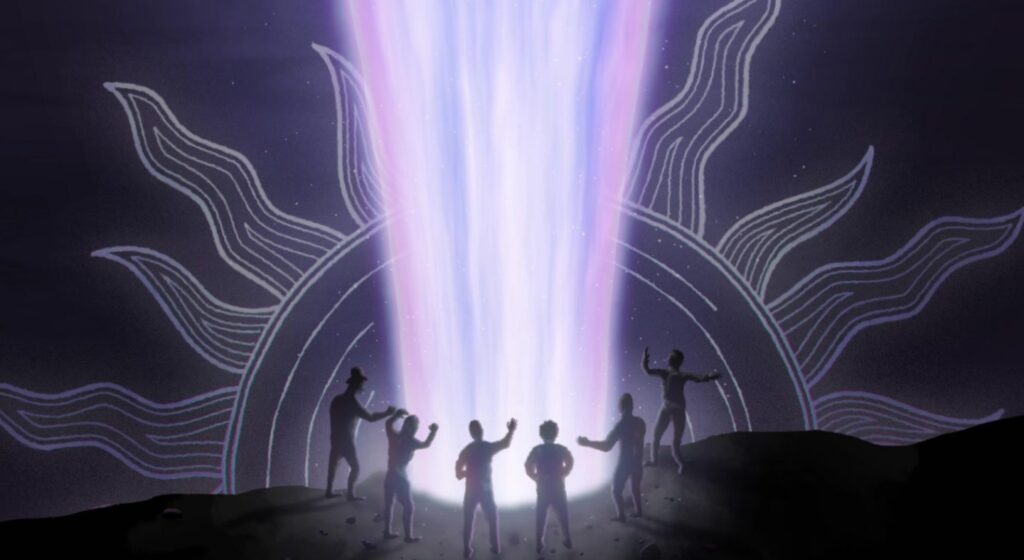
The Great Simplification Animated Series is a 32-minute animation – in four acts – describing the backdrop for an economic and cultural transition beginning in the not-too-distant future. Energy Blind reveals how fossil fuels shaped our world, while The Human Superorganism shows their impact on economies and ecosystems. The Human Being examines the psychology behind our short-term thinking, and The Great Simplification encourages a systems-thinking approach to future challenges. With detailed notes and transcripts, this series offers a thought-provoking look at our past, present, and future. You can also enjoy all four parts together in our Animated Movie.
Subscribe to our Substack

The Institute for the Study of Energy and Our Future (ISEOF) is a 501(c)(3) non-profit corporation, founded in 2008, that conducts research and educates the public about energy issues and their impact on society.

Support our work
Get in touch
x