Ep 207 | Craig Tindale
Why the West Can’t Defend Itself: How Material Scarcity Is Reshaping Global Power

Description
For decades, the West has outsourced its own material production to other countries, in favor of lower costs and short-term returns over more expensive, long-duration investments like mining and manufacturing. But while this has seemed like a success on the surface, it has left us with a society based on consumption, unable to produce what we need on our own. What are the deeper costs of this long-term offshoring – including for our geopolitical, climate, and technological ambitions?
In this conversation, Nate is joined by materials expert and investor Craig Tindale, who explores the profound vulnerabilities facing Western economies by what he calls “Industrialization 2.0.” Craig argues that decades of central banking policies favoring consumption and short-term returns have led the West to offshore virtually all materials production and processing to China – limiting the West’s ability to defend itself, as well as rebuild industrial capacity to address the growing technological needs of climate and AI. Tindale also introduces his “four clocks” framework, which describes how corporate quarterly cycles, 10-20 year climate urgency, immediate defense needs, and continuous consumption addiction are all ticking at different speeds and pulling society in incompatible directions. Furthermore, he posits that Silicon Valley’s “unspoken bet” is on human obsolescence, with capital flowing to robot owners rather than human workers.
How do all of these pieces – monetary policy, critical materials, climate action, geopolitical risk, and technological displacement – fit together to create a perfect storm for humanity’s future? Why might the only path to a circular economy be “through the valley of death” – forced by necessity rather than choice? And what types of practical investments and technological innovations are needed to make our societies more resilient in the face of impending geopolitical and economic turbulence?
About Craig Tindale
Craig Tindale is a private investor who has spent nearly four decades working in software development, business strategy, and infrastructure planning, including in leadership positions at Telstra, Oracle, and IBM. Additionally, he has direct experience working in east-to-west supply chains, including as the CEO and Asia Regional Director for DataDirect Technologies.
He’s now pivoted to investing in groundbreaking ideas such as drone reforestation through Air Seed Technologies, and uses his knowledge of Chinese industrial strategy and Western tech demand to identify the choke points in Critical Metals markets. Most recently he released the white paper, Critical Materials: A Strategic Analysis, which offers a systems synthesis on how the race for rare earths and the return of material constraints is shaping geopolitical relationships.
Show Notes & Links to Learn More
Download transcriptThe TGS team puts together these brief references and show notes for the learning and convenience of our listeners. However, most of the points made in episodes hold more nuance than one link can address, and we encourage you to dig deeper into any of these topics and come to your own informed conclusions.
00:00 – Craig Tindale (His Substack)
- His Whitepaper: The Return of Matter: Western Democracies’ Material Impairment
- Substack Essay: THE HARD BIFURCATION: The Convergence of Financial Liquidity and Physical Insolvency
- Substack Essay: Cost of Capital, Industrial Irreversibility, and the Survival of Western Mining and Smelting: A Geopolitical Analysis of Strategic Divergence
04:09 – Value chain, Global North outsources energy resources
05:10 – Economic rationalism
05:55 – Weighted Average Cost of Capital for long-term industrial investment: U.S. vs. China, (More info)
06:20 – Holocene epoch
07:09 – Asset price inflation, Wealth effect
09:21 – Net Present Value (NPV)
09:39 – U.S. investment in software, State of U.S. manufacturing industry
11:19 – Short-rate model, December 2025 Federal Reserve interest rate cuts
12:12 – Tariffs, Effect on the production economy
12:14 – History of U.S. debt ceiling
12:34 – Ben Bernanke, Bernanke’s contributions to economics, Neoclassical economics shift towards prioritizing consumption economy, 2008 financial crisis
12:54 – Neoclassical economics, Craig’s critique of neoclassical economics
13:37 – Significant U.S. governmental responses to financial crises
14:20 – U.S. government investment to expand domestic production of critical minerals/materials
15:20 – Metallgesellschaft AG, Role in Australian zinc mining/production
16:00 – Germany’s early global domination in metal industry
16:10 – Critical metals needed for military operations, Shell Crisis of 1915/Battle of Aubers Ridge, David Lloyd George
17:05 – 60% of the world’s copper is refined in China, Copper refinement process, Chinese export regulations
18:07 – 72% of silver comes from other metal refining, Slag
18:50 – China limiting of silver exports, 58% of silver consumption is industrial, Silver in solar panels and AI industry
19:40 – Price of silver commodity
19:50 – Russia outpacing NATO countries in weapons production
20:11 – Critical mineral: Antimony – Critical to U.S. economy and national security
20:40 – Human G-force tolerance
22:25 – Renison Tin Operation – Chinese off-take agreement
23:20 – China has financed *184 mines outside of China
24:39 – Lynas Rare Earth’s outpriced by China in attempt to open mining operations
25:00 – BHP and Rio Tinto, FMG all have deals to send iron ore to China for smelting
26:00 – Chinese energy mix, China has double the U.S. energy capacity even with smaller economy
26:43 – Copper requirements for data centers, *63 data center mega-projects currently planned in the U.S.
27:45 – AI used for mining optimization/efficiency, Rise in automated mining vehicles, Autonomous vehicles’ operational uptime improving
29:39 – American government recent investment in critical mineral mines/supply chains
31:20 – U.S. DoD has effectively 15% stake in MP Materials
31:45 – Average American energetically consumes 210,000 kcal/day *as of 1986
33:18 – U.S. total financial assets
33:57 – James Tour, Flash-Joule heating, Fly ash pollution, E-waste recycled into gold
35:27 – Zhigang Zach Fang metallurgist, F-35 titanium usage, Titanium exports by country
37:45 – AI Index Report
39:10 – Most of machinery is from China,China export shipping timelines, CEO of Lynas: we could build a rare earth refinery in Texas but at what cost?
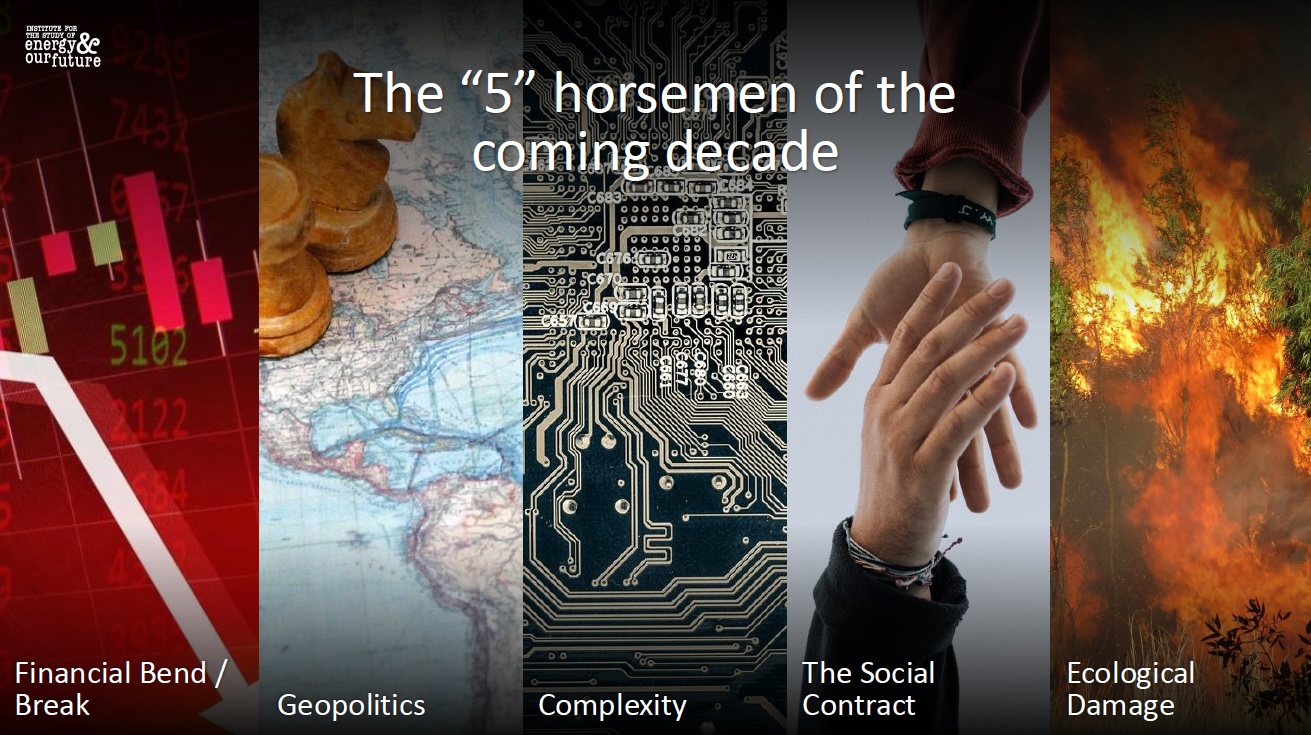
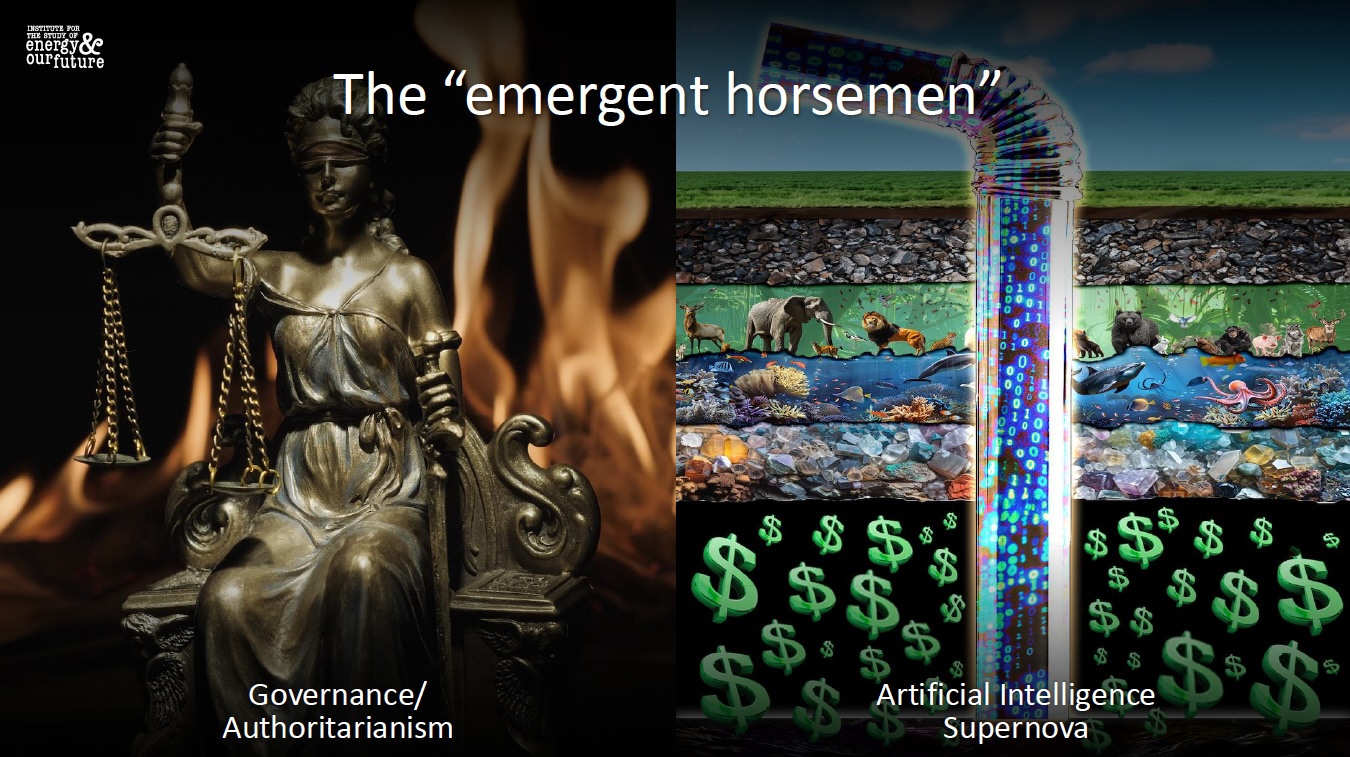
39:45 – The 5 Horsemen of the 2020s + Emergent Horsemen, Nate explaining the original 4 Horsemen of the 2020s
41:35 – The West: Throw-away society
42:41 – *Global circularity rate is 6.9%, Recycling rate by country
42:50 –Lithium-ion battery recycling
44:10 – Silver in 1 large missile vs. 1 solar panel
46:31 – Replacing and recycling solar panels
47:38 – West is leading in AI software (and why that’s a chokepoint), Nuance of Chinese dependency on U.S.
48:19 – World’s top AI superpowers in 2025
49:10 – Trump recently decided to allow China to import NVIDIA’s H200 chips
50:40 – Critique of IPCC Climate Models, IPCC report “uncertainty bars”
52:25 – Stratospheric aerosol injection: Albedo change, Increase rainfall, Health effects
53:00 – Future of human climate niche, ND-GAIN Country Index, List of areas depopulated by climate change
53:25 – IMO 2020 – reduce sulfur oxide emissions
54:10 – Trees sweat to keep cool
54:50 – Shortage of clouds in China and Gulf Coast of North America, Cloud clumping creating dangerous rains
56:25 – Slowing of the AMOC, TGS Episodes on the AMOC: Levke Ceasar (Ep #124) & Leon Simons (Ep #105)
56:40 – Ocean warming
57:45 – Off-shore windfarms cited as national security threat
58:40 – Germany current energy challenges
59:05 – Energy and Water use of AI in the U.S.
59:30 – AI data centers in Sydney ~*12% of its electricity and ~*25% of its water by 2035
1:00:01 – AI Productivity, AI Automation
1:01:40 – Democratic socialism
1:05:35 – Neo-Luddism, Fertility rates decreasing, Aging population
1:06:25 – Airseed Technologies
1:06:50 – How animals grow forests, Decline in bird populations
1:07:40 – Human-induced tree loss over time, Land-use change effect on carbon emissions
1:10:15 – Anastassia Makarieva (TGS #193), Biotic Pump, Mixed-species vs. monocultures in plantation forestry
1:11:00 – Rain forest evapotranspires ~20,000 gallons per acre vs. Pasture evapotranspires ~1050 gallons per acre
1:13:25 – Timeline of home gardening in the U.S.
1:15:30 – Degrowth vs Post-growth
1:16:10 – Great Reforming Time 1990s-2000s: Privatization, Deregulation, Floating exchange rates
1:16:50 – Fiat currencies, Gold reserve, U.S. held *70% of gold reserves after WWII
1:24:20 – Australia: Net positive migration, Less housing per person than *most other Western countries, Housing vacancy issues, Housing price crisis
1:35:40 – Forest bathing, Benefits of Nature experiences