#154 | Frankly
Unordinary Interventions: How to Plant Seeds for a Better Future
Description
What can one person actually do about the metacrisis? In this week’s Frankly, Nate explicitly outlines just a few of the countless actions we can take to actually change what’s coming, rather than just prepare for it. He touches on why the metacrisis is better understood as a predicament to be continually shaped, rather than as a problem with a single solution – calling for a shift in mindset in order to navigate the uncertainty ahead. In complex systems such as ours, even seemingly modest differences in initial conditions can lead to wildly different outcomes down the road, meaning that what each of us chooses to do today shifts what becomes possible in the decades ahead.
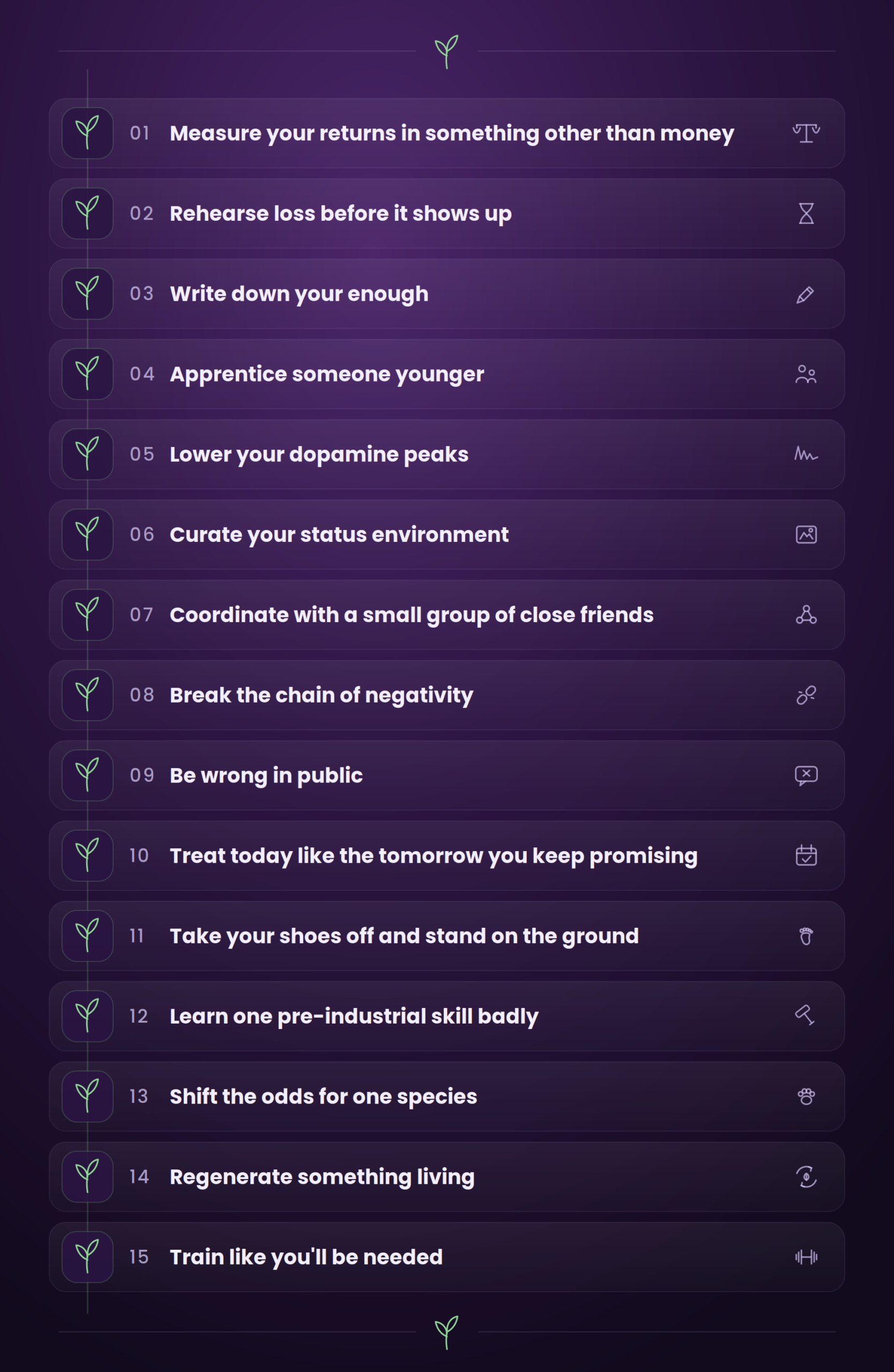
With that framing, Nate offers a list of small, specific, and slightly unordinary interventions that serve to challenge the forces driving the metacrisis. He explores methods like reducing dependence on constant stimulation, cultivating humanity and humility, and finding our own version of what is “enough.” Along the way, he also shares how he sees resilience growing through shared effort, meaningful relationships, and a renewed sense of responsibility for the more-than-human world. None of these things will solve our predicament on their own. But if millions choose to start living differently in the immediate present, the forces shaping our future might just start to shift.
How can redefining success, consumption, and community make us less vulnerable to today’s systemic challenges? Why does “practicing loss” help change the way we respond to disruptions? And what if the most meaningful response to the world’s biggest challenges isn’t a sweeping political movement or a technological breakthrough, but a collection of ordinary actions practiced consistently over time?
Show Notes & Links to Learn More
Download transcript
*The TGS team puts together these brief references and show notes for the learning and convenience of our listeners. However, most of the points made in episodes hold more nuance than one link can address, and we encourage you to dig deeper into any of these topics and come to your own informed conclusions.
Last November, Nate laid out directional headings and policy ideas for the more than human predicament. This Frankly turns from the directional to the personal, with a running list of small, specific, slightly unordinary things any one of us can do to change the starting conditions of the next stretch of time. Each suggestion is aimed at the storm itself rather than at weathering it. If you haven’t yet, begin with Frankly #114 | Directional Advice for the (More Than) Human Predicament and Frankly #132 | What to Do as the World Falls Apart: A Framework for Action.
00:00 – Infographic of the of 15 Unordinary Interventions, Essay version of this Frankly
00:33 – Metacrisis symptoms:
- Seven of nine planetary boundaries crossed
- Depletion of cheap, high-quality energy
- Debt as electronic claims
- Monitored wildlife populations down 73%
- Loneliness epidemic (The Great Simplification episode on such)
- Supernormal stimuli
- Politics as tribal signaling contests
- Artificial intelligence accelerating risk
- Declining trust in institutions and media
- The meaning crisis (The Great Simplification episode on such)
02:31 – Predicament, not a problem
02:54 – Complex systems, Sensitive dependence on initial conditions (butterfly effect)
03:37 – Coping vs. changing the storm: Adaptation vs. mitigation
03:56 – Growing and storing food, Improving sleep, Building a support network
05:23 – Measure your returns in something other than money: Beyond GDP
06:13 – Accumulated advantage (Matthew effect), Financialization of human experience, Wide-boundary capital
06:41 – Rehearse loss before it shows up: Rehearsing loss (premeditatio malorum), Loss aversion
07:33 – Downshifting: living on less, Voluntary simplicity
07:57 – Write down your enough: Defining your enough, Sufficiency
08:09 – Hedonic treadmill
08:41 – Biophysical spaciousness
08:56 – Moloch, The economic Superorganism, Advertising and manipulation
09:15 – Apprentice someone younger: Apprenticeship, Intergenerational transmission of skills
10:01 – Cultural transmission
10:17 – Lower your dopamine peaks: Reward prediction error, the unexpected reward
10:44 – *96 phone checks a day, Dopamine tolerance and rising baseline, The Great Simplification Ep highlighting such
11:22 – Two-thirds of men chose an electric shock over sitting alone with their thoughts
12:08 – Compulsive reaches: Smartphone use, Alcohol, Sports betting, Pornography, Sugar
12:19 – Adding friction to habit loops
12:43 – Audrey Tang on The Great Simplification, Grayscale phone mode
13:05 – Curate your status environment: Dunbar’s number, Social comparison theory
13:29 – Social status and conspicuous consumption
14:17 – Reference group
14:30 – Coordination failure, Collective action problem
14:42 – Dark triad personalities
15:18 – Coordinate with a small group of close friends: Food buying clubs, Makerspaces / hackerspaces, Tool libraries, Work parties
15:37 – Shared adversity and social bonding
16:11 – Break the chain of negativity: Emotional contagion
16:43 – Prosocial behavior, Random acts of kindness
17:04 – The Mordor economy
17:17 – Be wrong in public: Being wrong in public, Political polarization and the social cost of changing your mind
18:01 – Peak oil, Nate’s revised peak oil call
18:33 – Updating priors (Bayesian inference)
18:51 – Treat today like the tomorrow you keep promising: How to
19:32 – Procrastination, Hyperbolic discounting
20:18 – Take your shoes off and stand on the ground: Barefoot contact with the ground, Nature connectedness
20:33 – Nature-deficit disorder
20:55 – Neolithic Revolution, Industrial Revolution
21:35 – Learning one pre-industrial skill badly
21:46 – Global supply chain complexity and fragility, Jeff Currie (The Great Simplification Ep 229)
22:05 – Learn one pre-industrial skill badly: Growing your own food, Learning a musical instrument, Repairing broken objects
22:46 – Deskilling, The machine
23:14 – Shifting survival odds for a whole lineage
23:56 – The bottlenecks of the 21st century
24:11 – Outdoor cats kill more U.S. birds than windows and cars combined, ~600 million bird-window collisions a year, Window decals to prevent bird strikes
24:27 – Light pollution and bird migration (infographic), Lights Out programs
24:44 – Land trusts, Habitat connectivity
24:53 – County zoning and land use in the United States
25:21 – Regenerate something living: Regenerating something living, Brett KenCairn on The Great Simplification
25:38 – Living systems management, Natural climate solutions
25:53 – *Earth running at about half its biological productive capacity, Land use as the dominant driver of ecosystem damage
26:08 – Dust Bowl, Recovery of the Southern Plains
26:33 – Converting lawn to native plants, Ecological restoration
26:45 – Natural regeneration, Rewilding
27:04 – Global societal metabolism, Frankly on such
27:21 – The Carbon Pulse, Possible future shapes of the Carbon Pulse
27:53 – Train like you’ll be needed: Cultural mycelium (cultural mitochondria), Mycorrhizal networks
28:10 – A Guide to Staying Human Series: Part 1, Part 2, Part 3